
Yim Tin Tsai: Hong Kong’s Last Salt Village
From Abandoned Island to Cultural Oasis
By Xinyue Tang, Xindi Xie, Yuqi Chang, Yu Zheng, Yuning Song, Lanqing Mao
Among the numerous islands dotting Sai Kung Hoi in Hong Kong’s New Territories, there is a small island called Yim Tin Tsai. After a 20-minute boat ride from Sai Kung New Public Pier, the island comes into view. Unlike other tourist attractions in Hong Kong, this island is the only place that combines Hakka culture, Catholic religion, and beautiful natural environment.
In 1670, a Hakka couple surnamed Chan moved to Hong Kong from the area of present-day Shenzhen. They accidentally discovered this small island and settled there. The island is low-lying so seawater can be retained on the island during high tide and dried in the sun, making it perfect for salt production. The salt is not only used by the villagers themselves, but also sold to Sai Kung and other nearby areas.
In 1841, European missionaries came to Yim Tin Tsai to preach. By 1875, all residents of Yim Tin Tsai had received baptism and converted to Catholicism, so the village became known as the “Catholic Village”. Later, St. Joseph’s Chapel was built in 1890, which now stands as the island’s most renowned landmark.
According to Hong Kong Tourism Board, over the past century, the salt pans on Yim Tin Tsai had gradually become deserted. By the 1920s, no salt pans were left there. The main reason is that the salt produced here cannot compete with cheaper products from the Chinese mainland and Vietnam. Although there were still about 1,000 people living on the island in the 1940s, the population dropped significantly in the following decades as villagers moved away.
“Around 1997, the last family on the island moved away”, said Chan Chung-yin, the head of Yim Tin Tsai Village, also the eighth generation of the Chan family. “In 1998, I was elected as the village chief and the idea of reviving the village started to emerge.”
Chan and his nephew started with the township teahouse in 2008 and used it as a base to revitalize the village. The teahouse is used to entertain villagers and visitors. But back then, few people visited the island because apart from the restored church, the other buildings were still in disrepair and the roads were difficult to walk on.
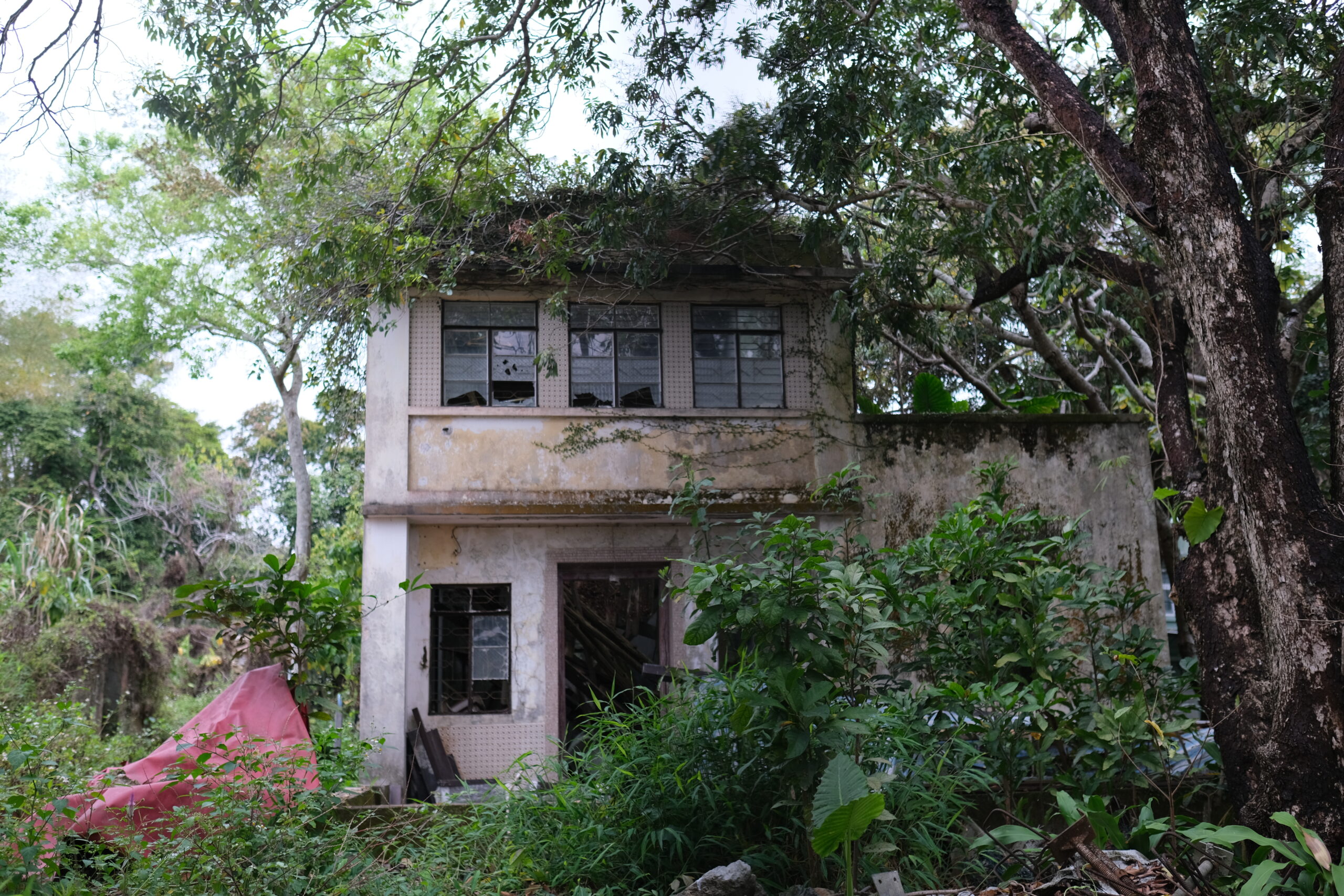
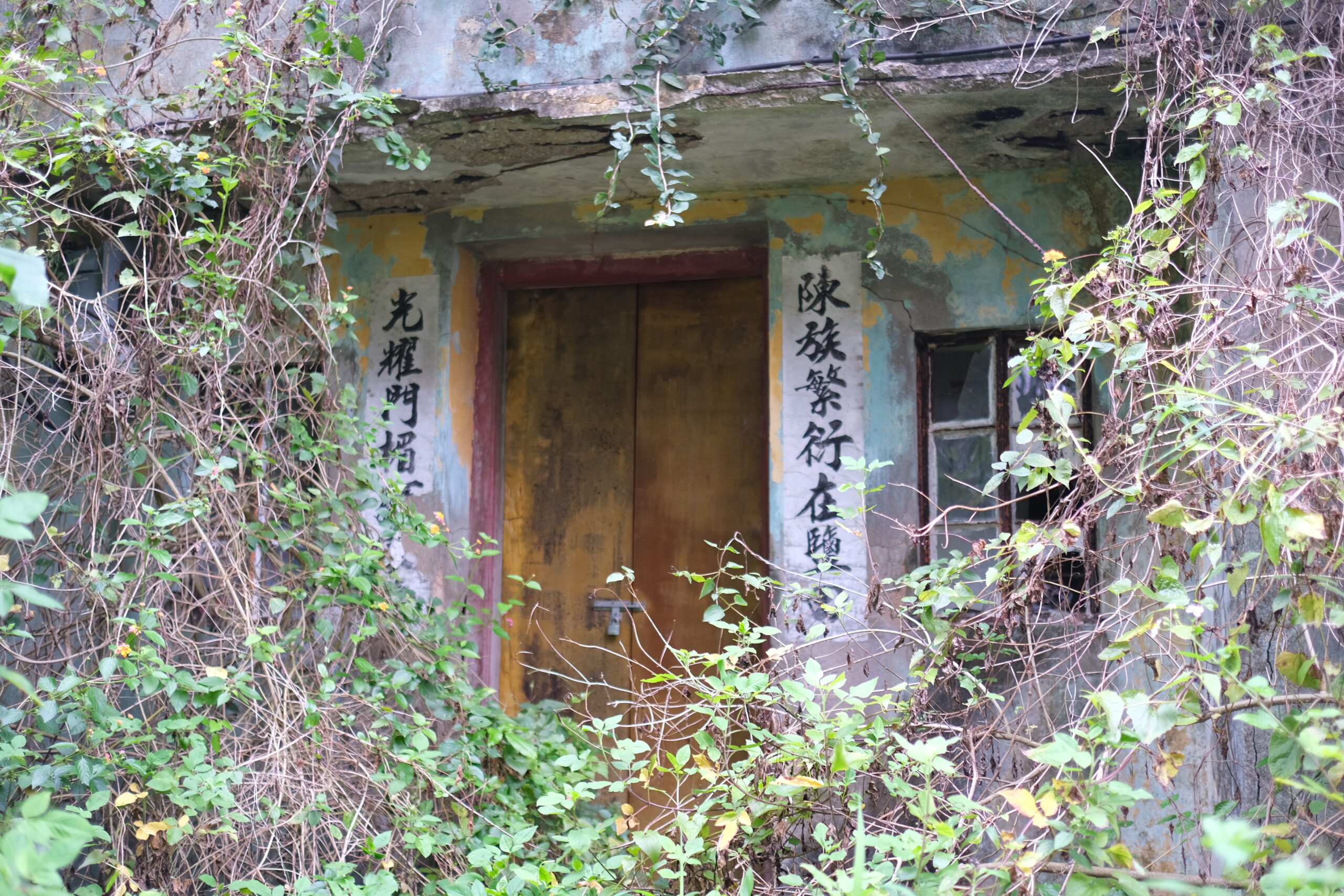
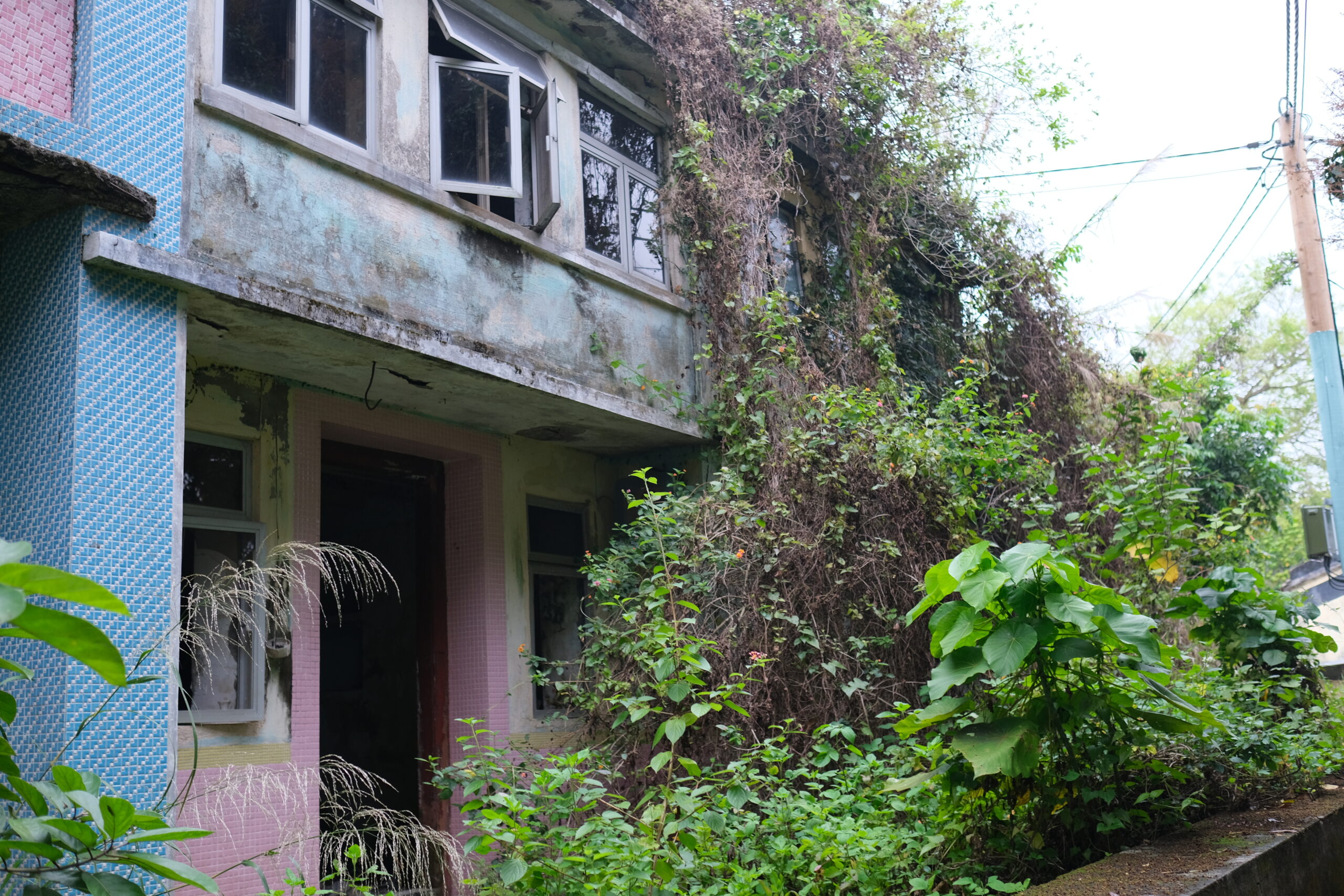
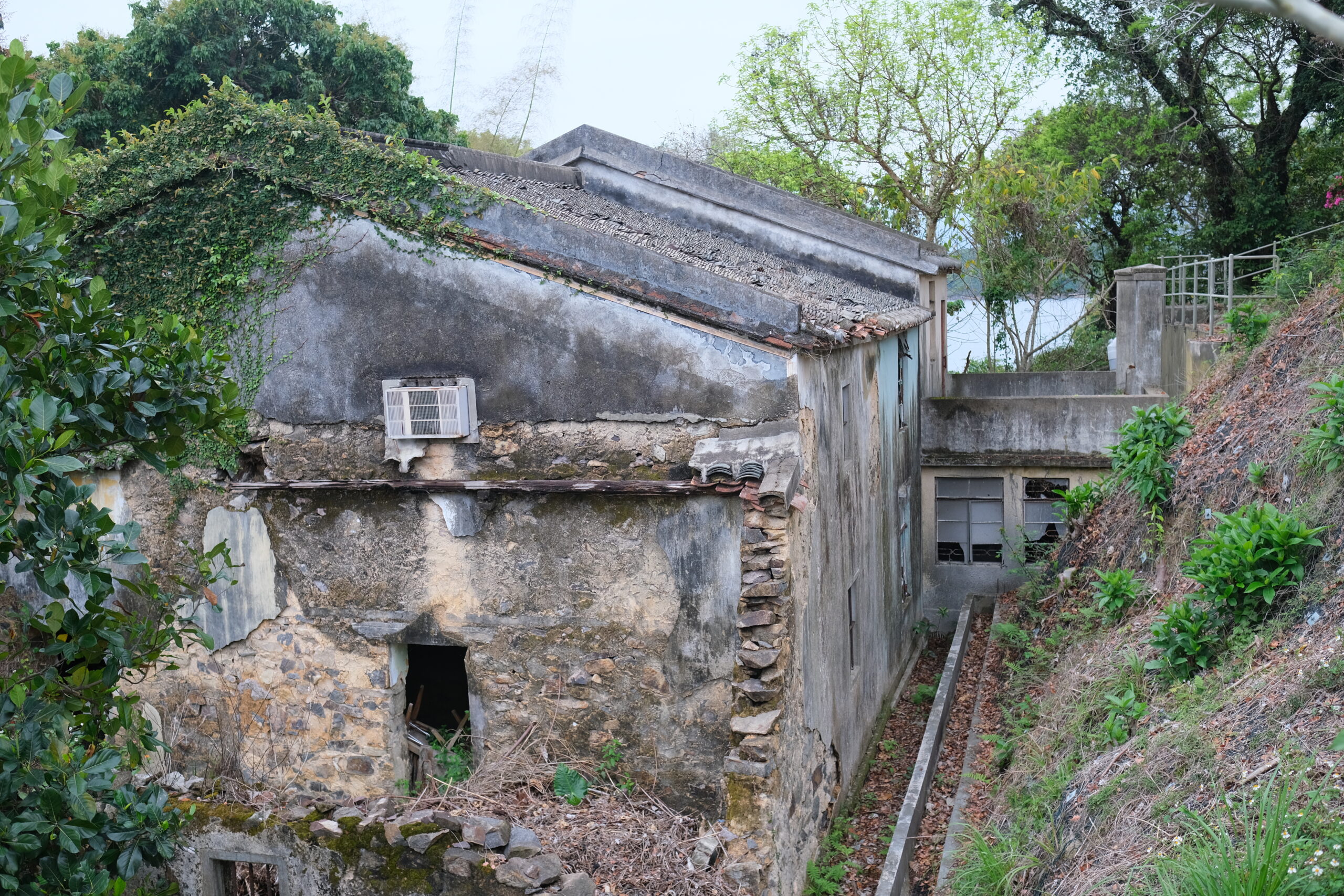
Some dilapidated houses in Yim Tin Tsai (Source: Xindi Xie)
“Since 2008, my nephew and I have been coming to the island every day to repair roads and houses, and this work has continued to the present. The process was lengthy because many of the houses needed repair” , said Chan. During the restoration process over the past decade, villagers gradually joined in, and since Yim Tin Tsai itself is a Catholic village, it also received support from fellow believers.
Another important event in the restoration of Yim Tin Tsai is the establishment of the Salt and Light Conservation Center. The center was established in 2015, which enabled the village to continue to entertain villagers and outside visitors. Some female villagers and young people have returned to assist at the village committee or the center. Some of them also served as tour guides for visitors.
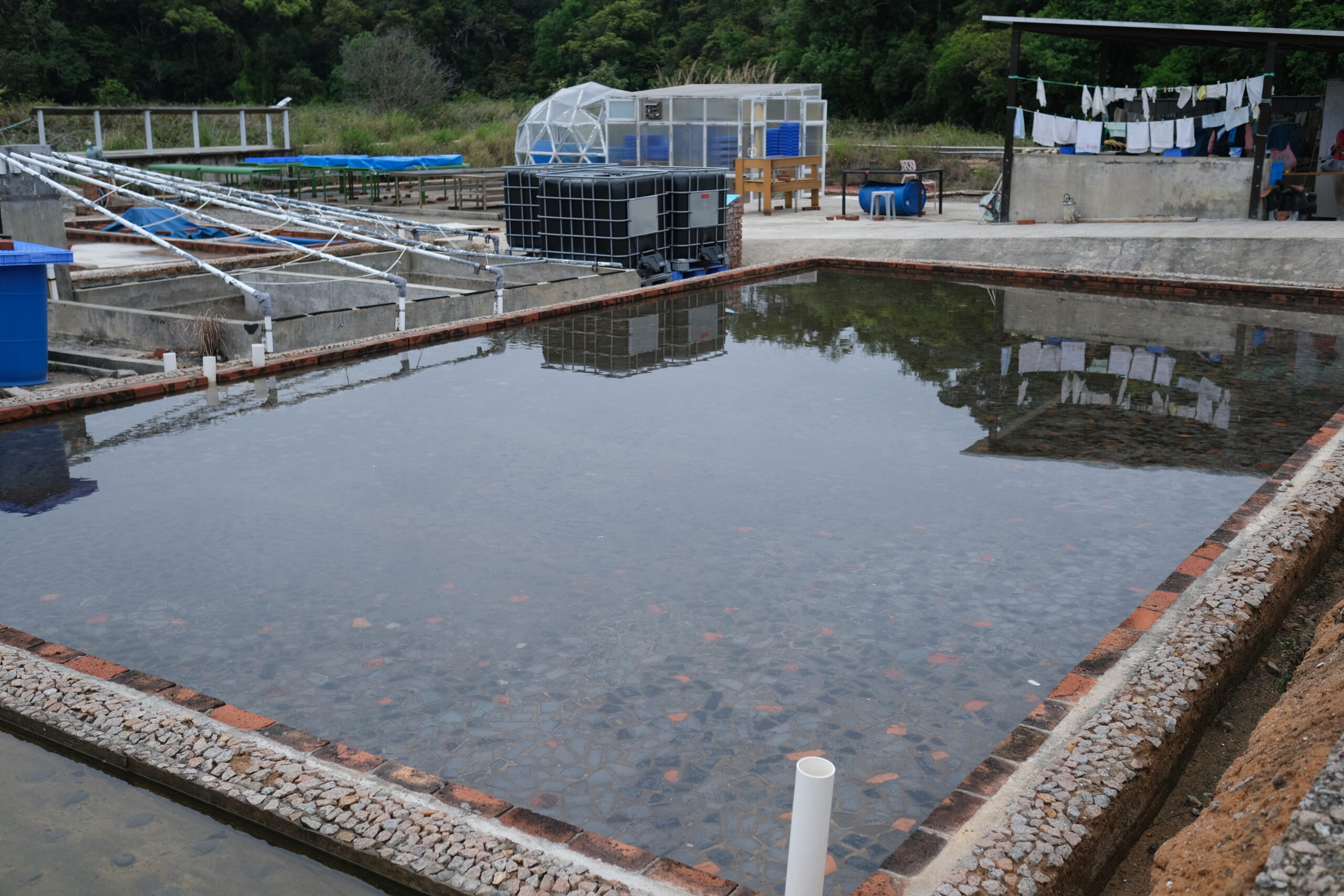
One of the salt pans (Souce: Xindi Xie)
After falling into disuse for over a century, Chan began to dream of restoring the village’s salt pans. “In 2009, I sat in a teahouse and looked at the salt pans below”, said Chan. “The village couldn’t have randomly been named ‘Yim Tin Tsai’ without reason—it must be because of its historical salt production.” After asking the elders, Chan confirmed that the village had indeed produced salt a long time ago.
During the restoration, Chan also visited Taiwan and Huizhou to study the method of drying seawater salt. “After 8 to 10 years of operation, with continuous attempts and improvements, the salt pans have become what they are today”, said Chan.
Different from industrial salt production, Yim Tin Tsai adopts the most traditional salt-making process, which is all done by people.
In traditional Hakka culture, Hakka people plant crops and raise pigs, and farming is their main way of life. Similarly, salt making is also called “planting salt”, so salt also plays an important role in Hakka farming and food culture.
“Hakka people like to pickle things,” said Chan. “In the early days, when our ancestors settled here and produced salt for self-sufficiency, they also made pickled vegetables, pork and fish as part of their practice.” In this way, Hakka people lived in harmony with the tidal sea water, making salt by drying it in the sun and wind.
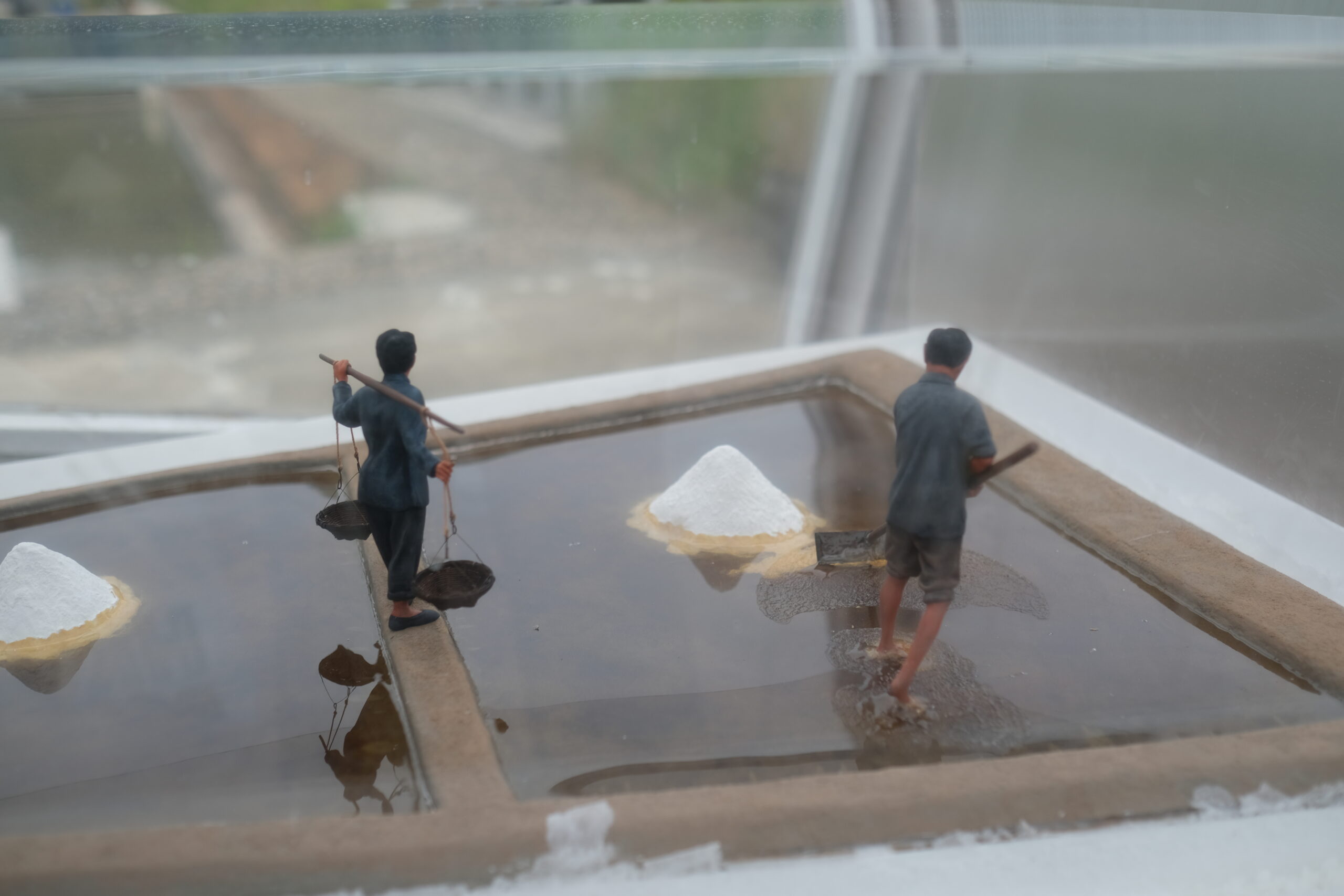
A model of the ancient salt-making process beside the salt pans in Yim Tin Tsai (Souce: Xindi Xie)
Windy, aged 60, took part in the first volunteer program in Yim Tin Tsai four years ago and is now responsible for making salt and explaining the process to tourists. The volunteer program was a four-day training course, in which volunteers were taught the traditional salt-drying method step by step by senior villagers. “Thinking about the sea water turning into a grain of salt, it’s amazing,” she said. “I feel like destiny brought me here to make salt, and I never thought I would enjoy it. It is truly magical!”
To begin the process, seawater is introduced into the salt fields, where it is exposed to the scorching sun to increase its concentration. Finally, the salt is naturally dried. The process may seem simple, but it takes 14 days from moisture drying to crystallization, requiring strong sunlight, breeze and low humidity.
The most difficult and challenging part of making salt using traditional techniques is that it depends heavily on the weather. In addition, to ensure the quality of the salt, it is equally important to take manual maintenance measures. For example, the staff will regularly clean the waterway to remove the sludge brought by the influx of seawater, and they have to prune the surrounding trees frequently to prevent seeds from entering the salt pond.
Windy mentions the most challenging part of salt production and their commitment to traditional salt-making (Source: Yu Zheng)
As a result, the salt produced was clean and pure white, with square crystals that had a cross in the middle, so it is also known as “square salt” or “cross salt.” When tourists see this unique crystal structure, many are impressed and take photos of it. “We hope that tourists realize there are still places in Hong Kong where salt is produced,” said Windy. “Nowadays, technology is so advanced, but when you come here, you will find that this is a traditional craft, entirely done by hand.”
In 2015, Yim Tin Tsai’s salt pan reconstruction project won the UNESCO Asia-Pacific “Cultural Heritage Conservation Excellence Award”. For the purpose of cultural heritage and education, the Salt and Light Preservation Center has set up a salt-making workshop for tourists to experience and sells sea salt as souvenirs.
“In today’s highly competitive society, fewer and fewer people are making salt because it’s difficult to make a living from this profession. As a result, traditional salt-making techniques are becoming increasingly hard to pass down,” said Windy. “So I hope more people can support this tradition. I think if everyone can support it, the tradition here will continue to be passed down.”
Yim Tin Tsai offers a variety of tourist attractions. Its salt pans, the only natural ones in Hong Kong, consistently draw significant tourist attention. Additionally, the art installation “Sanctuary of Salt” is located there, with volunteers available to explain the traditional salt-making process.
Besides the most distinctive and attractive salt fields and salt production, there are many other sights on Yim Tin Tsai that are worth visiting. For example, the Salt Light Conservation Centre is not only a visitors’ center, but also sells local salt and handmade items. Meanwhile, the St. Joseph’s Chapel, a Romanesque building with an important role in the history of Christianity in Hong Kong, appeals to those interested in religious heritage.
The island is closed on Mondays, open to group tourists from Tuesday to Friday, and only accessible to individual visitors on weekends. According to Chan, the majority of visitors are local residents. Over the past decade, school groups have accounted for about 50% of the total number of visitors. Additionally, pilgrims from the Catholic diocese makeup around 20%. Regular tourists who enjoy traveling account for approximately 20%, while the remaining 10% are other types of visitors.

Elaine Yeung, 26, a local office lady who visited Yim Tin Tsai for the first time with her friend, said, “The salt pans here are really impressive. We heard earlier that it received a UN award, making the place feel like a living testament to Hong Kong’s ancient cultural heritage.”

Corlia Wong, 50, a Christian worshiper who had traveled to the island several times before, said: “Today I came with my church for a pilgrimage to the Catholic Chapel here.The island is so peaceful, with no pollution and fresh air. I really enjoy the comfortable and tranquil atmosphere.
Every year, Yim Tin Tsai holds a renowned arts festival during select months. This unique event blends art, religion, culture and natural scenery. Launched in 2019 as a three-year pilot by the Tourism Commission, it uses the theme “Sky, Earth and Human” to showcase the island’s heritage through art.
What many may not know is that the festival’s concept originated from the villagers’ own initiatives. Chan recalled, “Actually, in 2018, before the government contacted us, we were already thinking about creating some artworks in the village, mainly focused on the art related to Catholicism.”
When the government proposed a collaboration at the end of 2019, the ideas of both sides coincided. “The government’s invitation came at just the right moment,” Chan said. “We believed art could help more people discover this village.”
Due to the change of the organizer in 2022, the Yim Tin Tsai Arts Festival was renamed to Sai Kung Hoi Arts Festival, broadening the scope of the arts festival to other islands of Sai Kung, including Sharp Island, Kau Sai Chau and High Island.
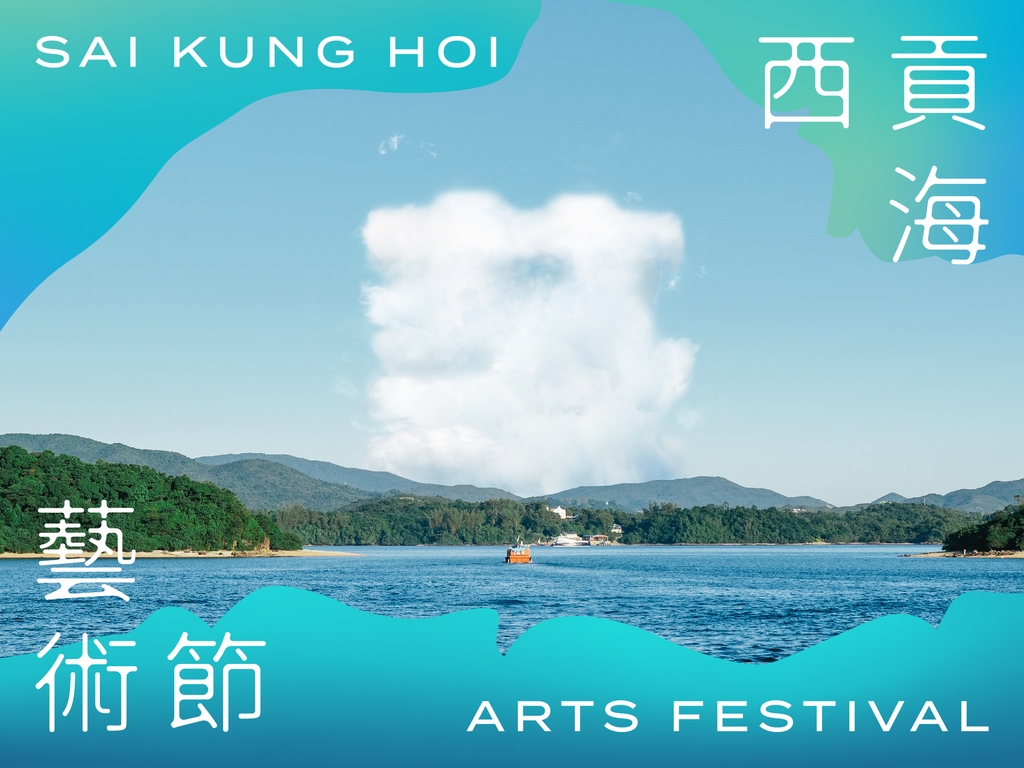
Poster of Sai Kung Hoi Arts Festival (Source: PLAYWHAT)
Louis Lu, a visitor involved in cultural and artistic work, first visited the place during the Yim Tin Tsai Arts Festival in 2021. He has since visited several times, mainly for the arts festival and also to bring friends for a tour. He said, “In Hong Kong, it’s rare to see an outdoor arts festival held in rural areas like this. Seeing how they transformed an abandoned island into a venue for the festival really intrigued me.”

Lu pointed out the main problem with the current arts festival: “While government departments want to hold it, they don’t have a long-term plan.They start similar things from scratch each time, like building temporary art installations and then tearing them down. Such a pattern not only causes a lot of waste, but also deprives the festival of an essential element: continuity.”
Chan also shared his opinion about the arts festival, “It does help more people know about the Yim Tin Tsai, but the artworks displayed must be rooted in the village. Otherwise, they lose their meaning, and that’s why we ensure every piece here tells the story of our community’s cultural heritage.”
From being abandoned to becoming a popular tourist spot in Sai Kung, Yim Tin Tsai has come a long way. Visitors have expressed their love and appreciation for the island’s culture and unique attractions. However, some also have pointed out shortcomings in the tour experience, and there is still plenty of room for improvement.
Chan is actually well aware of the tourists’ dissatisfaction. He is eager to address the shortcomings one by one, but it’s not an easy task. “The island has been abandoned for a long time, so many things need to be addressed. The main challenges are funding and manpower. If we can solve these two issues, I’m confident many problems can be resolved.” he said.
Large-scale projects on the island rely on external donations, mostly funding from churches. According to Chan, to maintain the island’s daily operations, fees are charged for services like boat trips, group arrangements, and tour guide services. He said, “The government doesn’t provide any funding, so it’s entirely reliant on our center. We hope to break even, but at the moment, it’s still losing money every month.”
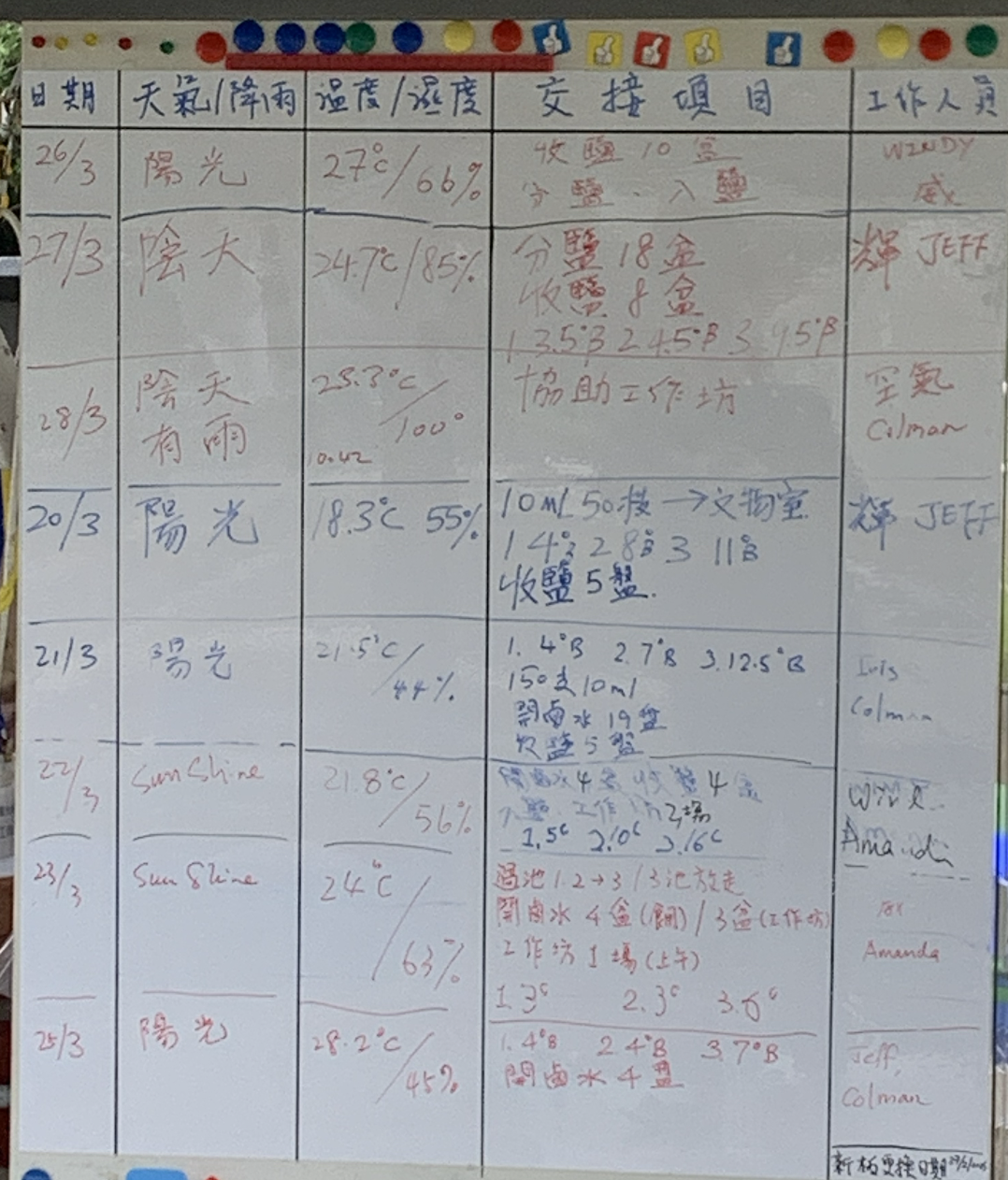
Daily records of staff making salt in Yim Tin Tsai (Source: Lanqing Mao)
Since its establishment, the core team of the conservation center has never exceeded 10 people. In Chan’s words, there are currently only six, so a large part of the work relies on recruiting and training volunteers. They have held three phases of volunteer recruitment, with the number gradually decreasing from 90 to 60, and then to 25. The fourth phase has not been launched due to a lack of resources.
Windy said, “Now there are only about 30 volunteers who are relatively stable, but they’re not always available every day.” Also, most of the volunteers are older, and Chan feels helpless about this. “I would definitely hope for more younger people to come in and help us, as they bring fresh ideas. However, I know it’s difficult because it’s not a full-time job, and our subsidies are limited.” he explained.
The inheritance of the salt-making technology, a core feature of Yim Tin Tsai, also needs more young talent.
As a former participant in a Yim Tin Tsai research project, Professor Cheung Siu-woo from the Hong Kong University of Science and Technology commented, “First-hand participation like salt-making workshops will be very enlightening for the younger generation. It’s a kind of sensory experience.”
Cheung further added, “To take this forward, a better understanding of the heritage itself is required, not just a sensory experience. It’s also important to understand its meaning, context, and history, and how the ancestors started it, as well as what motivated villagers to revive it.”
When discussing future plans, Chan shared his vision for the “Living Museum Project”, which aims to transform abandoned homes into multifunctional spaces. He noted that the village has around forty to fifty dilapidated houses and plans to divide them into four areas. Each area will serve a different purpose: housing for villagers, education, tourism, and religion.
Chan said, “These are all just dreams – restoring the salt pans is a dream, building the pier is a dream, all the repair work are dreams too. This is a large-scale plan, or you could call it a dream. Will I see it happen? I don’t know. For now, all we can do is to take it one step at a time. Maybe it’s for the next generation.”
BANKGROUND IMAGE SOURCES
Cover Image: Hong Kong Tourism Board
Salt-making Section: Xindi Xie
Tourism Section: Yim Tin Tsai Storytelling Project
Challenge Section: Yim Tin Tsai Storytelling Project
TEAM DIVISION
Team Leader (Coordinator): Xinyue Tang
History Section: Xindi Xie
Salt-making Section: Yuqi Chang, Yu Zheng
Tourism Section: Yuning Song
Challenge Section: Lanqing Mao