
The Demise of Cycling in Hong Kong
Once a popular pastime for Hongkongers, cycling has seen a steady decline in recent years.
Cycling has always been a simple joy for many in Hong Kong — Whether it’s a ride along the waterfront, or an urban exploration with friends. However, the bustling roads, inadequate bike lanes, and limited government support have pushed enthusiasts away from the pedals.
Although the industry returned to the spotlight during the pandemic, once things returned to normal, the same old challenges crept back in.
CHAPTER 1 : TO BIKE OR NOT TO BIKE
I loved cycling more than ever, but now…
Like many Hongkongers, Alex Au started cycling in his school days. Beginning with casual days out with his friends on weekends, renting bicycles from stalls in around the Sha Tin and Tai Po area, soon his love for cycling grew and grew and led him to purchasing his first bike.
Au’s passion for cycling didn’t stop there. Not before long, Au finds himself modifying his own bike, adding accessorizing and parts. He even began to learn how to assemble his own bikes.
“Building a bicycle takes a lot of effort,” Au, 23, said. “I’m not a professional, just a hobbyist. Sometimes changing a single component can take half a day.”
Alex hasn’t seriously worked on his bike in nearly three years, dating back to around his third year of university as academic pressure, and later work commitments started to get in the way. During the same time, he obtained a driver’s license – leading to an unexpected turn.
“The biggest issue is that I have a driver’s license now, if I get caught breaking the law while cycling, it could get me into trouble.” Au recalled that one of his friends, also a licensed driver, had three points deducted from his license for violating regulations while cycling.
Under current Hong Kong laws, bicycles on the road have the same status as motor-driven vehicles. If cyclists violate traffic laws while riding, they are subject to the same punishments as drivers. However, if cyclists do not possess a driver’s license, those punishments would be delayed until the offender obtains a driver’s license. That means, if these unlicensed cyclists will remain guilt-free, if they never plan to get a driver’s license.
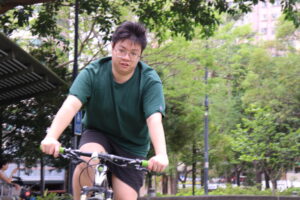
Alex developed an interest in cycling at young age. Credit: Rachel CHAN
Despite the rules not helping cyclists in Hong Kong, the COVID-19 pandemic, however, brought a temporary revival of cycling in Hong Kong.
“People were stuck in the city and were looking for outdoor activities,” Au said. “So, cycling got popular again for a while. But the ones who truly loved it — they kept going. To them, It wasn’t just a fad.”
Despite the surge in interest during the pandemic, Alex felt that the government hasn’t done enough to support or promote cycling to ride on the crest of this wave of popularity. He remembered there were plans to construct a bike trail along Castle Peak Road years ago.
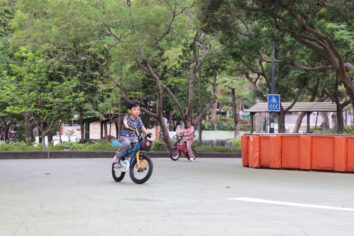
“But that project just vanished. There’s been no follow-up,” he said.
One exception, Au added, is the cycling track that now stretches across the New Territories. “It’s a good initiative that links different areas.”
“But Hong Kong’s urban environment deeply unfriendly to cyclists, particularly in Kowloon.”
“People can’t ride on the sidewalks, and there are no any proper bike paths,” he said. “If you cycle on the road, the traffic’s heavy, the lanes are narrow, and cars pass dangerously close.”
The lack of parking options also discouraged people from incorporating bicycles into their daily routines. “The setup in Hong Kong do not provide a transit station for cyclists to park their bike securely, then hop on a bus or train. That’s why biking as a daily commuting means doesn’t really work.”
Alex hoped there were more efforts made into fostering a stronger cycling culture locally, but only if it comes with real support systems.

Alex believes there is insufficient support for cycling in Hong Kong’s urban areas, citing the lack of parking spaces and proper bike paths as major issues. Credit: Rachel CHAN
“More people riding bikes is a good thing,” he said. “But without proper infrastructure, traffic policies, and basic facilities like parking and repair stations, it’s hard for everyday cycling to take root.”
When asked what changes he’d like to see, he emphasized education for both cyclists and drivers.
“We need proper cycling education from a young age — how to signal, how to share the road, and how to maintain your bike,” he said. “And drivers need to treat cyclists as equals, not as obstacles.”
Au recalled a few near-death scenarios he encountered while cycling on local roads, “Some drivers get impatient and try to squeeze past you, even when it’s unsafe. It’s really dangerous” .
Though he stepped away from cycling in recent years, Alex hasn’t let go completely. His modified road bike still sits in storage, tires deflated, frame collecting dust, but not forgotten.
“I still hope going on long rides again,” he said. “But until Hong Kong starts treating cyclists differently, it just won’t be part of my daily life anymore.”
CHAPTER 2 : NO BUSINESS TO CYCLE
“It used to be abnormally money making.”
As normal travel between Hong Kong and the Mainland fully resumed, travelling north of the border for shopping trip has become part of citizens’ daily lives parts, local-based activities like cycling has also suffered as a result.
L.K.Bikes, a chain bicycle shop which has been operating for more than 40 years, was one of the affected shops. Its owner Addy Law said the industry’s environment has become “more and more miserable” after COVID-19. As his 3-year lease expired, he could only move out of his shop in the Hong Kong Velodrome in March earlier this year.
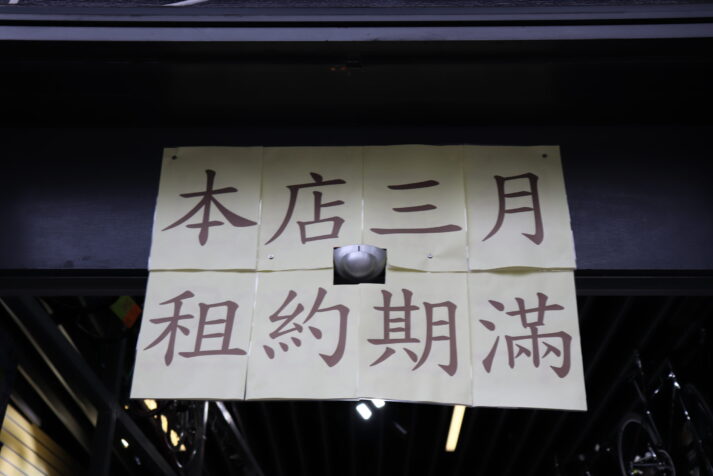
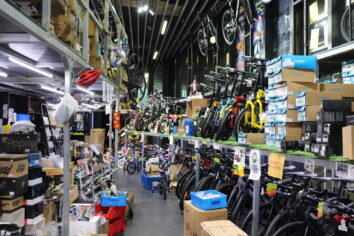
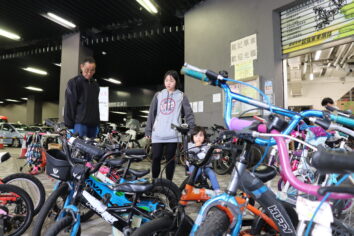
“Let’s say, if we sold 100 bicycles per month (on average during the pandemic), then it’s now (only possible to) sell around 15 (per month). The difference is pretty huge.”
Law pointed out that the bicycle industry was already going downhill before the pandemic, many stores planned to close down ── but the COVID-19 outbreak changed things.
“During the pandemic, everyone was not allowed to leave Hong Kong, and when citizens wanted to entertain themselves, some choose cycling ── even those who didn’t usually do so would also buy a bike,” he explained. “It was abnormally moneymaking.”
However, as the pandemic subsided, Hongkongers’ choice of leisure activities shifted again. With shopping trips to the Mainland becoming popular again, bicycle shops business started to be suffer.
“We just happened to enjoy a peak year, and then suffered for the next 2 years,” Law said.

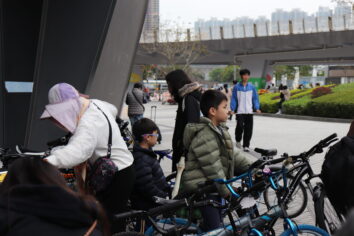
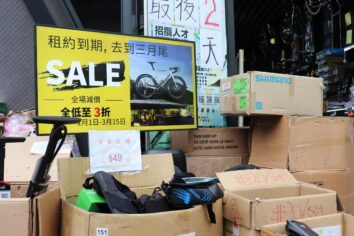
L.K.Bike’s branch in the Hong Kong Velodrome closed in March of this year. Law said it was also because the contract terms from the government is unrealistic. ‘The contract doesn’t change as long as there are no complaints.’
“(This current contract) contract is not very suitable for bicycle shop operators now.”
“It even states that you can assume that you will lose the next tender if you didn’t receive a notification within 150 days before the contract expiry date.” He said, adding that his shops only received notifications of winning a tender about two to three weeks before the commencement – an unrealistic timeline for bicycle shops as the move out or move in process often takens longest than the notice period.
Law suggests the government notify the operator who won the next tender and the current operating shop about the results three months in advance through emails. He believes that this could allow both parties to make better preparations ahead of time, and the current operator no longer have to “guess if he wins the next tender (until the contract expires).”
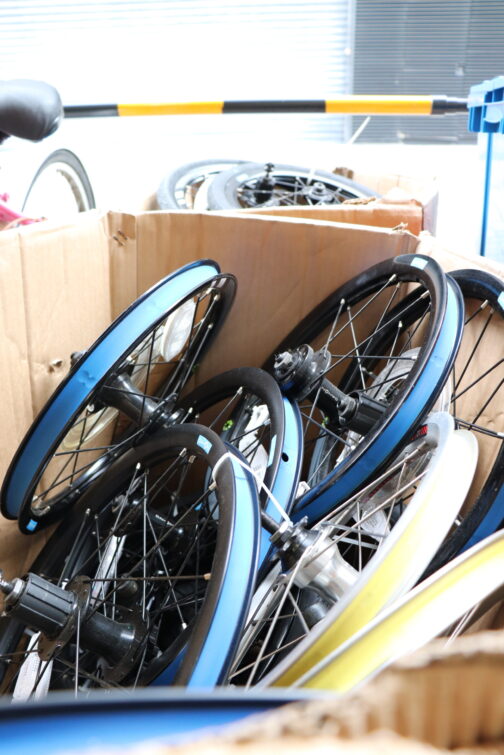
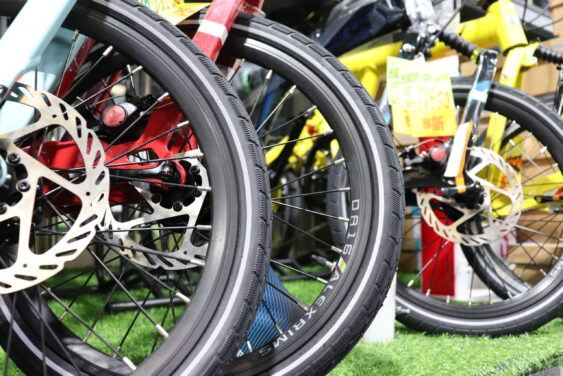

“They don’t have the intention to support the industry.”
According to Law’s understanding, the government seldom consults the views of bicycle operators when drafting contracts and designing bicycle kiosks. The terms were therefore impractical, such as restricting the shop from placing anything outside its doors.
“Even residents living in Tseung Kwan O for 10 years don’t know that this is a bicycle shop!’
“(Sometimes government officers) would come by and say that they received complaints about the bikes placed at the entrance,” Law said, adding that he doesn’t have the outdoor space to place a parking rack for customers at the entrance as according to the contract.
“When 10-ish cyclists come in (to get some supplies), should they push all their bikes (into my little kiosk)?”
“I have put forward my views many times, but there has never been any improvement,” he continued. “(If they don’t start to make improvements) Conscientious bicycle operators will leave the industry, there will only be fewer and fewer bicycle shops or bicycle repair services in Hong Kong.”
“Those who are conscientious in operating bike stores are (now) dispiritedly pulling out from the industry, and there is no turning back.”
CHAPTER 3 : REGIONAL COMPARISON
Cycling in Hong Kong is considered as a leisure activity rather than a way to commute
In Hong Kong, plenty of people love to ride, but the reality is that the city still makes it hard. From limited cycling routes to unclear policies, it is quite obvious that there’s still lots of room for improvement.
Cycling in Hong Kong is considered as a leisure activity rather than a way to commute, most of the cycling routes are located in the countryside, that is, in the New Territories.
If you want to ride a bicycle in the urban area, you will have no choice but to share the road with other vehicles. As long as you go on the road, your bicycle will be treated as a vehicle and cyclists must adhere to a set of laws and regulations governing bicycle use.
Before we explore how other places do it differently, take a quick quiz to see what you already know.
First, a bicycle must be equipped with a bell. When riding at night or in low-light conditions, a white light must be visible at the front and a red light at the back. A rear-facing reflector with a minimum diameter of 40 mm is required at all times, both day and night.
When riding on the road, cyclists cannot ride two abreast, meaning that if they are in a group, they must form a single lane. In contrast, cycling two abreast is allowed in the UK, Australia, the Netherlands, and at certain times in Singapore.
Wearing a helmet while riding a bicycle is not mandatory in Hong Kong. In fact, only a few countries, such as Japan, South Korea, Argentina, and Australia, have mandatory helmet requirements for cyclists.
However, the Transport Department in Hong Kong is considering mandating helmet use for cyclists starting in 2022 due to the increase in road accidents involving bicycles in recent years. This potential amendment has raised questions about whether bike-sharing companies should provide helmets to their customers and how they might implement such a policy.
Cycling is also not permitted on pavements or in road tunnels, and cyclists must use designated bicycle paths when they are available. This regulation is similar in Singapore, whereas in the Netherlands, Japan, cyclists are not always required to use cycle paths.
Then, flip through the cards below to find out how Hong Kong stacks up against bike-friendly countries like Japan and the Netherlands — where riding a bike feels simple and safe.
CHAPTER 4 : THE DOCTOR’S PRESCRIPTION
“Hong Kong is not a bicycle-friendly city, in terms of culture and design”

Executive Council Member Dr Lam Ching-choi enjoys cycling in his free time. Credit: Lam Ching-choi
Executive Council Member Dr the Honourable Lam Ching-choi, SBS, JP , an avid biker, suggests Hong Kong is not a bicycle-friendly city, “in terms of culture and design”.
“Many cities in Europe, or even Japan can create a harmonious environment catering both pedestrians and bicycles, but not Hong Kong.” Lam said.
Government figures has shown that the percentage of bicycle accidents among road accidents has been on rise since COVID-19, and yet there were little policy change from the Government to protect the safety of cyclists.
Lam believes the biggest problem is that Hong Kong as a city is not designed to accommodate both pedestrians and cyclists. Furthermore, unfriendly attitudes between cyclists and drivers, often stemming from misunderstandings, is also a big obstacle.
In terms of infrastructure, a quick look at the number of bicycle parking spots around Hong Kong shows the lack of planning and foresight from the Government. Although there are more than 57,000 bicycles parking spots in Hong Kong, less than 500 are in urban areas, with only 105 spaces in Hong Kong Island. Both Kwun Tong and Wong Tai Sin districts have zero bicycle parking spaces, meaning using bicycle as a means of transport is almost impossible for city dwellers.
Lam suggests the government should start enforcing a licensing system, so cyclists who plans to ride bicycle on streets and roads will need to “learn the rules of the road” before becoming a road user. Cyclists who rides in bicycle lanes and parks, however, would be exempt, because road-using cyclists will need to learn about ‘not cycling skills, but cycling manners’.
Lam still harbours hopes for Hong Kong to becoming a bicycle friendly city, but believes there is a long way to go. Lam says it will be considered a success if “10-20%” of car users can switch to using bicycles in Hong Kong, but he believes this will need “20-30 years of work”.
A better cycling city starts with connected routes and inclusive policies— is Hong Kong ready?
Credits
Advisor | Foon Lee
Editor | Charlotte Lam, Rachel Chan, Chris Chan
Data Visualization | Chris Chan
Interviewer | Kari Chan, Rachel Chan
Interactive Element | Kari Chan, Charlotte Lam, Johnny Wan
Photographer | Rachel Chan
Videographer | Rachel Chan, Johnny Wan
Website Design | Kari Chan