African Football Players in Hong Kong

They bring passion and vitality here

By Chen Hao & Zha Jiaming

Heavy rain, Wong Chuk Hang, Aberdeen Stadium. In the 60th minute of the 22nd round of the Hong Kong Premier League, Kwun Chung Southern District played against Standard Rovers. Mahama Awal took the ball on the left, ran through the dense rain, dribbled past the opposing defender, and sent the ball into the Rovers’ net with a powerful shot, tying the score to 2-2.

He is one of hundreds of African athletes who came to Hong Kong to develop their football careers. Although they come from different countries of Africa and speak different languages, their common language – football – gave them the opportunity to gather in Hong Kong.

The situation for our other 2 main interviewees-Micke Sam and Ugo Destiny- are quite similar but also have their own uniqueness. Both as retired footballers, they tried to develop their own post-career lifestyle working as coaches and living in Hong Kong.

Dream Come True for “Black Panther”

Mahama Awal, 33, now plays for Southern District in the Hong Kong Premier League and the Hong Kong national team. He started his career at AJ Auxerre B team, and was then discovered by his brother’s agent, who introduced him to Guangdong Sunray Cave for a trial, which offered him a formal contract. He spent six years playing in Mainland China and was praised as “Black Panther” due to his amazing speed.

At the end of 2014, Sunray Cave was acquired by a consortium and the team was relocated to Shaanxi and renamed Shaanxi Wuzhou. However, due to the arrears of wages, Sunray Cave was eventually disqualified from participating in the competition, and Awal also fell into an embarrassing situation of having no ball to play.
In 2015, Hong Kong club South China extended a branch to him, and he accepted the invitation and began his journey in Hong Kong football.
After sevne years living in Hong Kong, in March 2023, Awal officially obtained the status of a local player. After completing the formalities at the Immigration Department, he was immediately recruited by the Hong Kong team coach Anderson to participate in the Hong Kong team training that afternoon.

Awal makes a victory sign during the game.   Source: Mahama Awal

“I have never played for Cameroon in an international tournament, so being able to be part of the Hong Kong team and play in an international tournament is literally a dream come true,” said Awal.
He’s feeling confident of the future development of the Hong Kong team,“I’m gonna devote what I have to this team. At present, the level of the Hong Kong team is very close to that of the opponents of the same level. We are still making continuous progress. I hope that one day we can beat opponents like Thailand, Vietnam and Malaysia.”
As a current Hong Kong citizen and national team representative, Awal expressed his commitment to staying in Hong Kong and helping develop future generations of players.
These players have all spent more than 10 years living in this city. Sam and Awal have already become Hong Kong citizens. There are many African players like them who only planned to stay in Hong Kong for six months to a year before looking for opportunities in mainland or Europe, but eventually chose to settle in Hong Kong, start a family and become Hong Kong citizens.
“As an international city, Hong Kong’s living standards, working environment and career development opportunities have greatly attracted foreign players to participate in the Hong Kong Premier League. Hong Kong Premier League clubs also have the opportunity to participate in Asian competitions from time to time, so it is not uncommon for foreign players, including African-rooted players, to choose to join Hong Kong clubs.”

“The cultural background and competitive level of African football players can add vitality and freshness to Hong Kong football. Their participation will not only improve the level of football, but also promote the exchange and integration of different cultures,” said Hong Kong Football Association.

Build an Academy with Diversity

Light rain, Causeway Bay, Victoria Park Lawn. Dozens of kids of Young Talent Football Club(YTFC) were passing the balls to each other, led by different coaches.
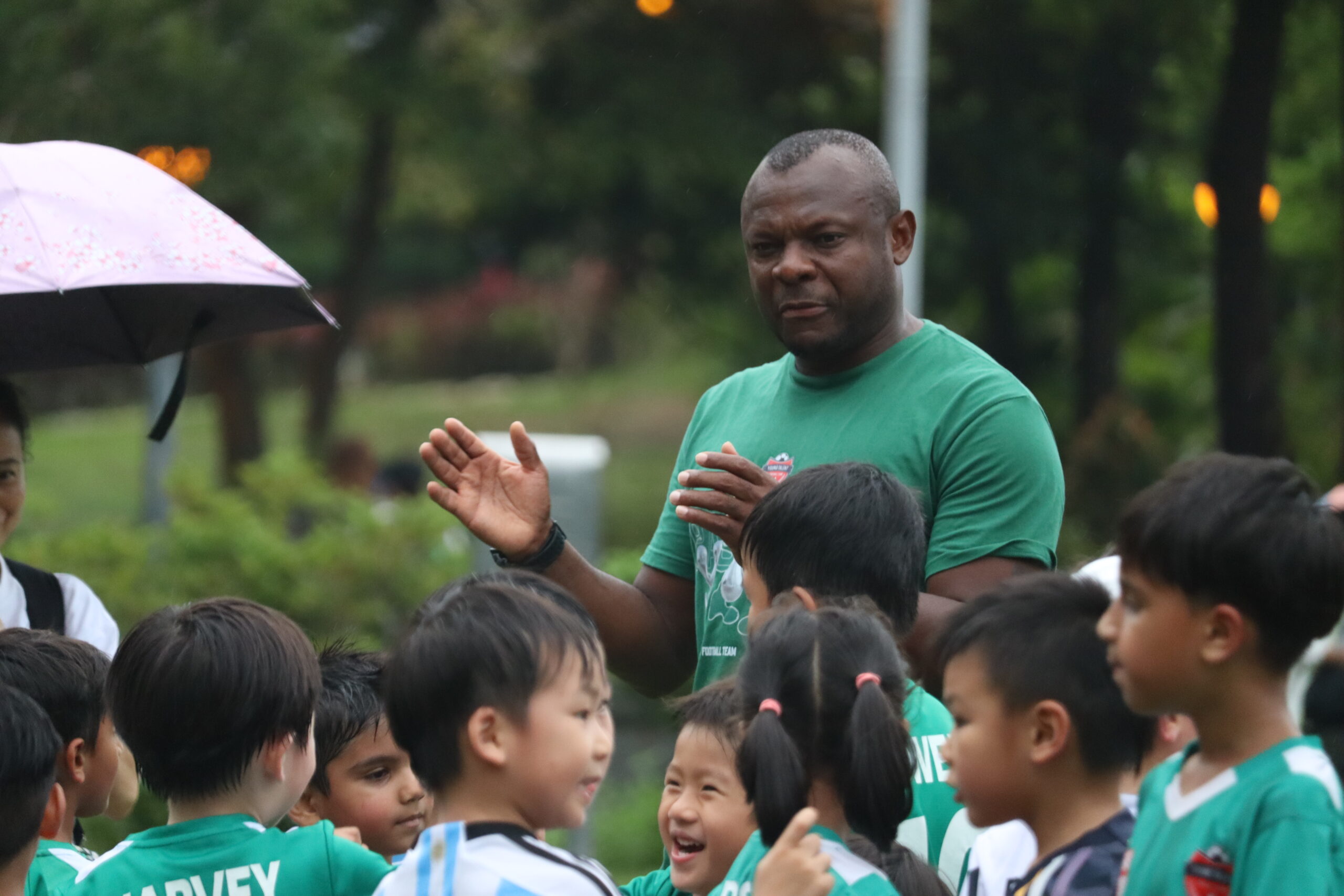
Coach Ugo Destiny stood in the middle of the field, watching the training of different groups, and occasionally stepped forward to personally guide them if they made mistakes. He looked very majestic when he raised his arms and shouted instructions to the youngsters, but he was meticulous and patient when he communicated with them individually.

Coach Destiny is teaching students about offside in football.  Source: Young Talent Football Club

Coming from Nigeria, Destiny began his football career in the local team inspired by his dad. As his skills improved, he progressed to compete in state-level tournaments. It was during this time that his friend, Christopher Annan—a former Ghanaian-born Hong Kong professional footballer who played as a striker and left winger—invited him to play in Hong Kong.

After arriving in Hong Kong, Destiny played for several teams, including Hong Kong Football Club, Shan Tin, Wan Chai, and Kowloon City, before retiring in 2017.

Unlike other players who decided to join an academy to become a coach, Destiny decided to start an academy on his own to fulfill his coaching ambition. Agnes found multiple places where they can use the grasslands for free and to operate their training sessions. They started by coaching rich people’s kids on their private lawn and gained considerable profit even during the pandemic lockdown.

The club won the Most Outstanding English Speaking School of The Year from the Hong Kong Commercial Times Business Awards. Now they have 25 training venues across Hong Kong, like Cyberport seaside park, Nam Cheong park, Happy Valley, etc.

“We want to build a club with diversity, hiring coaches from Africa, Pakistan, Eastern Europe, and so on. We also have women coaches at YTFC,” said Destiny.
Now, the couple was planning to expand their business to mainland China, mainly in Guangdong. “We love China, so why don’t we also try to share our experiences there? Plus, people there are friendly.”
They used to pay a visit to Evergrande Football School in Guangzhou to learn their training methods. Destiny’s previous coaching experiences in Zhuhai made him familiar with the training methods in the Mainland, making it even more reasonable to expand.
“The way mainland coaches train players is more direct and strict. Also, players follow coaches’ instructions without messing around,” said Destiny. “Discipline is all that matters, just the same as Nigeria. Here in Hong Kong, everything is chilling. Students dare to challenge you.”
Destiny said one of the greatest things in this coaching job is that he can see his students grow and become top players. “What I got is pure happiness, I really enjoy this process of transferring the knowledge.”

As for the professionalization of the African United Football Club, Destiny said that “the best preparation for tomorrow is doing your best today.” To play professionally is every player’s dream; lots of hard work needs to be done to make this happen. “Running a football club is not easier than running a company,” said Destiny. He wishes AUFC could reach its goal earlier.

United as One on the Pitch

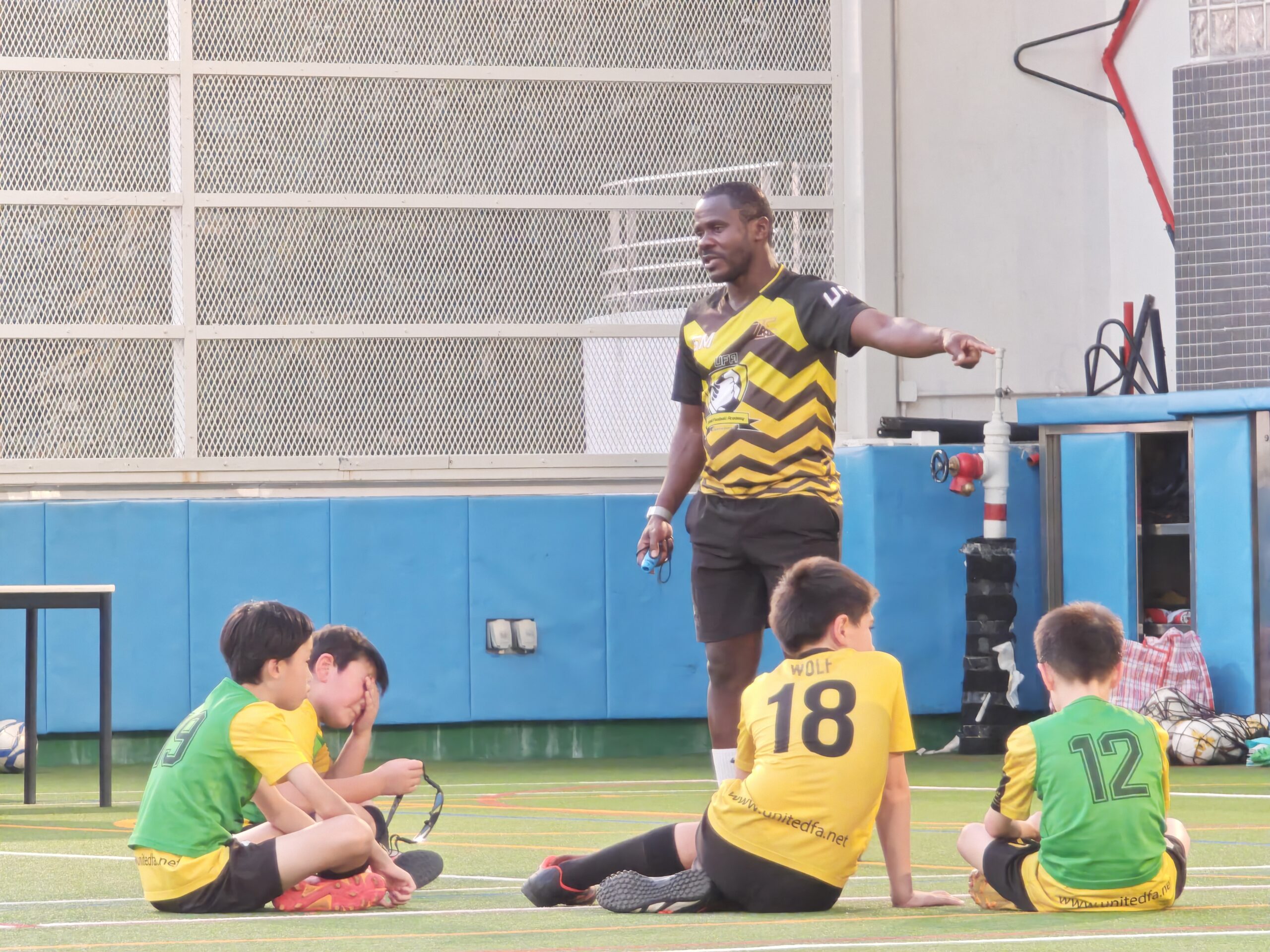
Sunset, West Island Secondary School. When the sun had sunk halfway below the horizon, the coach of African United Football Club (AUFC) academy, Micke Sam, ran into the training ground with a net bag of footballs, taking over from his colleagues to conduct the second half of the training for young players.

“Hey, kids, attention here!” Sam gathered students together, and showed them how to stretch their legs and hips to prevent injury.Then he separated kids into two teams to do the attack and defense drills.
After class, Sam stayed to train the goalkeeper kid by having him sprint to and from marked gates on the field because the kid’s lack of endurance made it difficult for him to keep up with his classmates.

Micke Sam, 37, arrived in Hong Kong from his homeland, the Republic of the Congo at 2013, as a professional football player. He used to play for the U19 and U20 teams of the Congo national team

As a stranger to Hong Kong, he managed to learn English and Cantonese from scratch, trying to integrate into the local society while playing professionally for different teams.
He worked as a French teacher at St. Margaret School. After that, he joined the All Black Football Club (ABFC), which was the earliest community for African footballers. When ABFC met management difficulties, he founded African United Football Club (AUFC) and its academy to teach children on his own at his friends’ requests.
Sam tried to cooperate with a professional football club in the second division of the Hong Kong pro league to make the club professionalize but eventually failed due to the pandemic era.
Now, the professionalization of AUFC has been put on the agenda again under his efforts. The club plans to join the fourth division of the pro league in 2-3 years.
 “Our team has been registered with the government. We hope to get more sponsorship for renting a stadium for practice, buying water, etc. The team hopes to participate in the official league of the Football Association in 2026,” said Sam.
Most African footballers get familiar with each other amid the socialization within football clubs. Mahama Awal, striker for Kwoon Chung Southern District, has played friendly matches with AUFC.
Awal perceives AUFC’s decision to join the pro league as a “good idea” for African players. “There are many young talented Africans born in or come to this city that just need to be discovered. In AUFC, they can progress and learn about Hong Kong football and get better opportunities in the future,” said Awal.
“This team hopes to connect players from all over the world. Some players may not have a schedule in Hong Kong, but they can come to our team to practice and maintain their form and confidence, and then be ready to return to the professional team at any time. This team can keep some players’ hopes of becoming professional football players in the future,” said Valdo Tita, a Cameroonian pro-footballer who is still active in the second division of Hong Kong football league, also the current captain of the AUFC, according to a report from OneTwo.hk.

This is a mutual assistance platform.”

Coach Sam is giving the players game tactics. Source: Zha Jiaming

“Some of the AUFC’s players are refugees and asylum seekers. They love football and have great potential. AUFC provides a valuable platform to support these individuals, keeping them engaged when they cannot work and ensuring they have access to the necessary training to pursue professional play if possible,”
Micke Sam

The founder of African United Football Club

Emblem of African United Football Club   Source: African United Football Club

When Pains came around

For African footballers, integrating into the local culture was very painful.
“I couldn’t even speak English when I just arrived here, not to mention Cantonese. During that time, there were not as many African people as there are now, so football mattered a lot in helping me to integrate into the society and the culture. We speak the same language on the pitch,” said Sam, “but gradually I made more friends and I can speak English and Cantonese now. It was extremely difficult at first.”
Destiny shared the same feeling on this. When he arrived in Hong Kong back in 2004, he was just 20 years old. Unfamiliar with the language, not used to the local food made him feel panicked.
The intensity of the daily training left him with little time to communicate with his fellow countrymen. “It was indeed a challenging time,” said Destiny, “It took me several months to know the environment around me.”
Besides language barriers, injuries are the biggest problems for these footballers.
Speaking of his injuries, Destiny showed his right leg to us. At least 5 injuries like ACL, Ankle sprain, and hamstring strain happened on this leg. Moreover, the football club only gave him compensation of HK$500 when he once suffered from an ACL.
“Luckily, we just decided to buy insurance for Destiny, and it covered most of the expenses of the surgeries,” said Agnes, “otherwise we’ll be desperate, cause the treatment fee was too high and it’s nearly impossible for us to pay for that, especially during the pandemic.”
The club’s poor treatment of players happens to Valdo Tita as well. A team once signed a contract with him, but when he returned to Hong Kong from vacation, the other party cancelled the contract due to insufficient funds.
He also encountered situations where the team owed him wages, and he was forced to change teams because his former team lost the qualification to participate in competitions due to frequent problems.
The pandemic is another thing that changed many African footballers’ lives. During the COVID-19 pandemic, players had no matches to play, so they received no salary. In order to survive, these players had to think of a way out. Sam and Destiny founded their own academies to coach students to earn money, others tried other jobs like acting and driving.
“It was very, very hard during that special period of time, I also worked in a kindergarten as a manager, but opening an academy has always been my dream,” said Sam, “Initially there were no kids coming, but fortunately, I managed to get through and kept my African United Football Academy alive.”

Stunted League and struggled local football

Hong Kong hosted multiple international football friendlies regularly in the past decade, attracting top European football clubs like Liverpool, Manchester United to come and play.

Barcelona and Real Madrid swap jerseys. Source: Zhang Jiaming

Hong Kong hosted multiple international football friendlies regularly in the past decade, attracting top European football clubs like Liverpool, Manchester United to come and play.
It seems like Hong Kong is a place where people are quite fascinated by football and its football atmosphere must flourish. But Hong Kong football is actually experiencing a decline amid match-fixing scandals, shrinking fans, and the absence of sponsorship.
The Hong Kong Premier League, the top-tier football league in the city, features only nine teams this season. Two clubs, Sham Shui Po and New Peak, withdrew due to financial difficulties, while the Hong Kong U-23 team was dissolved ahead of the 2024–25 season.
“I think the way they sell the football to the local population should be blamed. Because if you don’t do good marketing for the local, you won’t attract many good players coming from outside. The league will be stunted and won’t be growing,” said Caleb Tochukwa, 36, a Nigerian player who works as a coach under Destiny and previously played professional football in Hong Kong, Israel and Lithuania.
The league is also plagued by internal problems. On March 6, the Independent Commission Against Corruption (ICAC) charged four people, including two players in Fu Moon and a football club owner for allegedly offering bribes to fix match results in the 2021-22 season.
The Hong Kong national team slid from 90 in 1996 to today’s 153 out of 210 in the world team rankings.
Valdo Tita said the football environment in Hong Kong is complex: “If you really want to develop a football career, Hong Kong is not the right place. Of course, if someone insists on coming to Hong Kong to play football, it will be useless for us to tell him not to come, and he will always be able to gain some experience in Hong Kong.”

Spirits from Africa

Despite the current situation of Hong Kong football, it still attracts players from all over the world to play football and settle here. In the past two decades, African players have been a strong force that has been continuously injected.
Despite being neglected, unfair, and even discriminated against, they still uphold the optimistic concept of “since they are here, they will make the best of it” and are happy to bring the unique football philosophy from the African continent to Hong Kong, whether they are still active in the professional arena or retired to the second line as coaches.
Speaking of what African footballers mean to Hong Kong football, Destiny and his colleague pointed out that there are several spirits they have brought to Hong Kong.
“The way we play football is that we play with a lot of passion. In Nigeria, where street football is quite common, we bring a lot of passion into the game and we put every effort to make it,” said Caleb.
 “In contrast, here in Hong Kong, everybody is kind of laid back, relaxed when playing the game. So for me, when I come to coach kids, I want to bring that passion to them. So sometimes I’m a little bit loud in coaching, just because I want them not to be afraid,  let them feel comfortable with me and tell them that I’m passionate.”
“We Persist and we never give up. We always play to win, not to lose it,” said Destiny, ”Just go for the ball and win it.” This is also the motto he sticks to in life and teaches to his students
“If we have a passion for football, we can absolutely die for it.”
On the green field, naturalized players like Awal show the audience their indomitable fighting spirit and sturdy physical fitness; on the training ground, retired coaches like Sam, Destiny and Caleb teach the new generation of Hong Kong players the football spirits of “either not do it or do your best”, “never give up”, “play with passion” and “fight for every ball”
“Seeing other people’s smiling faces enjoying football is my greatest joy now,” said Tita.
We do think that what these African footballers truly believe can be summarized as follows: Football is not easy. The most important thing is how you treat it and your own mindset. If you want to improve and to reach a better version of yourself, it doesn’t matter what level you play or how old you are, as long as you do your best at every minute. “Football is life.”