
On a Saturday morning with misty drizzle, Xiaoqing Kuang traveled nearly two hours, first by subway, and then by bus, before she finally arrived at the animal management center in Pok Fu Lam. It was 11 a.m., dogs on the other side of the quarantine facility had already woken up and started barking softly.
After registering her name at the entrance, Kuang walked through the doors one by one – she knew the place like the back of her hand – until she reached her destination: her cat’s quarantine room. Six cats shared the space, each had a separate cubicle of about 1.35 square meter.
The cat, Suancaiyu, or “pickled fish” in English, rushed out happily after Kuang unlatched the door of her enclosure. She rolled on the ground excitedly, showing her furry belly with paws flailing in the air.
“Sometimes I think it’s not the animals, but human who can’t bear the quarantine,” Kuang said.
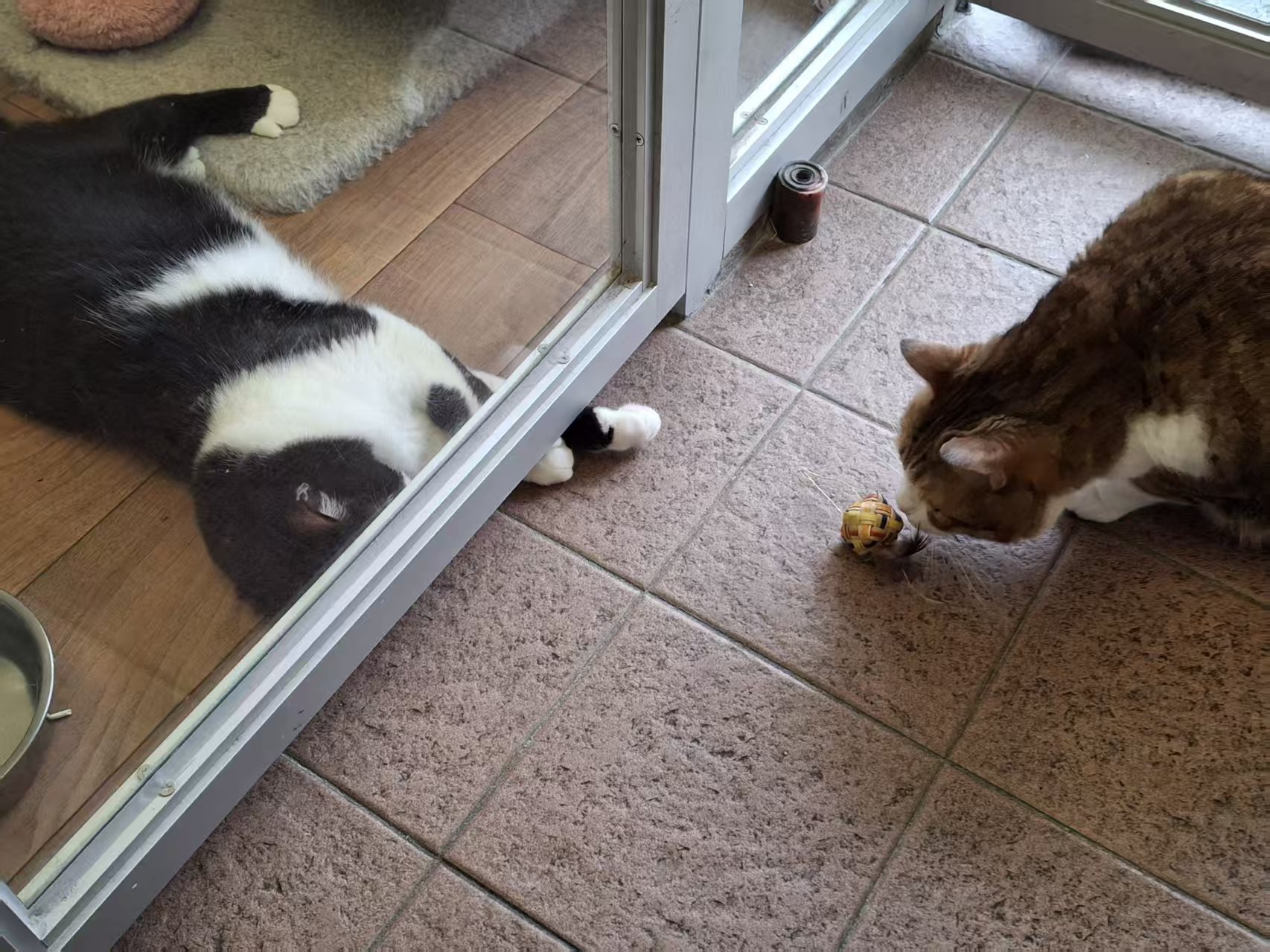
Suancaiyu and a neighboring cat interact against the glass door. Photo credit: Xiuyuan Ning
Suancaiyu, originally from Shenzhen, is serving quarantine under the Hong Kong government’s requirement. The city’s quarantine regulations for imported animals, depending on the animals’ origins, is among the strictest in the world. Cats and dogs from rabies-infected mainland China have been traditionally subjected to the longest quarantine period: 120 days.
Hong Kong’s regional counterparts have taken more relaxed approaches. Singapore adopted a similar stratified quarantine systems based on rabies risk status, but the highest quarantine period, which also applied to pets from mainland China, is only 30 days. In Japan, imported pets with implanted microchips, rabies vaccinations, and satisfactory antibody testing results face only a minimal 12-hour quarantine, even if arriving from non-designated regions where rabies still present.
In a surprising policy shift, however, the Agriculture, Fisheries and Conservation Department in Hong Kong announced on May 13 that the quarantine period for pets from China would be slashed to 30 days.
Despite the eased rules, which will take effect on June 3, the long quarantine remains a reality for many pet owners whose animals entered Hong Kong before the policy update. They have expressed concerns that the lengthy separation negatively impacts their pets’ physical and mental health – as well as their own– and may lead to illegal pet smuggling.
The Tale of Two Cities
For pet owners like Kuang, these rules come with steep emotional and logistical costs. Kuang is a final-year Ph.D. student in Hong Kong, while her husband, Zepei Liang, has been living and working in Shenzhen during the week, where he also cares for their other cat, Datouxia. Kuang and Liang pay regular visits to 7-year-old Suancaiyu, even though, as Liang described, the journey sometimes “almost takes an entire day.”
Suancaiyu was born to a stray cat. The young couple adopted her when she was just three months old, back when they were both college students. Over the years, she became a constant companion throughout their academic and personal journey. They have set up a RedNote account to document Suancaiyu’s quarantine experience, sharing updates with a growing community of fellow pet owners.
For many immigrants to Hong Kong, the separation with their pets begins even long before the quarantine starts. Due to the limited availability of quarantine spaces and the ensuing long queues, the average waiting time for a spot range from 12 to 15 months, according to the AFCD. Pets are typically left behind in the care of family or friends – sometimes for nearly a year – as human relocation only takes only a few months. Suancaiyu has waited eight months before securing her place, while Datouxia is still in line.
The total number of quarantine units for cats and dogs will rise from 21 to 34 and from 20 to 30, respectively, upon completion of an expansion project at the Kowloon Animal Management Center later this year, according to Tse Chin-wan, the secretary for environment and ecology, in response to a question raised in the Legislative Council.
Conditions at the newly built Kowloon center are noticeably improved, with each cat allocated a spacious 8-square-meter room.
However, Liang questioned the value of such luxury: “No matter how big the room is, it is better to take care of pets at home.” He believes that if the enclosures were smaller, the waiting time could be shortened significantly.
One thing comforting for the couple is that Suancaiyu has adjusted well to quarantine life. She would interact with the cat next to her through the glass door, and purr when the couple visits.
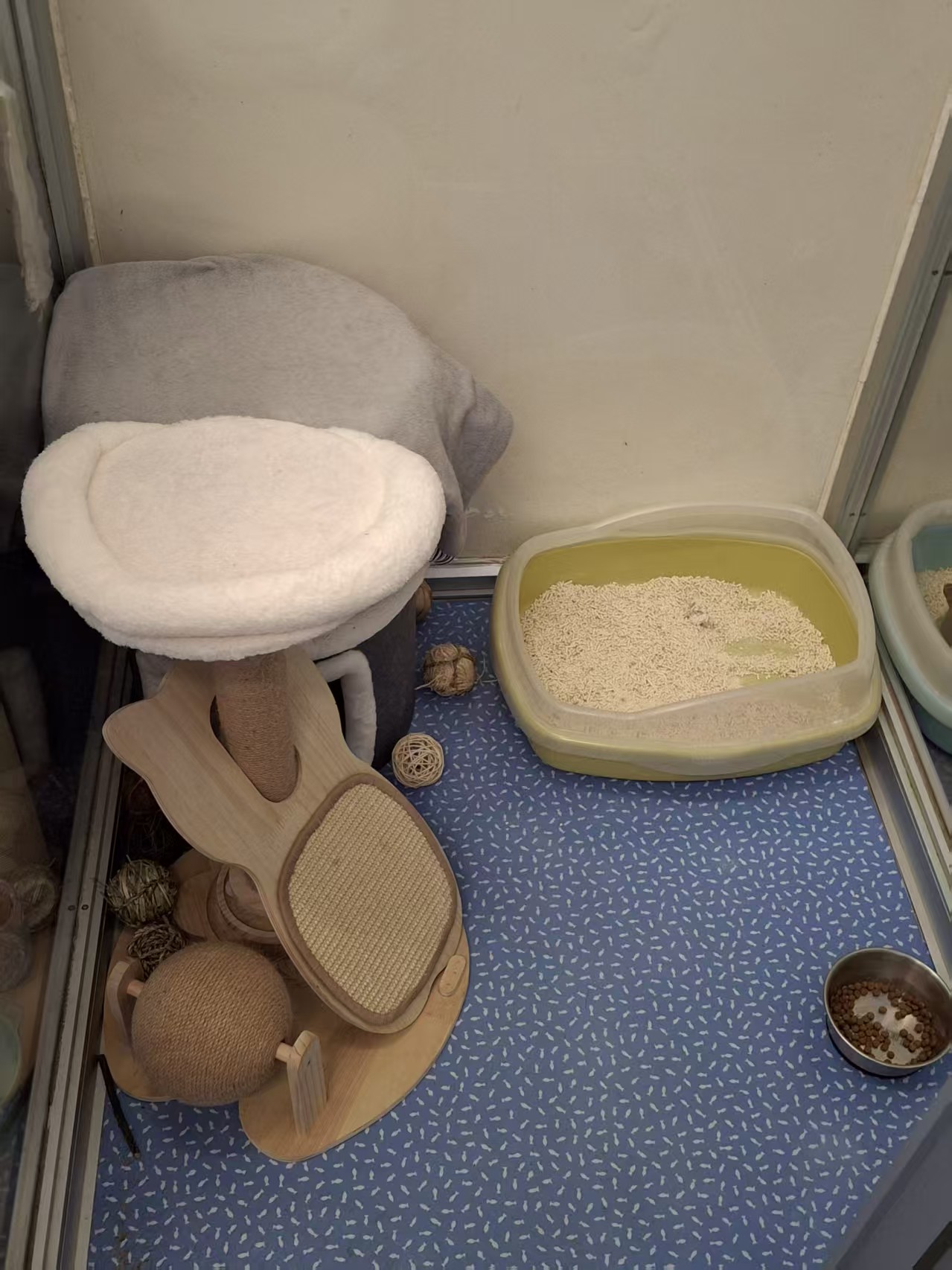
Suancaiyu’s quarantine room, with toys and cat towers brought by her owners. Photo credit: Xiuyuan Ning
Not Every Pet Adjusts
Christine Wang’s cat, Xiaobai, was less adaptable compared to Suancaiyu. Wang remembered that during her early days at the quarantine center, Xiaobai has trouble adjusting to the unfamiliar environment.
“She ate little. And she would dart into her cat cave whenever she heard a noise,” Wang said. For nearly two months, Xiaobai spent almost all her time hiding in that corner, and a neighboring cat’s constant meowing only added to Xiaobai’s stress.
Wang visited Xiaobai three to four times a week during those early periods. She considered herself lucky: as a master’s student at that time, she had enough time flexibility to make regular trips from Tai Wai, where she lived, to Pok Fu Lam.
At one point, Xiaobai developed a swollen chin, which Wang suspected might be related to improper sanitation of cat dish at the center, and had to be taken to the vet. Wang was allowed to accompany her, but a staff member sat beside them in the taxi throughout the trip. “It’s like a prisoner being temporarily released on medical parole,” she joked.
According to figures provided by the AFCD when contacted by HKU Journalism, 12 cats and 22 dogs required medical treatment outside quarantine facilities over the past three years. During this period, 2 cats and 2 dogs died, though the department did not specify the causes of death.
Xiaobai’s quarantine ended in the April of 2023. She made it through a long flight, a stressful transition from Malaysia’s tropical climate into Hong Kong’s winter, and months of isolation. “I am so proud of her,” said Wang, a native of Chengdu who had previously studied in Malaysia, describing Xiaobai as a naturally timid and sensitive cat. Wang recalled that Xiaobai was stressed out by moving place and barely ate or drank for almost a week when she was still a kitten.
To prepare for the journey, Wang hired an agent to help her deal with the paperwork and required procedures, such as blood tests, vaccinations, and parasite screenings. She found the process too complex to manage alone as an outsider. While she understands the public health concerns behind the long quarantine, Wang argued that the government should take extra efforts to combat illegal importation of pets, which poses a far greater risk, rather than tightening control over pets that observe legal requirements.
Fiona Woodhouse, a vet and deputy director of animal welfare in Society for the Prevention of Cruelty to Animals, a non-profit animal welfare organization, agrees with Wang. She said that properly vaccinated pets, with blood tests confirming rabies immunity, are “much safer” than smuggled animals in terms of health risk.
The Shortcut
Mainland pet-delivery companies offering same-day transport to Hong Kong have been ramping up their services, partly due to the 120-day quarantine requirement. A one-way shipment by land typically costs around CN¥1,000, plus an additional CN¥100 “cross-sea fee” for destinations on Hong Kong Island. That makes it both far cheaper— official quarantine costs HK$46 per day for cats and HK$90 for dogs — and much faster than official quarantine, with many firms even claiming the door-to-door trip takes under two hours.
The business, however, sits on shaky legal ground. Importing animals into Hong Kong without a valid permit is an offence under the Public Health Ordinance. Since November 2023, the Hong Kong customs and their Shenzhen counterparts have jointly run the “Pet Guardian” operation to crack down on illegal animal imports. In January, four smuggled pets with an estimated market value of about HK$120,000 were seized.
“We have a license and safety is guaranteed,” one pet shipping service provider responded vaguely when asked about how they handle customs inspection. He said that pet owners are allowed to stay with their pets in the vehicle and look after them during the entire trip, except at the border crossing – but did not specify what license the company holds.
Another pet shop owner, who sell pets from Shenzhen to Hong Kong, said he hires an “experienced” agent to deal with the importation process. “You don’t need to worry, we bring pets to Hong Kong every day,” he added.
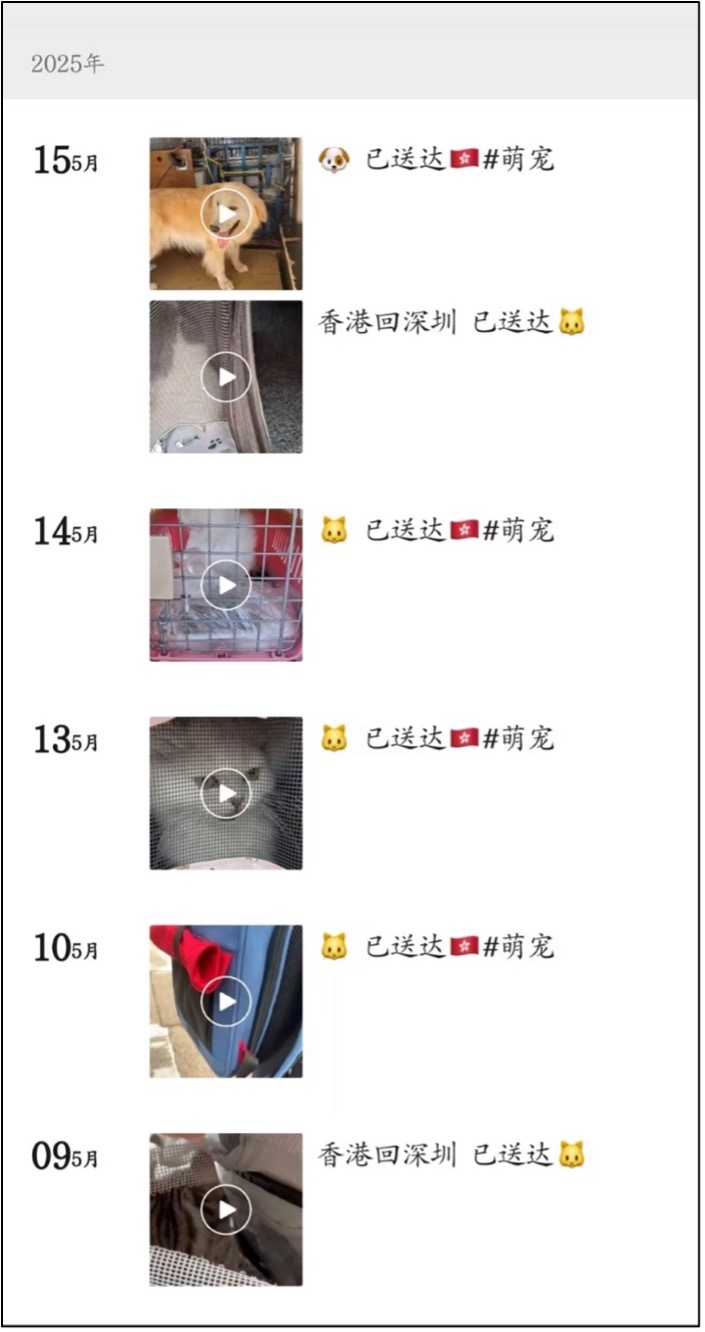
A screenshot of a pet delivery company’s WeChat Moments. The company documents the pets they have delivered almost every day to promote their business. Photo credit: Xiuyuan Ning
Woodhouse argues that while the long quarantine requirement might be a factor, those who conducted wrongdoing are “quite selfish” and bear the responsibility. “Even if we shorten [the quarantine period], there’ll still be people who will not care and think, do it straight away. It’s quicker, right?” she said.
For her, the deeper issue lies in legal loopholes. Crossing the border without permission is illegal, but Hong Kong’s laws do not have regulations to verify where animals originally come from, so authorities cannot prove whether an animal is imported legally or illegally unless caught at the border. As a result, consumers who receive smuggled animals often face no penalties, as the offense occurs before the animals arrive.
More importantly, Woodhouse said that the issue is also ethical and behavioral. “You can implement all the legal changes you want, but if you don’t address human behavior, people will still break the rules and hope they get away with it,” she said.
A Bittersweet Reality
While some people take the risk of smuggling, others are determined to follow the rules — no matter how burdensome they may be. Hanna Ching was infuriated when netizens questioned under her social media posts why she didn’t have her cat smuggled into Hong Kong instead of going through the lengthy quarantine process.
“Haven’t they seen the consequences of getting caught on the news? If pets are really part of the family, how could anyone take that kind of risk just to avoid 120 days of quarantine?” she said, referring to past smuggling cases that led to arrests and animal deaths – including incidents of animals being thrown into the sea during enforcement chases.
Ching, 30, grew up in Hong Kong but moved to the mainland for work. Last year, she decided to return – this time with her beloved cat. She admitted feeling frustrated by the government’s stringent quarantine rules, but said she had no choice but to comply, as it was the only legal option.
“I feel like crying when the staff [at the quarantine center] told me to visit her more often, because pets miss their owners too,” Ching said, recalling the first day arriving at the center. The moment was filled with a mix of anxiety about handing her “kid” over to strangers and a comforting sense of being understood.
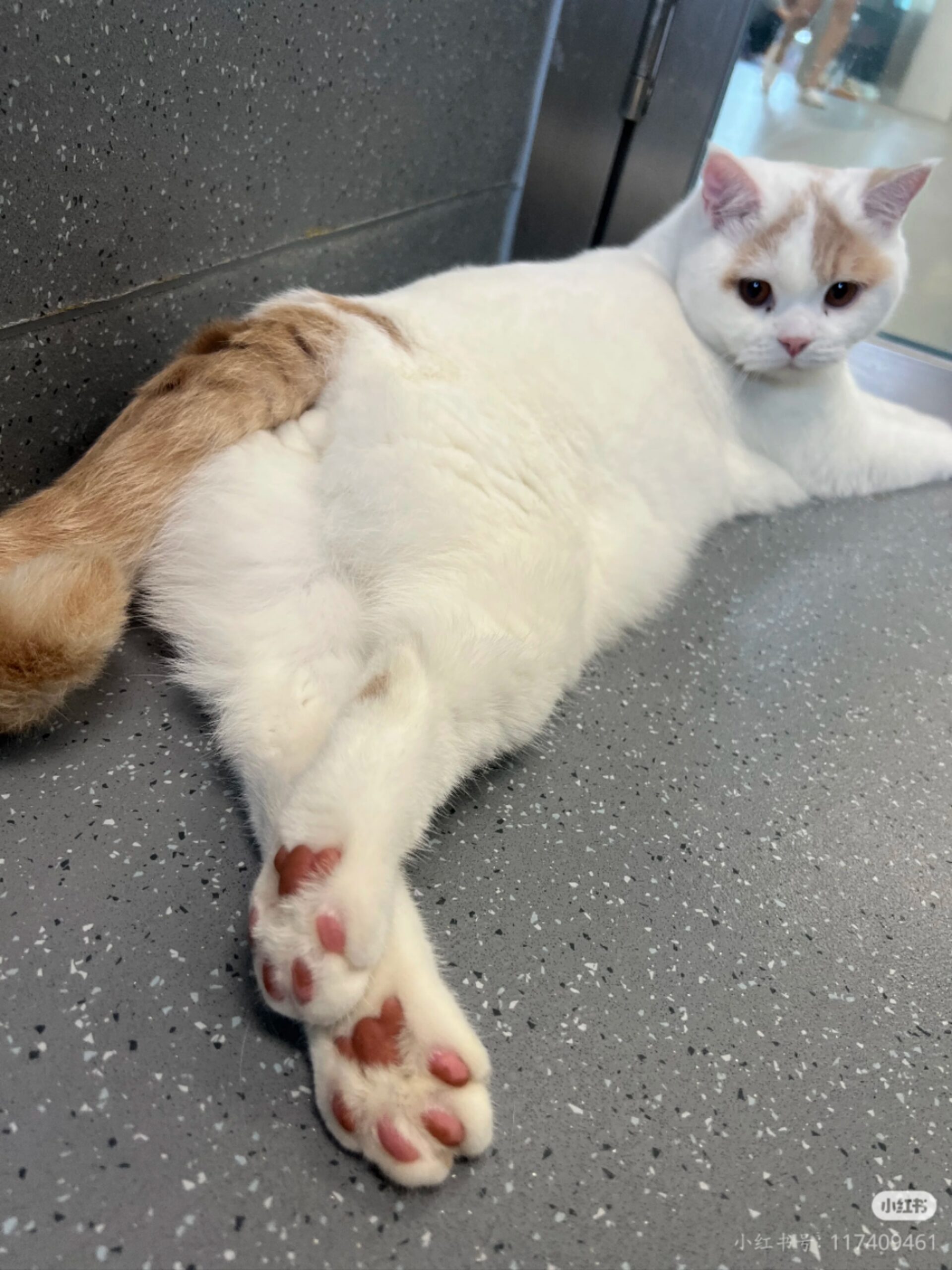
Hanna Ching’s cat, with his signature pose, inside the quarantine room. Photo credit: Hanna Ching
Ching’s cat arrived in early April, just one months before the new regulation was announced. Each time she visits, the cat would sit with his hind legs neatly crossed —his signature pose, and Ching couldn’t help taking photos. While she is eagerly waiting for the quarantine to end, she couldn’t help wondering how different things might have been if she had waited just a little longer.
Animal law expert Amanda Whitfort, a law professor at the University of Hong Kong who advises the government on animal-related legislation, believes the new policy is a step forward. “Thirty days is sufficient time in quarantine under the new health certificate rules and the new policy will help ensure pets are not abandoned when their owners move to Hong Kong,” she said.
The wait also continues for Kuang and Liang. Suancaiyu is now halfway through her the quarantine. Liang, meanwhile, is gradually moving to Hong Kong, leaving Datouxia in Shenzhen under the care of a friend. The couple plan to travel back and forth between the two cities every one or two weeks, depending on their schedules.
They still remembered when they first received the pop-up notification about the policy change from a WhatsApp group, which is created by fellow pet owners whose cats share the same quarantine room with Suancaiyu. The group was formed for pet owners to share photos and updates of each cat during their visits, providing mutual support since many were busy with work and couldn’t visit their pets frequently. It was an ordinary Tuesday afternoon, when Kuang was working at the school laboratory, and Liang on his way home with groceries.
Once the truthfulness of the message was verified, they made a quick discussion and phoned AFCD the next morning to know more about the details. The new policy still lacks clarity in parts, but one thing was certain: Datouxia would only need to stay in isolation for 30 days.
“Here it comes, at last,” Liang said, recalling the unexpected moment when he first heard the news. But the victory was bittersweet — Suancaiyu still has to serve the full 120-day quarantine, as the new, shorter rule doesn’t apply retroactively.
Supervisor: Dr. Bin Chen