
Hong Kong’s food delivery boom has a hidden cost, paid not by platforms, but by the workers behind the scenes.
Since Keeta disrupted the market with lightning, fast deliveries, customers expect meals in minutes. But for riders, speed comes at a price: shrinking pay, vanishing orders, and roads that turn dangerous under pressure.
We followed the workers trapped in this race, where algorithms decide who earns and who starves, where strikes fail, and where the only choice is to run faster.

The takeout bag’s handles grow heavier with each rushed step, leaving traces across fingers. The delivery app pings a reminder: Your order will expire in 5 minutes. The customer’s message pops up: Where is my food? Now, you stand at an empty crossroad, facing a dilemma:
Accept the penalty, a HK$3 late fee and possible algorithm-driven pay cuts, or risk running the red light.
In May 2023, Keeta stormed into Hong Kong’s delivery scene. Within just 11 months, Keeta grabbed 44% of the market share, overtaking Deliveroo and Foodpanda to become the city’s top delivery platform, according to Measurable AI.
Delivery times that once took two hours suddenly shrank to under 45 minutes. No more starving while waiting, no more hesitating over high delivery fees, food delivery has become a faster, more affordable option.

But will there be enough orders today? What’s the pay? Will the delivery deadlines be too tight?
To find out, we signed up as Keeta riders on January, joining the army of walkers delivering meals across Hong Kong Island’s concrete jungle.
The income of delivery works is greatly affected by changes of platform provided extra tips. After Deliveroo announced its exit from the Hong Kong market on March 10, Keeta added extra tips ranging from HK$4 for HK$15 riders during different time periods over the following two weeks. During that periods, a single order could earn around HK$ 40, while the same order would only pay around HK$20 during non-bonus times.
Another factor affecting riders’ income is Keeta’s additional rewards. Keeta offers various rewards program based on rider status, including newcomer bonuses, weekly rewards, and team competitions. Depending on order volume and performance, riders can sometimes earn an extra HK$60 per day.
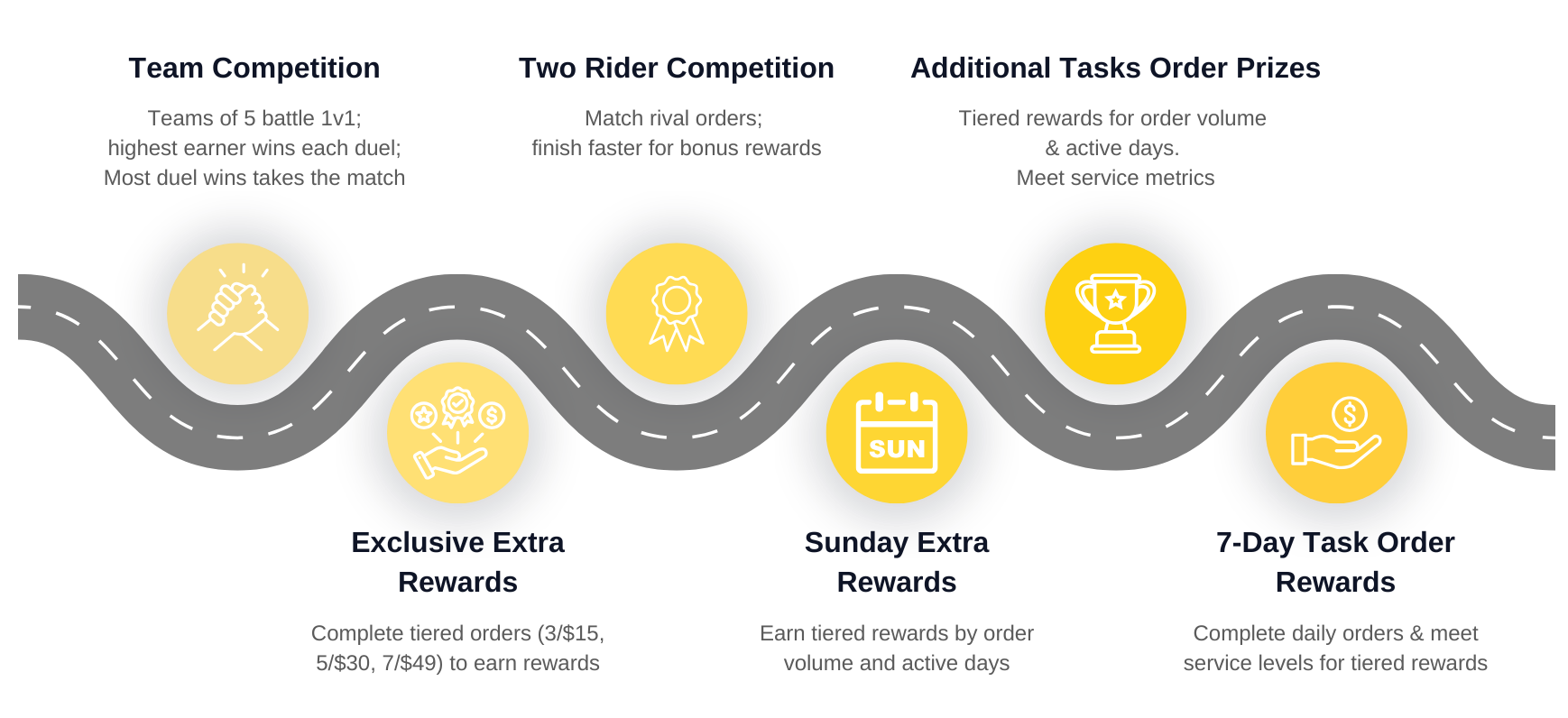
Introduction of additional rewards
Beyond platform rewards, factors including delivery distance, uphill routes, and working hours also make a delivery rider’s income unpredictable.
From our past experience, the pay difference between a 50 meters delivery and a 300 meters one can be as little as HK$0.5 to HK$2. The system also doesn’t fully account for uphill road. While climbing 200 meters takes more time and effort than covering the same distance on flat ground, the pay remains nearly the same.
We therefore analyzed our February order records, and the data tells a similar story.
Uphill distance and its share of total distance has little bearing on system delivery time. But as delivery distance increases, the system allowed time per kilometer actually decreases, indicating delivery works face tighter time pressure on longer trips.
Similarly, income for orders shows no meaningful link to uphill distance. While pay sees a slight increase with longer walks, the gains are slim. The rate of income increase per kilometer is smaller than the rate of walking time decrease per kilometer. This means that while couriers earn more over longer distances, it’s less efficient. Shorter trips are more profitable for couriers.
3D analysis of takeout delivery: distance, topography and revenue mapping
But our research only covers a small part of the delivery world. For workers who treat food delivery as a full-time job, the reality is much more complex. To them, the pay per order matters less, what counts more is the number of orders they can take.
Delivery worker James Zhang stared at his food delivery app. After a long wait, a notification of “you have a new order” finally pop up. He quickly tapped to accept the order, but it was already too late. Another delivery worker had already taken it.
The time in this phone’s top-right corner jump from 7 p.m. to 12 p.m., yet he remained seated in the same spot. That night, he did not managed to get a single order.
“I don’t care about the pay per order anymore,” said Zhang. “Just please give me some orders.”
The 25-year-old worker delivers food on foot seven days a week. His weekly routine, averaging 42 hours of work, means walking more than 130 kilometers for about HK$2,000 in pay.
But in early May, his orders had drop sharply. Zhang could only sit outside a restaurant in Tai Wai, watching other workers walk in and out with orders while his own app stayed empty, even though he already joined the Keeta’s Kgo program.
The Kgo program is designed for delivery workers with high acceptance, completion, and on-time rates. Participants earn less per order but are promised higher order density, meaning more order requests in the same time frame with shorter distances. According to Keeta’s rider app, workers who join this program will ultimately lead to higher expected earnings.

The algorithm sets the rules in the food delivery industry, but no one knows how or when they change.
What people know are just the possible system of rewards and penalties. Worker will be possible reward for order acceptance, punctuality and service, but penalize complaints, late deliveries, or refused orders, according to report released by government.
But will there be enough orders today? What’s the pay? Will the delivery deadlines be too tight? And is the restaurant-to-customer route actually doable?
These are all unknowns. The only thing riders can do is hope and accept what comes next.
Zhang had noticed that delivery times have been cut since late April. Orders that once allowed 20 minutes now give just 10 to 15.
Another change is the approval rate for late-delivery appeals. For Zhang and many others, running behind schedule is routine. Most delays have valid reasons including unreasonably tight timeframes. For instance, Google Maps might estimate 20 minutes for one order, but the system allocates just 23 minutes, including waiting time for red lights, building access registration, and elevator waits.
Therefore, the platform offers an appeals process to contest unfair delivery times. If approved, riders will get back the on-time bonus.
But while Zhang’s appeal success rate was around 80% in March, it decreased to about 50% by late April. The same reasons, the same explanations, yet different outcomes. Rejection reasons vary: failure to follow reporting steps, invalid appeals, false reporting.
Why? Customer service did not explain.
Lai Ka-bo, a representative from the Hong Kong Confederation of Trade Unions’ Self-Employed Workers Branch, believed the biggest issue for delivery worker is the lack of transparency in how the system calculates these decisions.

Another issue is the flood of undocumented workers. It tricks platforms into believing there are more available riders and giving companies room to cut rates, Lai added.
In July 2024, Keeta froze some accounts suspected of fraudulent registrations, account sharing, or multiple people using one login as part of a citywide crackdown on illegal labor. Yet undocumented workers remain widespread.
“Many accounts are rented out, and some people use family or friends’ identities,” said Lai.
The underground economy of Keeta accounts flourishes on the trading app Carousell.
Daily rates start at HK$60 for walking delivery accounts, with motorcycle and car accounts commanding higher prices.
Beyond the Keeta system, another hazard hide on every order: danger on the road. Even if delivery workers do not care about the on-time bonus, heavy loads and steep hills can lead to falls and injuries.
In mid May, Zhang twisted his ankle and scraped his knee during a delivery. But after contacting Keeta’s customer service, he was frustrated to learn the company would only let him cancel the order without penalty. No compensation, no pay.
“Unless it’s a traffic accident, Keeta won’t take responsibility, even if you’re hurt,” said Zhang.
Cheng Chi-hang, a motorcycle delivery rider, also became a victim of food delivery’s risky conditions.

On March 23, Cheng accepted an order with an tight deadline. To make matters worse, the customer had provided an address different from the one listed, down a rough path.
Though Cheng reported the issue, Keeta’s support insisted on letting him finished the delivery anyway, saying the locations were close enough. With an HK$8 on-time bonus at stake, Cheng pushed forward. Suddenly, loose sand and stones sent his motorbike skidding, crashing hard to the left.
Struggling to lift the bike, Cheng felt burning pain in his hands, legs, and knees. Sand had torn into his skin, blood slowly seeping out. When he finally stood, he saw the damage: various scratches along the motorcycle’s body, the rearview mirror dangling sideways.
Between Keeta’s buzzing call and the customer’s impatient texts, Cheng rushed washed his cuts. Then, hobbling, he delivered the damaged meal.
“Thank god I wore jeans, or I might’ve needed stitches,” said Cheng.
Hours later, resting at home, he was still shaken. He questioned whether the relentless time pressure and lack of protection were worth it.
Cheng later shared his story in a Facebook group for Keeta riders, where many echoed his worry. One user, Kenneth Wong, replied with his own experience, a wound that required eight stitches. Another commented that motorcycle delivery riders “can’t avoid” such accidents.

While delivery workers faced numerous challenges, customers continue to voice complaints about the industry.
In a random sample of 40 user reviews, many respondents noted delivery fees and food prices are still too high.
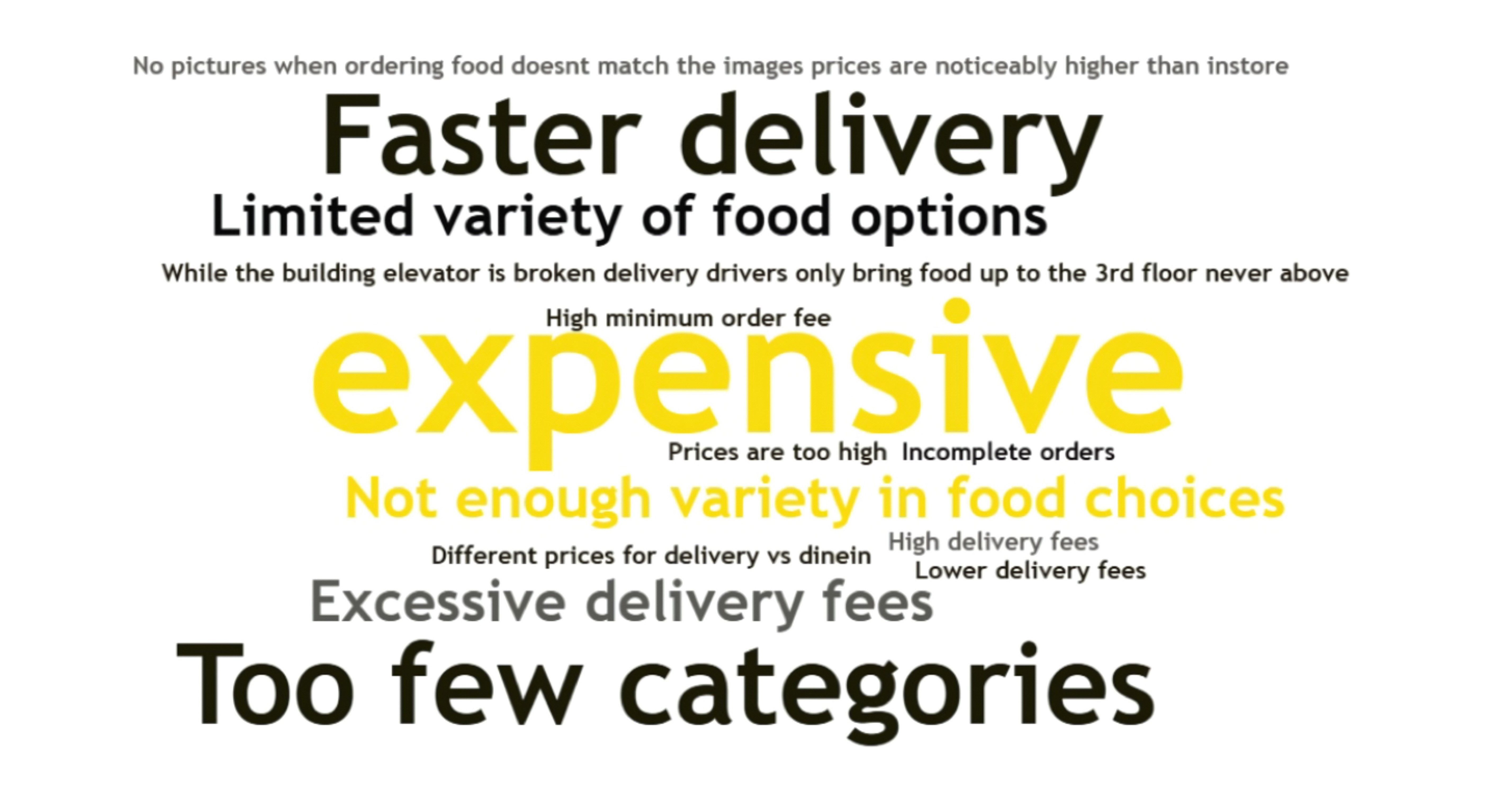
Word Cloud of Consumer Complaints on Pricing, Service Efficiency and Restaurant Diversity
While only 27.5% of users cited delivery speed as a factor in choosing a platform, nearly 70% expect their orders to arrive within 30 minutes. Yet only 45% actually get their orders in that time frame, missing the expectations of a large number of users.
Customers want faster, cheaper deliveries. Delivery workers need fair pay and reasonable deadlines. Caught in the middle, food platforms keep cutting delivery times and fees to win customers, leaving riders bearing the cost.
Delivery workers now find themselves trapped in a system that prioritizes profits above all. Platform algorithms push them harder while reducing their earnings, shrinking their already thin earnings past the breaking point.

But why can’t delivery riders leave this industry, could only accept adjustment of the platform?
Oliver Chan, a professor of communication and journalism at the Chinese University of Hong Kong, believed that ethnic minorities’ lack of job alternatives is one of the key reasons.
“Ethnic minorities make up a significant portion of the delivery workforce in Hong Kong,” said Chan. “Many face barriers to accessing formal employment opportunities, which makes platform-based delivery work one of the few viable options.”
While ethnic minorities comprised just 8.4% of Hong Kong’s population in 2021, they account for roughly 60% of the city’s food delivery workforce, the Hong Kong Christian Industrial Committee’s Takeout Workers’ Rights Concern Group told Initium Media.
Unemployment rates were higher among ethnic minorities compared to the general population, except for Filipinos, Japanese, Koreans and Caucasians, according to a study on education and employment pathways for Hong Kong’s ethnic minority youth. Ethnic minorities, especially South Asians, continue to face employment discrimination in Hong Kong, severely limiting their career options.
Another key reason is the flexibility that food delivery work offers.
“Some people choose to work on delivery platforms partly because of household responsibilities, such as caring for family members. In this case, flexibility becomes a key factor in their decision to take up platform work,” Chan said.

With no way out of delivery jobs, delivery workers can only turn to unions or strikes.
On May 23, 300 Keeta delivery workers went on strike, calling for the company to scrap its order-grabbing system and restore recently reduced pay rates. The strike was followed by two strikes on May 10 and May 17.
Keeta told Ming Pao “base pay alone doesn’t reflect riders’ true earnings” and called workers “key partners,” saying that they have regular communication channels with workers.
Yet, Keeta didn’t negotiate with strike representatives, and the strikes seem to have failed to bring meaningful change.
From 2017 to 2024, there had been nine strikes in Hong Kong’s delivery industry. The largest was in November 2021, when Foodpanda delivery workers launched a citywide strike.
The 2021 strike was one of the few that achieved results, leading Foodpanda to agree to address 15 worker demands after negotiations.
But in 2022, when Foodpanda cut pay again, it changed strategies. Instead of an across-the-board reduction, only some riders in certain areas saw lower wages, while others kept or even got slight increases. This divide-and-rule strategy weakened worker unity.
As a result, the 2022 strike changed nothing. Since then, there have been very few large-scale strikes.
“The workforce is quite fragmented. Workers themselves may have different interests, rendering it difficult for them to unite and organize labor actions.” Chan explained.
“Second, as platforms like Keeta rely upon dynamic pricing mechanisms, workers may receive personalized earnings. Third, there are also structural barriers to organizing collective action in Hong Kong due to factors such as the lack of legal recognition for platform workers as employees and the evolving political context,” Chan added.

Strikes being off the table leaves workers powerless. Workers now have only one option left: relying on the government. Their union has repeatedly appealed to governments, urging them to act as industry regulators and rule-makers.
On May 14, the General Union of Free Workers under the Hong Kong Federation of Trade Unions met with the Hong Kong Labour and Welfare Bureau, demanding legal protections for platform-based delivery workers. Among their requests were legal clarification of riders’ employment status and the creation of a work injury compensation system.
Chan also agreed that the government should regulate and establish standards for this “black-box”.
“I think a key first step is to provide delivery workers with basic and essential labor protections, just like the same labor protections that full-time employees are entitled to,” said Chan.
Acknowledgements
Project Advisor Bin Chen
Producer Edith, Liu Zhiling & Eve, Qiao Yushan