
Loosening the Leash on “Pawlicy”
Hong Kong’s Evolving Path to a Pet-Friendly SocietyBy Cecilia Xinyi Dong
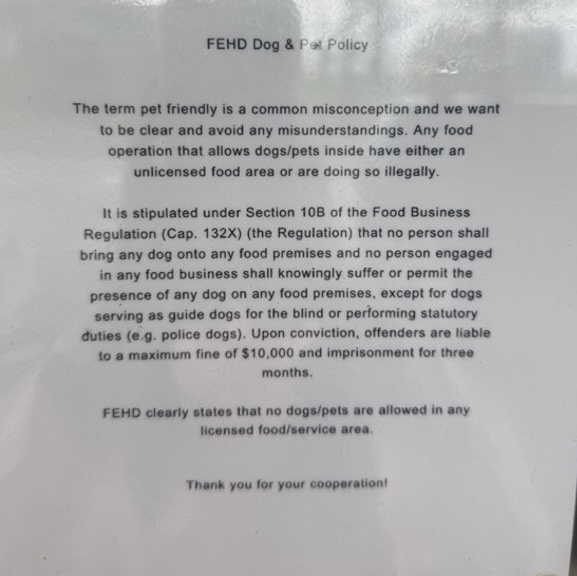
A notice posted outside a restaurant in Kennedy Town (Source: Cecilia Dong)
For decades, Hong Kong’s Food Business Regulation (Cap. 132X) drew a hard line: no dogs into food premises, with narrow exceptions only for guide dogs or dogs connected to a lawful power. Violators faced a fine of up to HK$10,000 and three months’ imprisonment.
That line is now being redrawn. In early 2026, a landmark pilot policy was launched, which allowed dogs into licensed restaurants for the first time since a blanket ban was introduced in 1994.
Behind the rollout lies a much larger story. According to the government policy address of 2025, Hong Kong is home to over 240,000 households with more than 400,000 pets. In a report from Edigest, the Hong Kong pet economy is to be over HK$ 6.2 billion.
A small step for humans, a big leap for pets
Hong Kong’s new policy allowing dogs to enter qualified restaurants“The Government will introduce a licensing arrangement allowing operators to let dogs enter their food premises. Clear signage will be put up by permitted restaurants, so that customers know dogs are allowed. Pet-friendly restaurants will create new business opportunities for the industry.”
—The Chief Executive’s 2025 Policy Address
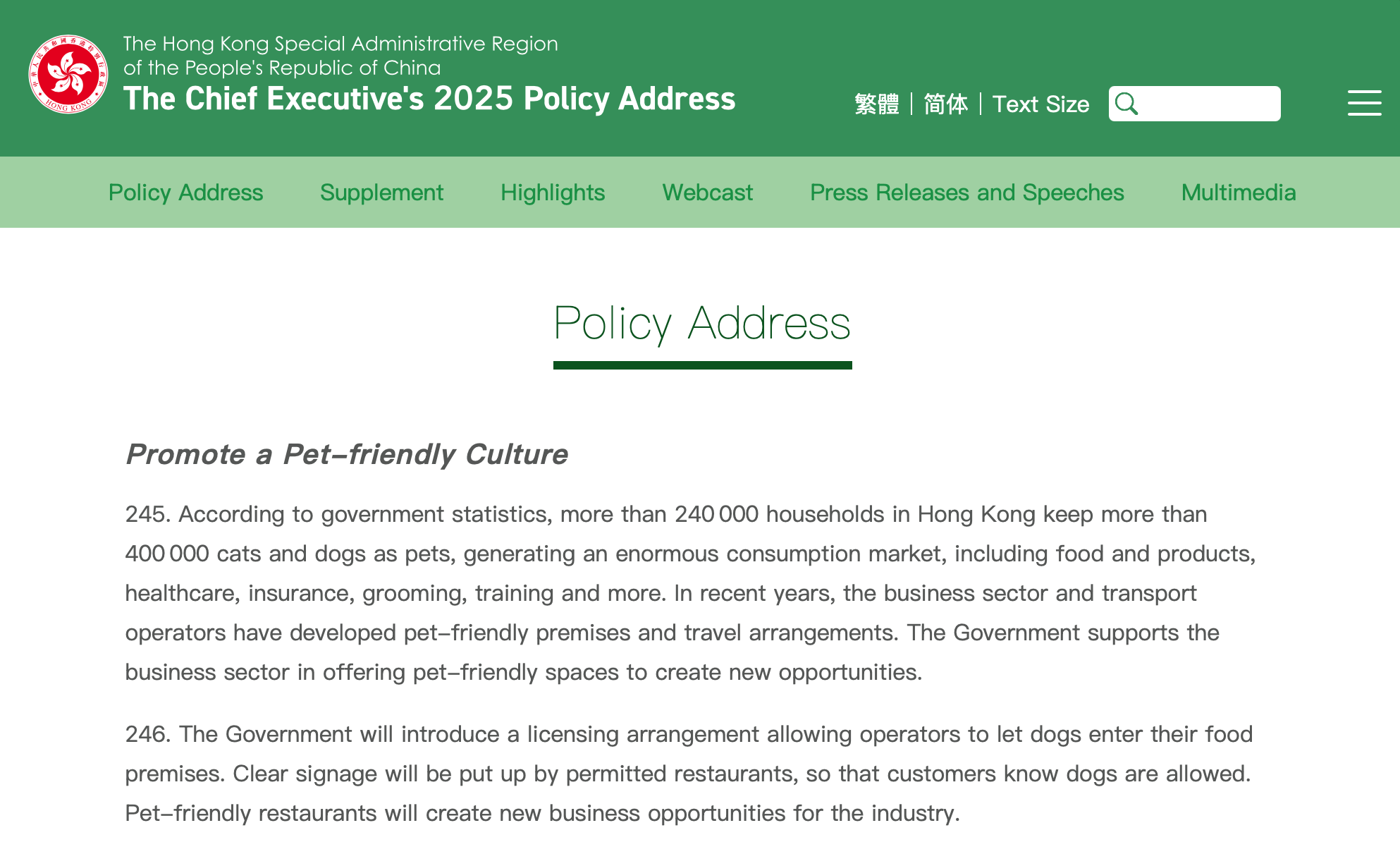
The Government Policy Address of 2025 (Source: https://www.policyaddress.gov.hk/2025/en/p245.html)
This new policy isn’t a free-for-all—It would be characterized as a careful, almost tender, first step. Only restaurants that apply and meet the licensing requirements can join. Dogs must be on a leash no longer than 1.5 meters, must stay out of food preparation areas, and must be neither “fighting dogs” nor “known dangerous dogs”. There are also simple, sensible rules: no cooking dog food on site, no sharing human utensils, no dogs on tables, and no open flames at tables where dogs are present. These rules are meant to keep everyone, both two-legged and four-legged, safe.
With only 500 to 1,000 permits (roughly 3% to 5% of all eateries in Hong Kong) initially available – and strict conditions around space, hygiene, and dog supervision—the first phase of the policy is intentionally cautious. In the government response from the Environment and Ecology Bureau issued on 2 April, 2026, it is said that the Guidelines of Good Practice and Behavior (“Guidelines”) is to be issued by FEHD for reference by restaurant operators and customers bringing dogs. There are indeed strict conditions. For instance, the Guidelines “will recommend that each adult customer should bring no more than two dogs and where dogs are allowed indoors (not only in outside seating accommodation), operators may actively consider installing air-filtration devices as appropriate.” As for the application quota, the allocation in the first phase will be made by balloting. If the First Phase operates smoothly, applications for the next phase may be invited around six months after its launch, subject to review and necessary refinements.
When the new policy was announced, reactions were mixed.

Karina O’Carroll (Source: Cecilia Dong)
“I do think it’s a good step in the right direction, but as a pet guardian myself, I think there’s definitely a lot of things to consider from all sides: from the owner of the pet to the restaurant or establishment, we need to consider a lot of different things.”
Through an online interview via Zoom, Karina O’Carroll, the Animal Welfare Education Manager who has been with Animals Asia for almost 16 years, greeted the city’s new policy with what she calls “tentatively hopeful” optimism – but together with the hope, she said, there is a deep awareness of the obstacles ahead.
She thinks the new policy is good, yet she immediately stresses that genuine progress requires far more than a regulatory change. For O’Carroll, the central question is not whether the law allows dogs into restaurants, but whether individual pet owners are ready to take on the responsibility that comes with that freedom.
“The question people need to ask themselves is: is my dog going to be okay with this?” she says. Dogs, she notes, have personalities just like people; some are simply not suited to the noise, crowds, and confinement of a dining space. Dragging a reluctant dog to a café just because the owner wants the experience, she warns, risks turning a well‑intended policy into a source of misery for the animal and conflict for people.
What worries O’Carroll most, however, is not the policy itself but the fragility of public acceptance. “I’m just waiting for one incident to happen,” she says. “And it’ll all go wrong for everybody again.” A single dog bite, a hygiene complaint, or a piece of viral footage showing careless ownership could undo years of advocacy. She points to the wide spectrum of pet guardians – from the “super responsible” who think through every detail, to those who “may not be as responsible and don’t feel like they’re doing anything wrong.” That gap, she argues, is the real fault line. “If we want to have a harmonious balance in society between pet owners and non‑pet owners, there definitely needs to be a higher level of responsible behavior from the guardians of pets.”
“As pet lovers, we are definitely strongly in favor of the policy. And I think opponents are not necessarily against pets themselves – they are against owners who don’t restrain their pets well.”

Leo Ping Hong Ng (Source: Cecilia Dong)
Leo Ng, a veteran volunteer and co‑founder of a Hong Kong animal rescue group, welcomes the new dog‑dining policy with open arms, because it finally gives dogs legal access to more spaces. But he also understands the opposition. Echoing O’Carroll’s opinion, Leo also believes that the real challenge is not the policy itself but owner responsibility. “If everyone showed more restraint and respect for others, the policy would work much better,” he says.
Beyond the dining table, Ng sees the policy as a small but meaningful step toward a more pet‑inclusive Hong Kong. He points to the shaggy breeds that suffer in the city’s summer heat – Alaskan malamutes, Samoyeds, golden retrievers, and also short‑nosed dogs like French bulldogs.
“Being able to enter an air‑conditioned space is a huge improvement for them,” he explains. Hygiene, he argues, is manageable: many restaurants already have waterproof outdoor areas for pets to relieve themselves or ask owners to put “politeness pants” (dog diapers) on their pets before entering.
Yet Ng’s deepest worries come from several different aspects. First, he points out that space is a real constraint: “Hong Kong’s biggest limitation is land. If you don’t have enough room for large dog breeds or space to separate dogs from other diners, you can’t manage it well.”
Second, most restaurants that welcome pets are in indoor shopping centers; therefore, getting the mall’s consent is a prerequisite for applying a license. Another barrier he sees within this policy is about the facilities. “Whether the mall has the necessary supporting facilities, for instance, to allow animals to go from the car park to the restaurant, is a crucial factor to be considered. If the mall has few such facilities, owners will most likely not bring their pets to dine there.”
Ng also highlights a quiet economic reality: pet owners are among the few groups still spending locally, because dogs cannot easily go north to mainland China. “If the government ever allows pets to cross the border freely, even fewer restaurants will apply for this license,” he says. But Leo hopes that people can focus their attention on the welfare of these furry friends, rather than just on the commercial value that pet owners like him can bring. He says that “beyond this policy, we have many other aspirations. We want to see stronger animal protection laws and fewer acts of cruelty.”
Ng’s message is both hopeful and grounded: the policy can be a start, but to steadily build a pet‑friendly society, better infrastructure, responsible owners, and a uniquely Hong Kong approach – neither solely relying on animal euthanasia nor remaining static, are needed.
“When I first learned about this policy, as someone who deeply cares about animal welfare, I was absolutely overjoyed. I felt that Hong Kong society is finally making progress. I also believe this policy can help people – whether they own pets or not – to better understand dogs, including their habits and body language.”

Sally Lee, shop manager of Petizen (Source: Cecilia Dong)
“We can’t use open flames, and food storage is limited,” she explains. Worse, the FEHD conducts regular inspections; if a dog is spotted inside during a spot check, a warning follows. “We have to ask customers to wait outside,” she says.
Despite these hurdles, Lee has found ways for her business to thrive. Her seats are all outdoors, which keeps her within existing regulations. Hygiene is managed through daily cleaning and using items designed for pets’ excrement. Fortunately, most of her neighbors are dog owners themselves and understand basic etiquette.
When asked about the biggest management challenge, she points to conflicts between dogs. “Not everyone reads canine body language,” she says. “You have to step in before a fight happens.” Her staff all have pets, which helps, but she thinks offering formal training in the future is also quite necessary.
Like O’Carroll, Lee is cautiously optimistic about the policy. Her advice to newcomers is practical: post clear house rules at the entrance; communicate them thoroughly to the guests; learn about dog behaviors and body languages; and if space allows, separate small dogs from large ones. The policy is a welcome step, she says, but success will depend on careful management, responsible guardians, and a willingness to learn.
The restaurant policy triggers a broader question to consider: how pet‑friendly is Hong Kong? Dogs in restaurants may appear as a symbolic and practical step forward, but it is only one piece of a much larger puzzle. In other areas – public transport, housing, animal welfare legislation, and enforcement – Hong Kong still has considerable room for improvement.
Silver Linings: Where Hong Kong Gets It Right
O’Carroll, who has lived in Hong Kong for 30 years, says she “can definitely see that there is a lot more compassion and more people who care about animals.”
She’s also witnessed a “generational difference” in the field of animal care. “The younger generations,” she says, “are a bit more attuned to animal welfare and protection.”

Julie Tse, the founder of an animal rescue group (Source: Cecilia Dong)
Julie Tsui, the founder of an animal rescue group and an insurance consultant, highlights Hong Kong’s increasingly mature insurance market for pets, where “even a simple pet insurance or home insurance can cover third‑party liability,” giving owners a safety net.
Others see the new restaurant policy as a sign that the government is willing to test the waters. As Professor Amanda Whitfort, a legal expert dedicated to animal laws in Hong Kong from the Faculty of Law at the University of Hong Kong, says in an online interview, “any way to make responsible ownership easier for the public is a positive step forward.”

Amanda Whitfort (Source: Faculty of Law at the University of Hong Kong)
Challenging shadows: the Existing Barriers
Public Transport: The Missing Link
The most frequently cited frustration among interviewees was transport. O’Carroll, who has worked with Animals Asia for 16 years, puts it bluntly: “Not every volunteer has a private car. Getting dogs from A to B in Hong Kong is a major issue.”
She recalls that Animals Asia spent 18 months negotiating with the MTR for just one day of therapy‑dog access. Ng also agrees that if the MTR had dedicated pet carriages, it would be a game changer for a more comprehensive future of pet‑friendliness. He believes that such efforts can attract more tourists, and also make local Hong Kong people like the city more. Currently, without reliable public transport options, many pet owners are forced to drive or pay extra for taxi transport – a barrier that excludes a large segment of the population.

The route of the pet bus (source: the Kowloon Motor Bus site, https://www.kmb.hk/)
In 2024, Hong Kong’s Kowloon Motor Bus launched a “Pet Bus Tour” for weekend and public holiday travel. And at the end of January 2026, KMB expanded the service scope of this pet-friendly route. Bus routes remain limited and don’t reach as many places as the MTR, but it has given pet owners more options for traveling with pets.
Legal Protection: Outdated and Under Enforced
In the area of animal protection, change has been slow. In April 2026, the AFCD responded to the Office of The Ombudsman, updating its departmental guidelines in the fourth quarter of 2025. The AFCD stated that it will “actively follow up to” The Ombudsman’s recommendations, such as amending the Prevention of Cruelty to Animals Ordinance in stages.
However, Hong Kong’s main animal welfare law, the Prevention of Cruelty to Animals Ordinance(Cap. 169), uses a core framework that dates back to 1935 – a fact that critics call “badly outdated”.
The long‑proposed “duty of care” amendment, which would allow authorities to intervene before an animal begins to suffer, has been stuck in legislative limbo for years. Since 2019, the government has proposed to “impose a positive duty of care on people who are responsible for animals,” indicating that humans must take action to protect animals from suffering, illness, and harm as well as to meet their welfare needs. However, until recently, “duty of care” standards were not being imposed. In a February 2026 Legislative Council session, Tse Chin-wan, Secretary for Environment and Ecology, said this was because “the Government understands there are divergent views among stakeholders on the introduction of ‘Duty of Care’ at this stage and the penalty level for animal cruelty”.
It’s a contentious issue, and people are hesitant to speak out publicly. “Duty of care is a well‑established concept in the UK, Australia, and the US now,” one interviewee notes, “but we’re still lagging behind in Hong Kong, and it’s taking forever.”
Even when laws do exist, enforcement remains weak. “We have all these fancy laws, but if nobody enforces them, they are pointless,” another source adds, “we need the laws in place, and we need enforcement when they come into place.”
Housing: A Barrier to Responsible Ownership
Housing policy remains Hong Kong’s most powerful obstacle to pet‑friendliness. Professor Whitfort notes that “the main reason animals are returned by adopters is housing issues.”
Many public housing estates ban pets outright, forcing residents to choose between their home and their companion. Ng, guardian of two dogs, says that a big reason he chose his current neighborhood is because it is pet-friendly. “The government should be actively assisting by building pet‑friendly public housing,” he argues.
Housing restrictions are not limited to public estates; private residential buildings often have their own rules that prohibit or severely limit pet ownership, and the lack of pet‑inclusive design can make daily life difficult for those who do keep animals. Until housing policy catches up, adoption rates are likely to stay low, and abandonment will remain a persistent problem.
Space and Overpopulation of Pets: The Hong Kong Squeeze
While Hong Kong’s lack of space is often cited as a barrier to pet‑friendliness, other structural problems remain urgent. O’Carroll points out that the city has an overpopulation issue, with too many pet animals in need of homes.
Without a territory‑wide program of free desexing or trap‑neuter‑return (TNR), the number of stray and abandoned animals continues to strain shelters and public resources. This concern is echoed by Ng, who observes that even existing animal welfare organizations struggle with capacity. He notes that many animals, especially older or less “marketable” ones, remain unadopted and may eventually be euthanized.
In his experience, the most practical solution is to focus on sterilization first: “take in animals, neuter them, and then return them to their original place.” Yet neither the government nor the public sector has provided sufficient resources to scale up such efforts.
O’Carroll laments that “there’s often not enough financial government or legislative support” for frontline animal welfare work. Professor Whitfort, in her analysis, also lists “Territory‑wide TNR for feral dogs by AFCD” as one of the top three priorities for Hong Kong’s animal welfare legal framework – a goal that remains largely unfulfilled.
