
A Place to Land
Hong Kong’s Urban Parrots
by Huan Ran & Zhang Linzhuo
For residents living near urban parks in Hong Kong, a high-pitched squawk that comes in bursts may be a familiar sound in the quiet morning.
At a casual glance up, a flock of snow-white birds with flashing yellow crowns can be seen flying overhead and landing on branches and light poles.
Many may not realize they are looking at one of the world’s rarest birds: the yellow-crested cockatoo.
But for scientists, the birds’ presence is more than a familiar part of the cityscape. It represents a rare conservation opportunity for protecting an endangered species in Hong Kong.
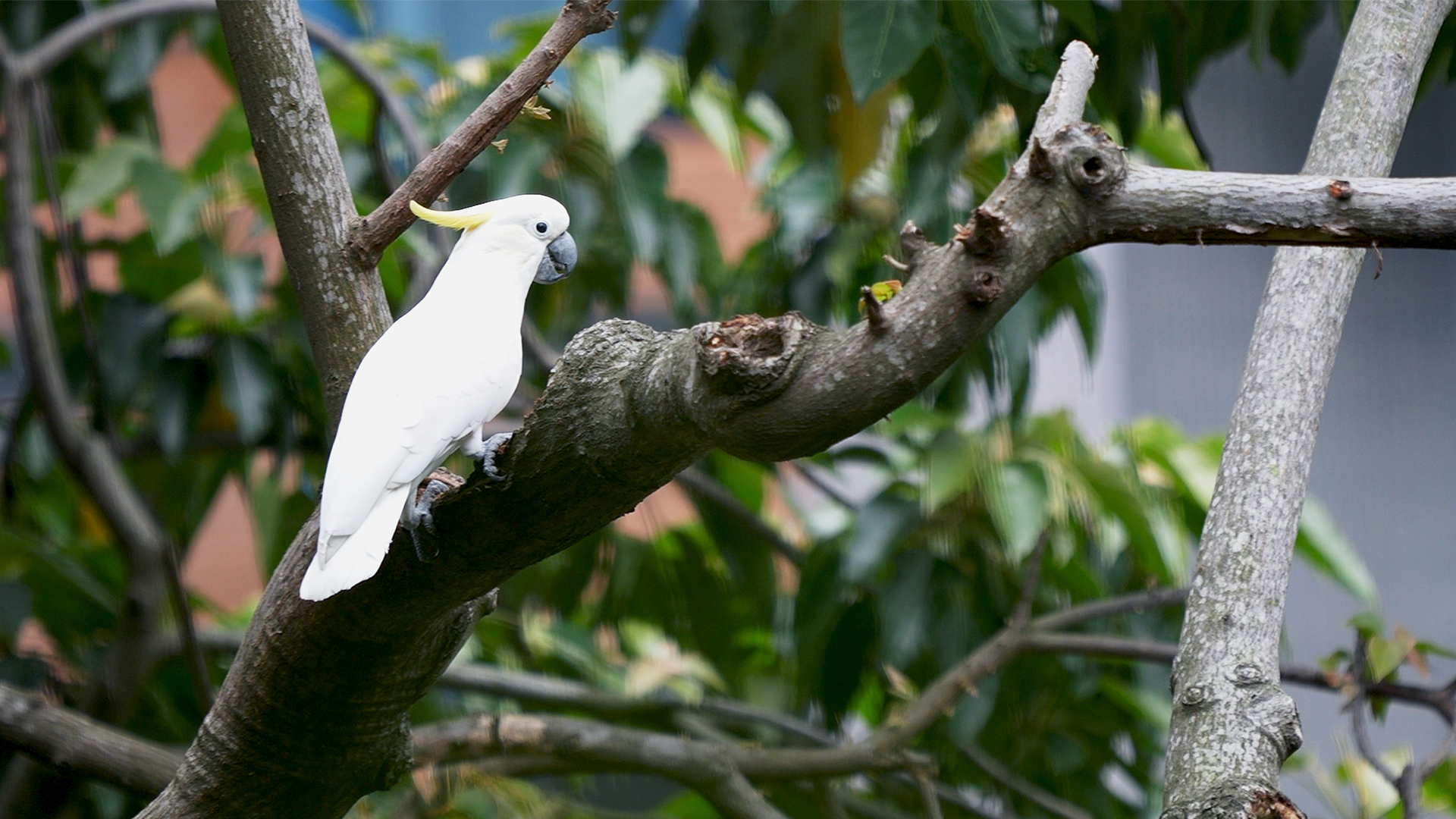
A yellow-crested cockatoo rests on a branch on the University of Hong Kong campus. (Ran Huan)
Native to Indonesia and East Timor, yellow-crested cockatoos have established one of their largest habitats on northern Hong Kong Island, home to about 10% of the global wild population.
The species is critically endangered, with only 1,200 to 2,000 mature individuals remaining in the wild worldwide, according to the International Union for Conservation of Nature (IUCN). Other populations are scattered across Indonesia’s Lesser Sunda islands and Sulawesi, as well as East Timor.
In their native habitats, the species’ numbers have plummeted due to decades of over-exploitation for the exotic pet trade, alongside rapid deforestation and climate change. Few places still host a “large and cohesive” flock like Hong Kong’s, which researchers say can be critical for the survival of the species.
“They are in a relatively safe environment here. It can be a good backup population to ensure that the species won’t go extinct on the planet,” said Astrid Andersson, a postdoctoral researcher at the University of Hong Kong, who has studied the species for nearly a decade.
But in recent years, the same pressures that have brought down the number of cockatoos in their native range, especially habitat loss and demand from the pet trade, have begun shaping what happens here.
For residents living near urban parks in Hong Kong, a high-pitched squawk that comes in bursts may be a familiar sound in the quiet morning.
At a casual glance up, a flock of snow-white birds with flashing yellow crowns can be seen flying overhead and landing on branches and light poles.
Many may not realize they are looking at one of the world’s rarest birds: the yellow-crested cockatoo.
But for scientists, the birds’ presence is more than a familiar part of the cityscape. It represents a rare conservation opportunity for protecting an endangered species in Hong Kong.
A yellow-crested cockatoo rests on a branch on the University of Hong Kong campus. (Ran Huan)
Native to Indonesia and East Timor, yellow-crested cockatoos have established one of their largest habitats on northern Hong Kong Island, home to about 10% of the global wild population.
The species is critically endangered, with only 1,200 to 2,000 mature individuals remaining in the wild worldwide, according to the International Union for Conservation of Nature (IUCN). Other populations are scattered across Indonesia’s Lesser Sunda islands and Sulawesi, as well as East Timor.
In their native habitats, the species’ numbers have plummeted due to decades of over-exploitation for the exotic pet trade, alongside rapid deforestation and climate change. Few places still host a “large and cohesive” flock like Hong Kong’s, which researchers say can be critical for the survival of the species.
“They are in a relatively safe environment here. It can be a good backup population to ensure that the species won’t go extinct on the planet,” said Astrid Andersson, a postdoctoral researcher at the University of Hong Kong, who has studied the species for nearly a decade.
But in recent years, the same pressures that have brought down the number of cockatoos in their native range, especially habitat loss and demand from the pet trade, have begun shaping what happens here.
A Housing Crisis in the Tree Canopy
When cockatoos were imported as pets from the 1960s through the 1990s, Hong Kong’s urban parks, with abundant exotic and fruit trees, provided an ideal habitat for them to survive and grow in number.
Today, however, that growth has stalled. After 10 years of monitoring the local population, Andersson noted that their numbers have stagnated, with fewer juveniles each year.
The problem may be the loss of nesting spaces, Andersson said. The cockatoos don’t make a nest; instead, they need an existing tree cavity to lay eggs and raise their chicks.
Andersson has observed an 80 percent decrease in the number of natural nests over the last decade. Trees with large enough cavities are often older and more fragile, making them vulnerable to typhoons and more likely to be trimmed by the government for public safety.
Last year, Andersson began a project to install artificial nest boxes designed to mimic natural tree hollows and expand the birds’ nesting options. Her team aims to install 50 boxes across Hong Kong Island over the next few years, targeting areas where the population is most concentrated.
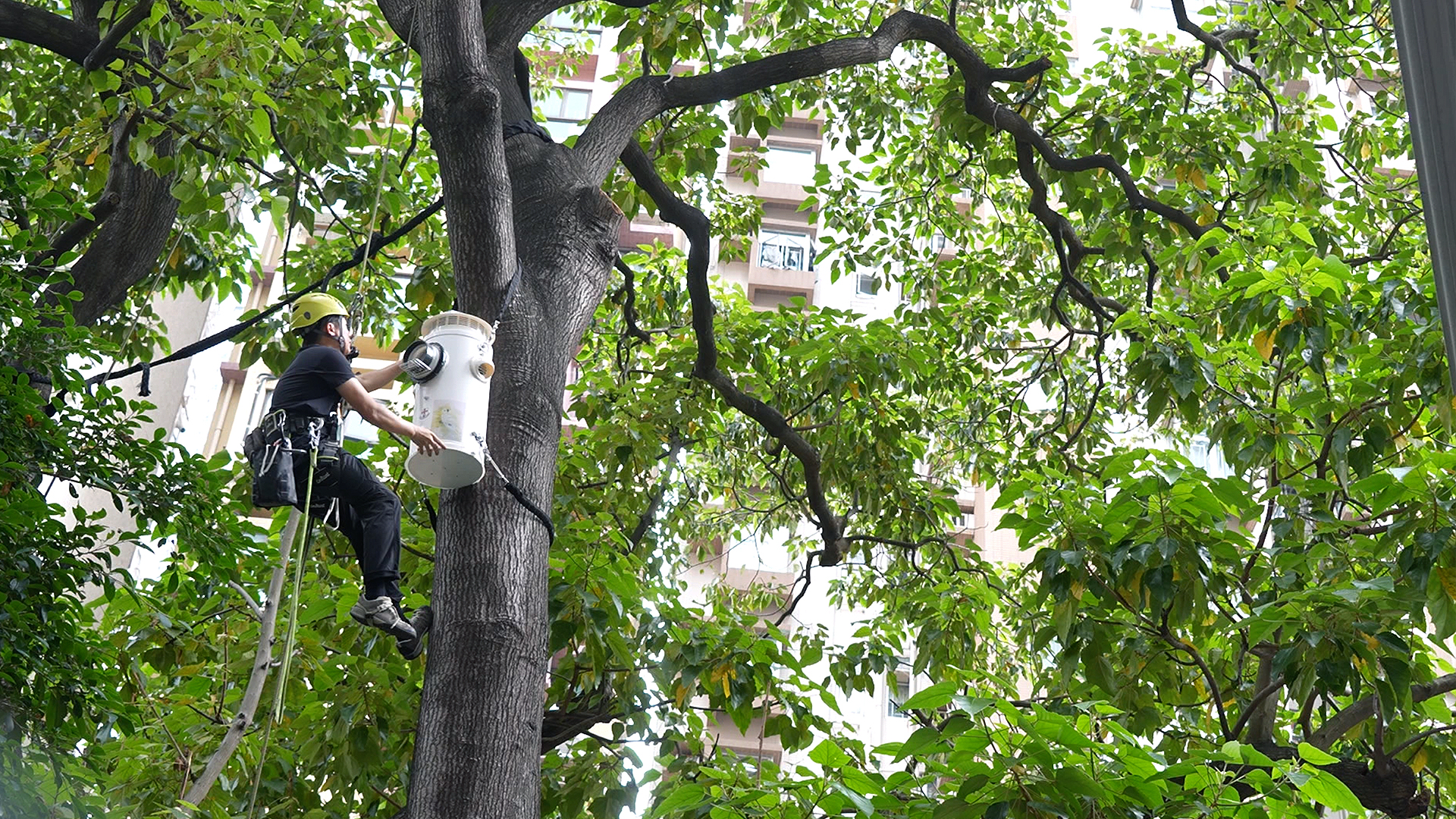
Harry Wong, who has partnered with Astrid Andersson on the nest box project, installs an artificial nest box on the campus of St. Louis School in Sai Ying Pun. (Ran Huan)
So far, 11 boxes have been installed, with four more planned before this year’s breeding season. Andersson said the project has moved faster than expected. Three of the boxes have already attracted cockatoos, including one on the University of Hong Kong campus that a pair began visiting within months of installation.
That early response was an encouraging surprise, she said, because birds may take several breeding seasons to accept an artificial nest box. They can be wary of entering a man-made structure, or may not discover it at all.
One of the boxes is secured high on a tree on the HKU campus, visible from a busy pathway where students pass by every day. A pair of cockatoos perched nearby, their loud squawks breaking through the campus background noise and drawing glances upward from passersby.
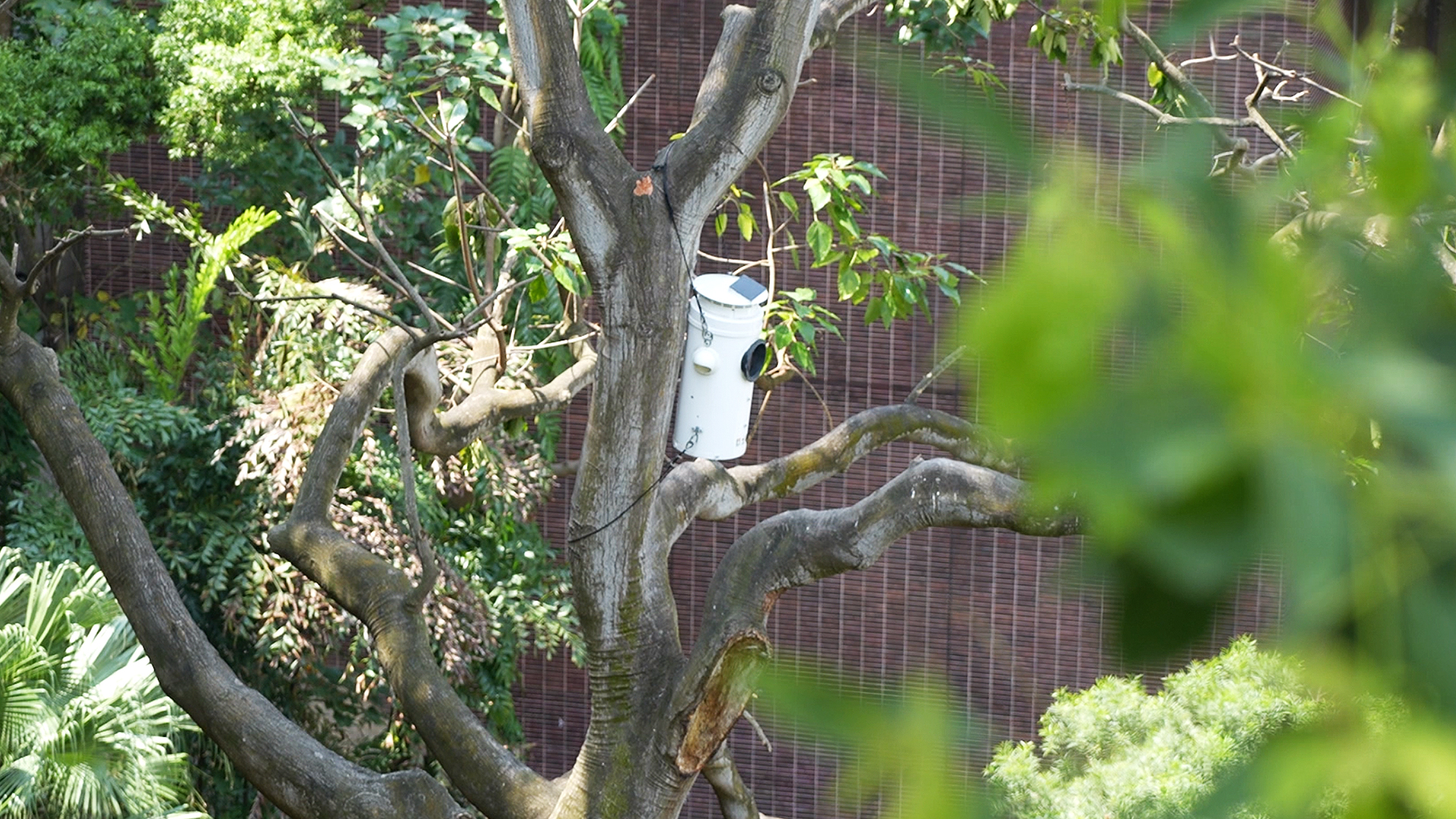
An artificial nest box installed by Astrid Andersson’s team for yellow-crested cockatoos hangs on a tree on the University of Hong Kong campus. (Ran Huan)
“This year’s breeding season hasn’t started yet,” she said. “But we hope that we will see some egg laying and some chicks hatching.”
The nesting box design is now in its third version. With cameras installed inside and powered by solar panels, Andersson will be able to monitor the birds in real time. This provides rich data on cockatoos’ breeding behavior, which hasn’t been extensively studied due to their rarity.
When cockatoos were imported as pets from the 1960s through the 1990s, Hong Kong’s urban parks, with abundant exotic and fruit trees, provided an ideal habitat for them to survive and grow in number.
Today, however, that growth has stalled. After 10 years of monitoring the local population, Andersson noted that their numbers have stagnated, with fewer juveniles each year.
The problem may be the loss of nesting spaces, Andersson said. The cockatoos don’t make a nest; instead, they need an existing tree cavity to lay eggs and raise their chicks.
Andersson has observed an 80 percent decrease in the number of natural nests over the last decade. Trees with large enough cavities are often older and more fragile, making them vulnerable to typhoons and more likely to be trimmed by the government for public safety.
Last year, Andersson began a project to install artificial nest boxes designed to mimic natural tree hollows and expand the birds’ nesting options. Her team aims to install 50 boxes across Hong Kong Island over the next few years, targeting areas where the population is most concentrated.
Harry Wong, who has partnered with Astrid Andersson on the nest box project, installs an artificial nest box on the campus of St. Louis School in Sai Ying Pun. (Ran Huan)
So far, 11 boxes have been installed, with four more planned before this year’s breeding season. Andersson said the project has moved faster than expected. Three of the boxes have already attracted cockatoos, including one on the University of Hong Kong campus that a pair began visiting within months of installation.
That early response was an encouraging surprise, she said, because birds may take several breeding seasons to accept an artificial nest box. They can be wary of entering a man-made structure, or may not discover it at all.
One of the boxes is secured high on a tree on the HKU campus, visible from a busy pathway where students pass by every day. A pair of cockatoos perched nearby, their loud squawks breaking through the campus background noise and drawing glances upward from passersby.
An artificial nest box installed by Astrid Andersson’s team for yellow-crested cockatoos hangs on a tree on the University of Hong Kong campus. (Ran Huan)
“This year’s breeding season hasn’t started yet,” she said. “But we hope that we will see some egg laying and some chicks hatching.”
The nesting box design is now in its third version. With cameras installed inside and powered by solar panels, Andersson will be able to monitor the birds in real time. This provides rich data on cockatoos’ breeding behavior, which hasn’t been extensively studied due to their rarity.
A Market in the Shadows
While the nest boxes address the birds’ “housing” problem, Andersson said the illegal pet trade remains a parallel risk.
She has been informed of a few incidents in which people have climbed into natural nests and grabbed chicks to sell in the market, which poses a threat to wild cockatoo populations. “Every chick is very valuable because they have such limited space to reproduce,” she said.
Hong Kong bans the commercial trade in wild-caught yellow-crested cockatoos, following the species’ uplisting to Appendix I of the Convention on International Trade in Endangered Species (CITES) in 2005. But birds bred in captive facilities with a valid CITES license can be legally traded.
Sharon Kwok Pong, founder of Hong Kong Parrot Rescue, said her group has handled roughly a dozen rescue cases involving yellow-crested cockatoos, including birds surrendered by owners who could no longer keep them. Kwok said cockatoos can live up to 80 years, and many were bought legally as pets long before the ban took effect.
“I catch a glimpse of a shop or two on Bird Street, which still has cockatoos. If they see me, they will say they are not selling it. It’s an old bird,” she said. “But I don’t think that is true because I can tell the bird is very young.”
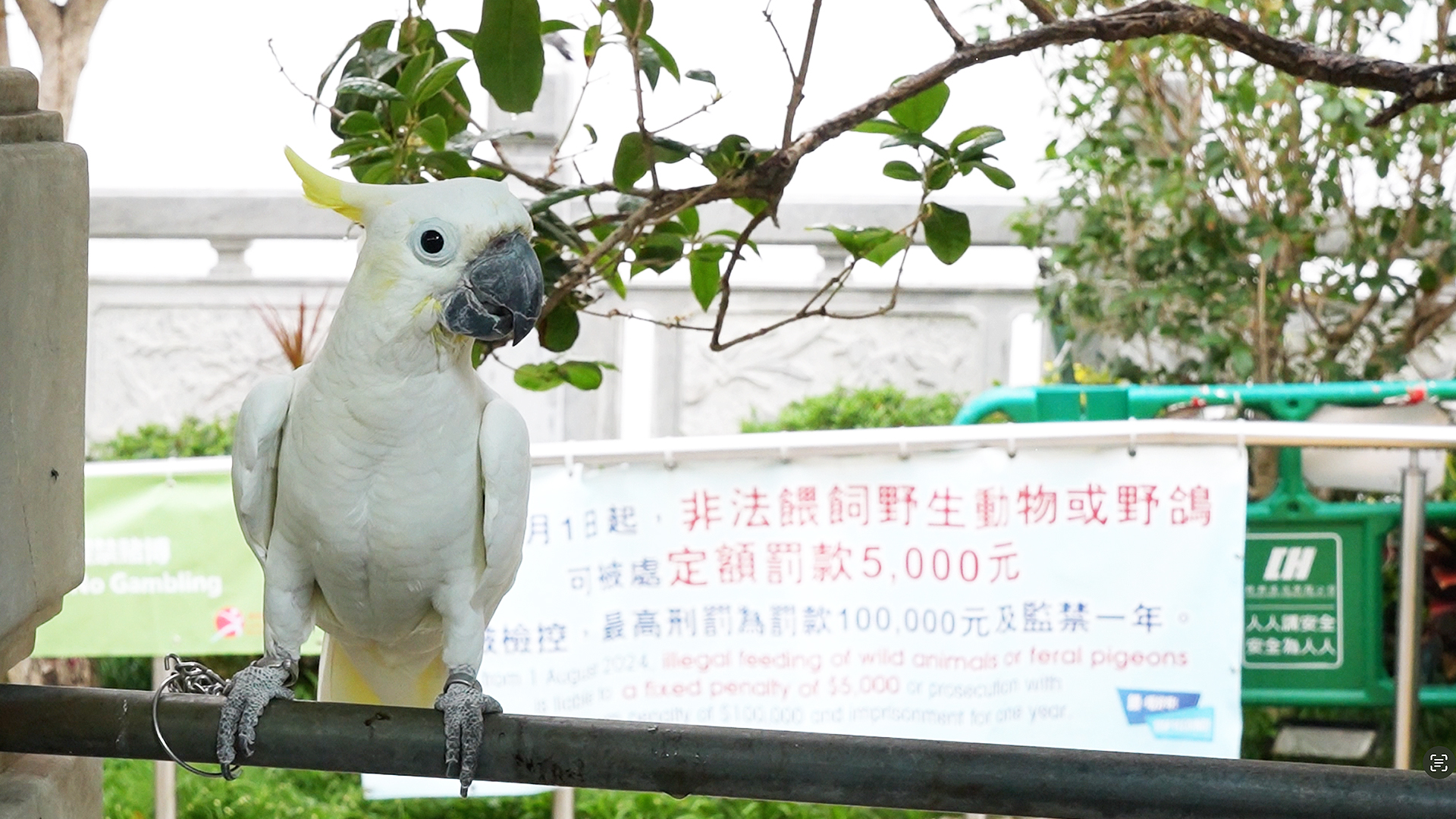
A captive cockatoo perches on a railing at Bird Garden in Mong Kok. (Ran Huan)
At the practical level, it can be hard to distinguish whether a bird displayed at the market is wild-caught or captive-bred without scientific techniques, said Chloe Hatten, a wildlife trade specialist and junior research fellow at Lingnan University.
Legally, captive-bred cockatoos should be tagged with a leg ring and have documentation to prove their origin. But Hatten said those are not reliable evidence.
“Because animals within a species all look the same, regardless of whether it is captive or wild,” she said. “If you’re a trader, you could just put a tag that symbolizes captivity. It’s quite easy to fabricate the permits that are required.”
A 2017-2018 market survey conducted by Andersson found 33 yellow-crested cockatoos for sale at a bird market in Mong Kok. This number has more than tripled the amount legally imported since 2005. According to the survey, these birds could be from home breeders, trafficking from abroad, or poaching from the local wild population.
Hatten said a forensic tool has been developed to help distinguish wild-caught birds from captive ones. By analyzing the chemical signatures within a bird’s feathers, scientists can infer whether its diet more closely matches a captive or wild environment.
While the nest boxes address the birds’ “housing” problem, Andersson said the illegal pet trade remains a parallel risk.
She has been informed of a few incidents in which people have climbed into natural nests and grabbed chicks to sell in the market, which poses a threat to wild cockatoo populations. “Every chick is very valuable because they have such limited space to reproduce,” she said.
Hong Kong bans the commercial trade in wild-caught yellow-crested cockatoos, following the species’ uplisting to Appendix I of the Convention on International Trade in Endangered Species (CITES) in 2005. But birds bred in captive facilities with a valid CITES license can be legally traded.
Sharon Kwok Pong, founder of Hong Kong Parrot Rescue, said her group has handled roughly a dozen rescue cases involving yellow-crested cockatoos, including birds surrendered by owners who could no longer keep them. Kwok said cockatoos can live up to 80 years, and many were bought legally as pets long before the ban took effect.
“I catch a glimpse of a shop or two on Bird Street, which still has cockatoos. If they see me, they will say they are not selling it. It’s an old bird,” she said. “But I don’t think that is true because I can tell the bird is very young.”
A captive cockatoo perches on a railing at Bird Garden in Mong Kok. (Ran Huan)
At the practical level, it can be hard to distinguish whether a bird displayed at the market is wild-caught or captive-bred without scientific techniques, said Chloe Hatten, a wildlife trade specialist and junior research fellow at Lingnan University.
Legally, captive-bred cockatoos should be tagged with a leg ring and have documentation to prove their origin. But Hatten said those are not reliable evidence.
“Because animals within a species all look the same, regardless of whether it is captive or wild,” she said. “If you’re a trader, you could just put a tag that symbolizes captivity. It’s quite easy to fabricate the permits that are required.”
A 2017-2018 market survey conducted by Andersson found 33 yellow-crested cockatoos for sale at a bird market in Mong Kok. This number has more than tripled the amount legally imported since 2005. According to the survey, these birds could be from home breeders, trafficking from abroad, or poaching from the local wild population.
Hatten said a forensic tool has been developed to help distinguish wild-caught birds from captive ones. By analyzing the chemical signatures within a bird’s feathers, scientists can infer whether its diet more closely matches a captive or wild environment.
A Sanctuary in the Concrete Jungle
With the loss of nesting sites and trade pressure continuing to be a concern, Andersson said the nest boxes are designed to tackle both problems at once. They provide cockatoos with more secure breeding sites, while cameras inside the box allow monitoring and may deter people seeking to poach chicks.
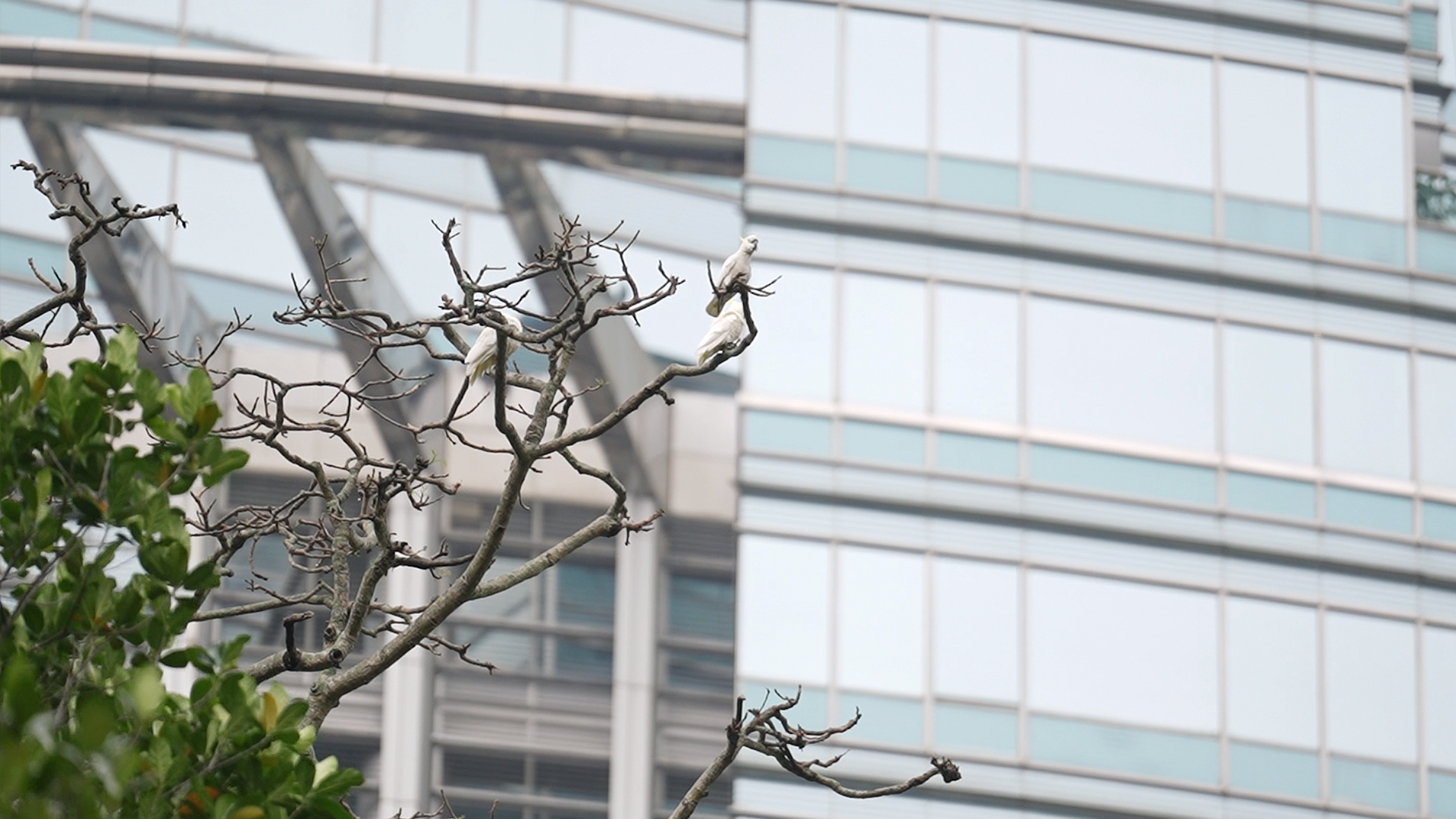
Yellow-crested cockatoos perch on a bare tree in Hong Kong Park, with office towers rising behind them. (Ran Huan)
As the breeding season approaches, the yellow-crested cockatoos continue to fly above the city’s bustling commercial district. Andersson views Hong Kong’s flock as a positive conservation opportunity.
“We have a critically endangered species that is surviving even in the central business district,” she said. “We can think of solutions that help support them and show the world how, even in a highly urbanized environment, human and wildlife can coexist.”
With the loss of nesting sites and trade pressure continuing to be a concern, Andersson said the nest boxes are designed to tackle both problems at once. They provide cockatoos with more secure breeding sites, while cameras inside the box allow monitoring and may deter people seeking to poach chicks.
Yellow-crested cockatoos perch on a bare tree in Hong Kong Park, with office towers rising behind them. (Ran Huan)
As the breeding season approaches, the yellow-crested cockatoos continue to fly above the city’s bustling commercial district. Andersson views Hong Kong’s flock as a positive conservation opportunity.
“We have a critically endangered species that is surviving even in the central business district,” she said. “We can think of solutions that help support them and show the world how, even in a highly urbanized environment, human and wildlife can coexist.”
Extra Credits
Advisor
John Noonan
Editor in Chief
Clarisse Choo
Creative Directors
Syrena Jin
Cheryl Xie
Serena Zhou
Managing Editor
Jiachen Li
Copy Editor
Andy Huang
Visual Producer
Isco Zhang
