
The Micro-Drama Factory
by Cheng Lisheng
Inside a filming studio in Dongguan earlier this summer, rookie actress Lu Mengting wrapped up two scenes in less than 10 minutes. First, she played a nurse checking a beeping monitor in a hospital setting, a stethoscope around her neck. Moments later across the same room, she was positioned in a dim prison meeting an inmate.
Her entrance into the micro drama factory was as fast as the sets revolve. 10 days earlier, she was just another high school student absorbed in five-minute micro-dramas. After just 16 hours of free actor training, the 16-year-old Lu was on set, stepping into her first role.
She had no agent, no contract, and was still preparing for exams.
Rather than attending classes, Lu spent her days at the Shudian Vertical Studio, an 8,000-square-meter labyrinth of 108 modular sets, ranging from hospital rooms and prison cells to office conference rooms and underground casinos. Every inch is designed to save time.

At Shudian Film Base, the hospital, prison, and conference room are just a wall apart, only a minute’s walk away. (Source: Shudian Film Base)
The studio is a condensed version of the ecosystem of the broader micro-drama industry, in which production operates on a model of total compression. Space is folded. Entry barriers are lowered. Time is treated as the primary currency.
As the market expands, micro-dramas have become a high-speed ‘dream factory,’ a product native to the platform economy. It provides a new gateway for young actors and a survivalist “second chance” for film and advertising professionals fleeing a cooling traditional market. However, what sustains this massive engine is rarely the craft; but a system of punishing schedules, fragile labor protections, and a creative order dictated strictly by the logic of traffic and distribution.
By late 2025, China’s micro-drama industry was generating close to 90 billion yuan in annual output, nearly double the roughly 50.5 billion yuan recorded a year earlier. Micro-dramas were producing not only hits, but jobs. A 2025 industry report said the sector’s main production links had already created 1.333 million jobs, with related talent demand up 26% in the first three quarters of the year.
This institutionalized environment, where speed is the primary metric of labor, is what Zhou Liyan encountered upon arriving in Hengdian.
Less than a year after graduating from the performance program at Zhejiang University of Media and Communications, she moved to Hengdian, a town in eastern China often called the “Chinese Hollywood” for its sprawling film and TV studios. Renting a room, she pursued casting calls, submitted her profile, auditioned, and quickly entered one production after another.
She soon felt the full force of a production model built around time compression: shorter shooting schedules, lower budgets, page-driven shooting progress, and almost no time to prepare, rest, or recover.
“What shocked me the most was that the ‘Pass’ doesn’t belong to the director or the crew—it belongs to the clock,” Zhou said. Unlike longer productions where the crew can pause and adjust until a scene feels right, “On a micro-drama set, the call sheet rules: if a certain number of pages must be completed, they have to be completed.”
She remembers filming a scene where she was supposed to scream and cry. She flubbed a line and her tears hadn’t fully fallen, but the director insisted they move on, considering the take satisfactory.
This contrasted sharply with traditional film production, where lighting setups, positioning, and rehearsals might take hours. In micro-drama, scenes are modular, and the crew often just pivots the camera within the same room to capture a new angle.
Zhou said that actors often have to memorize lines on the spot, and that scripts are usually colloquial. What matters most, she explained, is hitting the right emotional tone rather than delivering lines perfectly. “You don’t have time to breathe; the next scene is already rolling,” she added.
Zhou recalled that a filming day could start as early as 5 a.m., before sunrise, and continue almost nonstop until 4 a.m. the following day, with actors pausing only for ten-minute meals while the rest of the time was spent on set.
The compressed schedule took a physical toll on her. She spent 12 hours in 10-centimeter heels and a short dress for a crying scene, pushing herself to the limits of endurance. “Even after the cameras stopped rolling, I couldn’t stop crying,” she recalled. To cope, she hired an assistant to help with quick costume changes, a small cost that made performing possible.
Interactive element generated with Claude Sonnet 4.6. All images and written content are real and sourced by the author.
Zhou’s experience reflects how young actors in the micro-drama industry face the challenges of compressed timelines. As for Li Jing, despite having worked in the industry for four years, the rapid expansion of the micro-drama market forced her to confront intense competition from newcomers flooding the industry.
Li entered the industry in 2022, often playing mothers or middle-aged antagonists. She found speed dictates nearly every aspect of production, with some series requiring nearly 100 episodes to be filmed in just three to five days, leaving almost no buffer time.
On one shoot, she received news on the first day that her grandfather had passed away, but since micro-dramas rarely leave room for actors, leaving would have delayed the entire schedule and might have even required recasting.
She negotiated with the crew to film the remaining scenes in advance. After a 14-hour shoot, she drove two hours to attend a funeral, managing only the burial before returning early the next morning to continue filming. “Micro-dramas don’t have that kind of flexibility,” Li said, contrasting them with longer productions.
Two months after giving birth to her second child, Li returned to set for a shoot that had originally been promised as half-day work with no night sessions. However, due to time constraints, the shooting was delayed into the late night.
As she had to pump breast milk every two hours, she had to sneak into the bathroom, as there was no designated nursing room on set. “It felt like a guerrilla war,” she said.
For Li, the challenge wasn’t just the intensity of the crew but the production model itself. “The production environment of micro-dramas is inherently temporary, compressed, and patchy,” she said.
Platforms have now directly entered the casting process, she said. She often went through auditions and received approval from directors, only to be told at the last moment that the role had been rejected. “Many roles are now decided by the platform, not the directors,” she said.
She had previously joined in the “Hongguo” platform, a short drama platform under ByteDance. Because she played a supporting role, the exposure didn’t lead to significant fan growth. Later, she was offered “fake fan data,” — fabricated followers, views, likes and comments used to inflate an actor’s apparent popularity, which she rejected. “Although fan data affects casting, I would rather let my audience grow slowly than buy fake popularity,” Li admitted. “The anxiety now is not just about acting, but whether or not I can make it onto the trending list and be recommended by the platform.”
Zhou Liyan echoed this. Leaderboard positions on the platform can shape both status and on-set conditions, with high-ranking actors receiving priority and sometimes influence the pace of filming, while lower-ranking newcomers having to follow the schedule with little room to negotiate. “Your traffic ranking and exposure don’t just affect respect—they determine the conditions you work under,” Zhou said.
Together, their experiences illustrate how the rise of micro-dramas has accelerated production and reshaped casting. In this system, an actor’s visibility, engagement, and leaderboard ranking determine who is cast, who receives priority on set, and how they are treated during filming, fundamentally changing the way actors are selected and managed.
Zhang Yuwei, CEO of Zhouye Media, a short-drama production company specializing in micro-dramas and platform-commissioned short-form series, noted a shift away from traditional creative judgment. In micro-dramas, he said, casting decisions are increasingly driven by three factors: an actor’s engagement and whether their followers convert to paid clicks, internal traffic circulation that favors talent signed with the platform, and whether the actor’s persona aligns with audience profiles generated by big data. In this platform‑led ecosystem, exposure and casting decisions no longer rest solely with directors and producers, but with algorithms and engagement metrics.
“Platforms run casting by the numbers,” said Zhang.
Production processes have also been transformed. Zhang explained that micro‑drama production has shifted from the traditional B2C model—where producers create content, distribute it, and then reach the audience—toward a Customer-to-Manufacture (CTM) approach. In this system, content is designed and released directly through the platform to viewers.
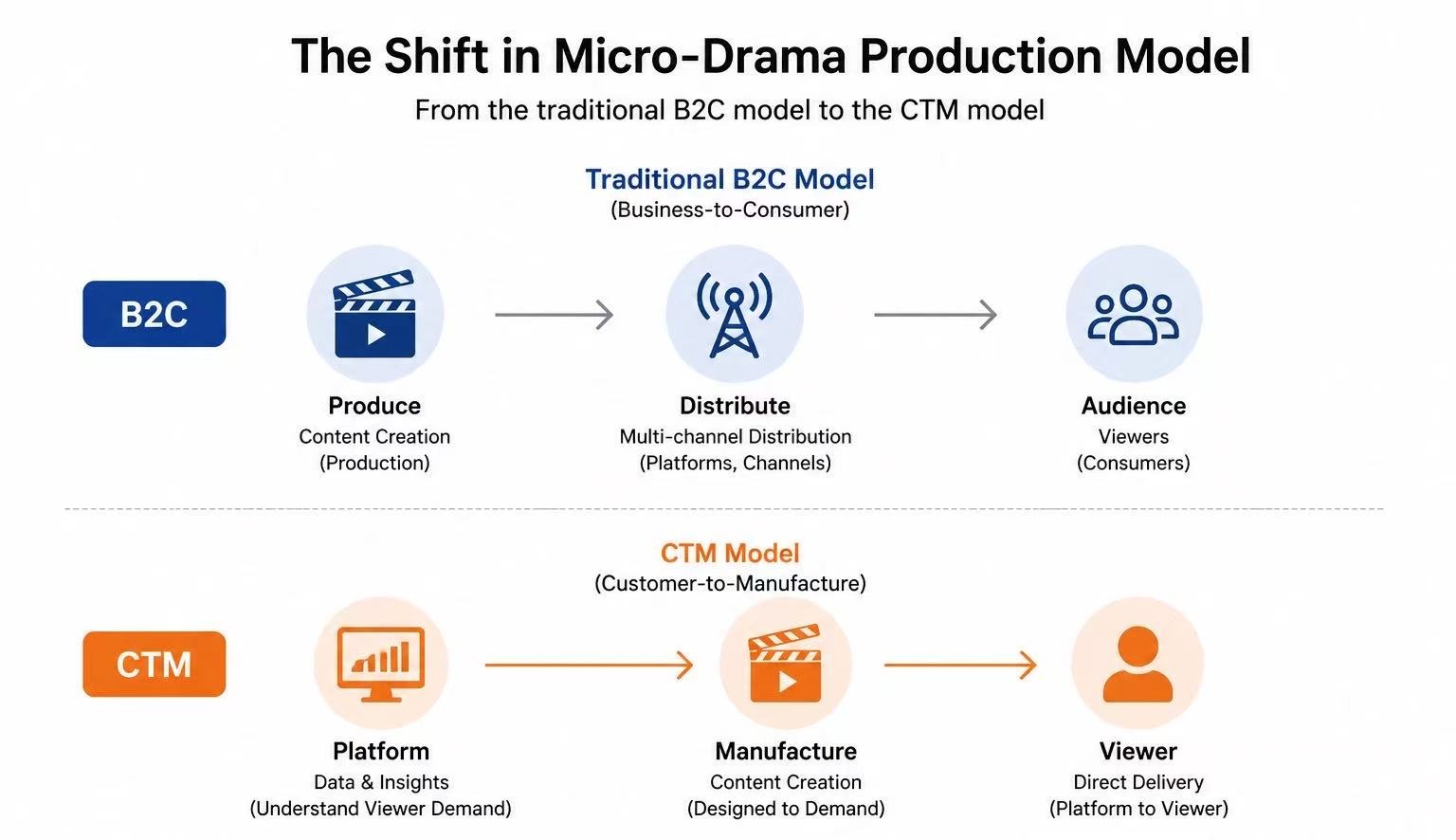
“The creative process no longer relies on the old production‑distribution chain; it goes straight to the audience through platforms,” Zhang said. As a result, production cycles are drastically compressed, and content is engineered around emotional impact rather than narrative complexity.
Platforms now also dominate distribution decisions, particularly paid traffic.
According to DataEye Research Institute’s 2025 H1 Micro‑Short Drama Industry Data Report, the scale of traffic purchasing for micro‑dramas grew substantially, with the market’s paid traffic investment rising from about ¥24.9 billion yuan in 2023 to approximately ¥33 billion in 2024.
Zhang said that in one platform‑executive project he oversaw, paid distribution costs exceeded the entire production budget by more than 100 times.
And according to reporting in the New Beijing News, traffic buying typically accounts for around 80% of a micro‑drama project’s total cost, easily surpassing traditional production expenses such as filming and locations.
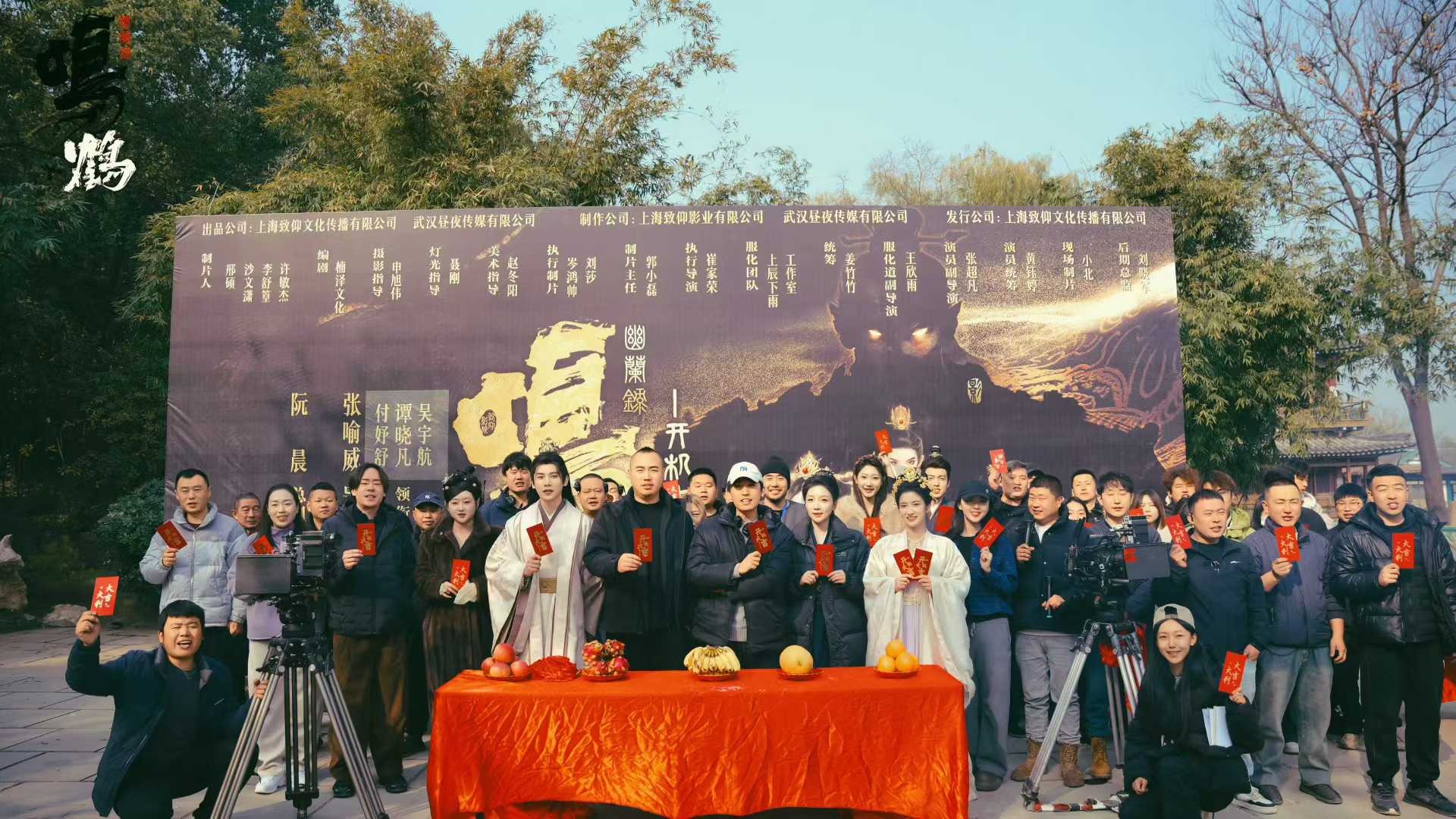
Last year, Zhang’s micro-drama Minghe 1: Into the Blue Sky reached the Top 3 on the Red Fruit platform’s popularity chart, garnering over 20.61 million views.
Zhang stressed the implications of these economics: “Platforms today are no longer just ‘buyers of shows’ — they are ‘makers of shows.’ The closer an actor’s relationship with the platform, the more exposure and influence they receive.” He noted that in many cases, success depends not on script quality or production value, but on the platform’s traffic investment and advertising placement.
Echoing this shift, Ouyang Jie, CEO of Dongguan Film and Television Base, emphasized that micro-dramas are internet-native content shaped from the outset by platform algorithms, segmented audiences, and data signals. “Platforms now control the actor selection process,” he said. “Micro-dramas are created to fit recommendation algorithms, with every element designed to capture attention quickly.”
In this environment, actors like Li following traditional paths compete in a system where algorithm metrics often outweigh experience. Content can still be creative and artistic, but production decisions are increasingly guided by platform metrics and audience data, balancing narrative and storytelling with the need to drive engagement and monetization.
For directors, this logic is physically visible on set. Han Yue, who moves between film and micro-dramas for economic stability, notes that while the work is steady, the craftsmanship is fundamentally different.
To keep up with the fast production schedule, crews often use three cameras at once to film all angles in a single take, avoiding the need for elaborate actor and camera choreography. Performances are tailored to algorithmic logic, favoring immediate physical intensity—such as pushing someone into a river or delivering a slap on others face—over gradual dramatic build-up. Lighting is no longer adjusted for mood but set to a “universal bright” that allows actors to rotate through scenes like products on a conveyor belt.
The industry’s obsession with speed enforces a punishing work rhythm. Crews often begin setting up the next scene before the current one is finished, leaving little room for careful adjustments. “In this environment, any pursuit of cinematic precision is seen as a threat to the delivery schedule,” Han said.
In the micro-drama system, speed dictates nearly every aspect of production, a pressure felt not only by actors but also by the crews behind the camera.
Advertising director Zhou Yicong spent eight days as an editor on a suspense micro-drama in Zhejiang. Initially, his role was limited to editing from the hotel as the crew filmed, but upon arrival, he was repeatedly asked to take on Digital Imaging Technician duties, transferring footage on set.
Once shooting began, Zhou’s work left almost no gaps. The crew filmed from 6 a.m. until midnight. After wrapping, five SD cards were handed to him for processing. The cards were ordinary-speed, and the computer could handle only one at a time.
“If I wanted to sleep at all, I would have to get up every hour, swap the card, and keep going until dawn,” Zhou said. Eventually, he abandoned regular sleep, combining editing and transfers into the same block of time and surviving only on brief daytime naps.
After brief daytime naps, he would immediately resume processing the next day’s material.
Zhou tried to negotiate renting several high-speed cards to shorten transfer time and allow at least one uninterrupted stretch of sleep, but the proposal was rejected. “I remember someone saying to me, ‘Isn’t it normal not to get any rest?’” he said.
For him, the problem went beyond exhaustion. The relentless pace and overlapping responsibilities left little room for careful creative work: monitors were rarely watched, and most artistic decisions fell entirely to the executive director.
The executive director himself, already in poor health, worked nearly 20-hour days for eight consecutive days while others scrambled to prepare the next scene. Many on set treated such endurance as dedication.
Interactive element generated with Claude Sonnet 4.6. All images and written content are real and sourced by the author.
Zhou tried to negotiate renting several high-speed cards to shorten transfer time and allow at least one uninterrupted stretch of sleep, but the proposal was rejected. “I remember someone saying to me, ‘Isn’t it normal not to get any rest?’” he said.
For him, the problem went beyond exhaustion. The relentless pace and overlapping responsibilities left little room for careful creative work: monitors were rarely watched, and most artistic decisions fell entirely to the executive director.
The executive director himself, already in poor health, worked nearly 20-hour days for eight consecutive days while others scrambled to prepare the next scene. Many on set treated such endurance as dedication.
By early 2026, news reports said that Liu Quanyou, the executive director of the hit micro-drama The Female Fortune Teller, had died of a heart attack at 43, after remaining active in the fast-paced micro-drama industry until his final months.
Zhou shook his head: “Could the rental cost of an SD card really be more important than the lives of a team forced to stay up all night?”
In this environment, content quality often takes a back seat to speed, crew roles are blurred, and human stamina is treated as the cheapest resource. Low budgets, minimal equipment, and high turnover leave workers physically and mentally exhausted, underscoring the human cost of micro-drama’s industrialized, algorithm-driven production model. “To the boss, it’s just a financial product. People are machines. If they can avoid spending, they will,” Zhou said.
None of these has yet to concern Lu Mengting. At the Shudian base in Dongguan, life is “manageable” for the 17-year-old, even though she has never signed a contract and regularly works 16-hour shifts.
The market around her is dominated by sweet-love plots and wealthy-boyfriend fantasies, and as a minor, she must stay alert to production limits, avoiding any intimate scenes that could have a project pulled. One recent period micro-drama featuring an 11-year-old girl in a marriage plot was quickly taken down.
In the massive micro-drama factory, where space is folded and time compressed, Lu has submitted 10 audition applications over the past few weeks, balancing new roles and lines across multiple sets. She hopes that by the time she turns 18, she will land a breakout role that could move her from background player to star. ‘I just have to keep going,’ she said.”
Inside a filming studio in Dongguan earlier this summer, rookie actress Lu Mengting wrapped up two scenes in less than 10 minutes. First, she played a nurse checking a beeping monitor in a hospital setting, a stethoscope around her neck. Moments later across the same room, she was positioned in a dim prison meeting an inmate.
Her entrance into the micro drama factory was as fast as the sets revolve. 10 days earlier, she was just another high school student absorbed in five-minute micro-dramas. After just 16 hours of free actor training, the 16-year-old Lu was on set, stepping into her first role.
She had no agent, no contract, and was still preparing for exams.
Rather than attending classes, Lu spent her days at the Shudian Vertical Studio, an 8,000-square-meter labyrinth of 108 modular sets, ranging from hospital rooms and prison cells to office conference rooms and underground casinos. Every inch is designed to save time.
At Shudian Film Base, the hospital, prison, and conference room are just a wall apart, only a minute’s walk away. (Source: Shudian Film Base)
The studio is a condensed version of the ecosystem of the broader micro-drama industry, in which production operates on a model of total compression. Space is folded. Entry barriers are lowered. Time is treated as the primary currency.
As the market expands, micro-dramas have become a high-speed ‘dream factory,’ a product native to the platform economy. It provides a new gateway for young actors and a survivalist “second chance” for film and advertising professionals fleeing a cooling traditional market. However, what sustains this massive engine is rarely the craft; but a system of punishing schedules, fragile labor protections, and a creative order dictated strictly by the logic of traffic and distribution.
By late 2025, China’s micro-drama industry was generating close to 90 billion yuan in annual output, nearly double the roughly 50.5 billion yuan recorded a year earlier. Micro-dramas were producing not only hits, but jobs. A 2025 industry report said the sector’s main production links had already created 1.333 million jobs, with related talent demand up 26% in the first three quarters of the year.
This institutionalized environment, where speed is the primary metric of labor, is what Zhou Liyan encountered upon arriving in Hengdian.
Less than a year after graduating from the performance program at Zhejiang University of Media and Communications, she moved to Hengdian, a town in eastern China often called the “Chinese Hollywood” for its sprawling film and TV studios. Renting a room, she pursued casting calls, submitted her profile, auditioned, and quickly entered one production after another.
She soon felt the full force of a production model built around time compression: shorter shooting schedules, lower budgets, page-driven shooting progress, and almost no time to prepare, rest, or recover.
“What shocked me the most was that the ‘Pass’ doesn’t belong to the director or the crew—it belongs to the clock,” Zhou said. Unlike longer productions where the crew can pause and adjust until a scene feels right, “On a micro-drama set, the call sheet rules: if a certain number of pages must be completed, they have to be completed.”
She remembers filming a scene where she was supposed to scream and cry. She flubbed a line and her tears hadn’t fully fallen, but the director insisted they move on, considering the take satisfactory.
This contrasted sharply with traditional film production, where lighting setups, positioning, and rehearsals might take hours. In micro-drama, scenes are modular, and the crew often just pivots the camera within the same room to capture a new angle.
Zhou said that actors often have to memorize lines on the spot, and that scripts are usually colloquial. What matters most, she explained, is hitting the right emotional tone rather than delivering lines perfectly. “You don’t have time to breathe; the next scene is already rolling,” she added.
Zhou recalled that a filming day could start as early as 5 a.m., before sunrise, and continue almost nonstop until 4 a.m. the following day, with actors pausing only for ten-minute meals while the rest of the time was spent on set.
The compressed schedule took a physical toll on her. She spent 12 hours in 10-centimeter heels and a short dress for a crying scene, pushing herself to the limits of endurance. “Even after the cameras stopped rolling, I couldn’t stop crying,” she recalled. To cope, she hired an assistant to help with quick costume changes, a small cost that made performing possible.
Interactive element generated with Claude Sonnet 4.6. All images and written content are real and sourced by the author.
Zhou’s experience reflects how young actors in the micro-drama industry face the challenges of compressed timelines. As for Li Jing, despite having worked in the industry for four years, the rapid expansion of the micro-drama market forced her to confront intense competition from newcomers flooding the industry.
Li entered the industry in 2022, often playing mothers or middle-aged antagonists. She found speed dictates nearly every aspect of production, with some series requiring nearly 100 episodes to be filmed in just three to five days, leaving almost no buffer time.
On one shoot, she received news on the first day that her grandfather had passed away, but since micro-dramas rarely leave room for actors, leaving would have delayed the entire schedule and might have even required recasting.
She negotiated with the crew to film the remaining scenes in advance. After a 14-hour shoot, she drove two hours to attend a funeral, managing only the burial before returning early the next morning to continue filming. “Micro-dramas don’t have that kind of flexibility,” Li said, contrasting them with longer productions.
Two months after giving birth to her second child, Li returned to set for a shoot that had originally been promised as half-day work with no night sessions. However, due to time constraints, the shooting was delayed into the late night.
As she had to pump breast milk every two hours, she had to sneak into the bathroom, as there was no designated nursing room on set. “It felt like a guerrilla war,” she said.
For Li, the challenge wasn’t just the intensity of the crew but the production model itself. “The production environment of micro-dramas is inherently temporary, compressed, and patchy,” she said.
Platforms have now directly entered the casting process, she said. She often went through auditions and received approval from directors, only to be told at the last moment that the role had been rejected. “Many roles are now decided by the platform, not the directors,” she said.
She had previously joined in the “Hongguo” platform, a short drama platform under ByteDance. Because she played a supporting role, the exposure didn’t lead to significant fan growth. Later, she was offered “fake fan data,” — fabricated followers, views, likes and comments used to inflate an actor’s apparent popularity, which she rejected. “Although fan data affects casting, I would rather let my audience grow slowly than buy fake popularity,” Li admitted. “The anxiety now is not just about acting, but whether or not I can make it onto the trending list and be recommended by the platform.”
Zhou Liyan echoed this. Leaderboard positions on the platform can shape both status and on-set conditions, with high-ranking actors receiving priority and sometimes influence the pace of filming, while lower-ranking newcomers having to follow the schedule with little room to negotiate. “Your traffic ranking and exposure don’t just affect respect—they determine the conditions you work under,” Zhou said.
Together, their experiences illustrate how the rise of micro-dramas has accelerated production and reshaped casting. In this system, an actor’s visibility, engagement, and leaderboard ranking determine who is cast, who receives priority on set, and how they are treated during filming, fundamentally changing the way actors are selected and managed.
Zhang Yuwei, CEO of Zhouye Media, a short-drama production company specializing in micro-dramas and platform-commissioned short-form series, noted a shift away from traditional creative judgment. In micro-dramas, he said, casting decisions are increasingly driven by three factors: an actor’s engagement and whether their followers convert to paid clicks, internal traffic circulation that favors talent signed with the platform, and whether the actor’s persona aligns with audience profiles generated by big data. In this platform‑led ecosystem, exposure and casting decisions no longer rest solely with directors and producers, but with algorithms and engagement metrics.
“Platforms run casting by the numbers,” said Zhang.
Production processes have also been transformed. Zhang explained that micro‑drama production has shifted from the traditional B2C model—where producers create content, distribute it, and then reach the audience—toward a Customer-to-Manufacture (CTM) approach. In this system, content is designed and released directly through the platform to viewers.
“The creative process no longer relies on the old production‑distribution chain; it goes straight to the audience through platforms,” Zhang said. As a result, production cycles are drastically compressed, and content is engineered around emotional impact rather than narrative complexity.
Platforms now also dominate distribution decisions, particularly paid traffic.
According to DataEye Research Institute’s 2025 H1 Micro‑Short Drama Industry Data Report, the scale of traffic purchasing for micro‑dramas grew substantially, with the market’s paid traffic investment rising from about ¥24.9 billion yuan in 2023 to approximately ¥33 billion in 2024.
Zhang said that in one platform‑executive project he oversaw, paid distribution costs exceeded the entire production budget by more than 100 times.
And according to reporting in the New Beijing News, traffic buying typically accounts for around 80% of a micro‑drama project’s total cost, easily surpassing traditional production expenses such as filming and locations.
Last year, Zhang’s micro-drama Minghe 1: Into the Blue Sky reached the Top 3 on the Red Fruit platform’s popularity chart, garnering over 20.61 million views.
Zhang stressed the implications of these economics: “Platforms today are no longer just ‘buyers of shows’ — they are ‘makers of shows.’ The closer an actor’s relationship with the platform, the more exposure and influence they receive.” He noted that in many cases, success depends not on script quality or production value, but on the platform’s traffic investment and advertising placement.
Echoing this shift, Ouyang Jie, CEO of Dongguan Film and Television Base, emphasized that micro-dramas are internet-native content shaped from the outset by platform algorithms, segmented audiences, and data signals. “Platforms now control the actor selection process,” he said. “Micro-dramas are created to fit recommendation algorithms, with every element designed to capture attention quickly.”
In this environment, actors like Li following traditional paths compete in a system where algorithm metrics often outweigh experience. Content can still be creative and artistic, but production decisions are increasingly guided by platform metrics and audience data, balancing narrative and storytelling with the need to drive engagement and monetization.
For directors, this logic is physically visible on set. Han Yue, who moves between film and micro-dramas for economic stability, notes that while the work is steady, the craftsmanship is fundamentally different.
To keep up with the fast production schedule, crews often use three cameras at once to film all angles in a single take, avoiding the need for elaborate actor and camera choreography. Performances are tailored to algorithmic logic, favoring immediate physical intensity—such as pushing someone into a river or delivering a slap on others face—over gradual dramatic build-up. Lighting is no longer adjusted for mood but set to a “universal bright” that allows actors to rotate through scenes like products on a conveyor belt.
The industry’s obsession with speed enforces a punishing work rhythm. Crews often begin setting up the next scene before the current one is finished, leaving little room for careful adjustments. “In this environment, any pursuit of cinematic precision is seen as a threat to the delivery schedule,” Han said.
In the micro-drama system, speed dictates nearly every aspect of production, a pressure felt not only by actors but also by the crews behind the camera.
Advertising director Zhou Yicong spent eight days as an editor on a suspense micro-drama in Zhejiang. Initially, his role was limited to editing from the hotel as the crew filmed, but upon arrival, he was repeatedly asked to take on Digital Imaging Technician duties, transferring footage on set.
Once shooting began, Zhou’s work left almost no gaps. The crew filmed from 6 a.m. until midnight. After wrapping, five SD cards were handed to him for processing. The cards were ordinary-speed, and the computer could handle only one at a time.
“If I wanted to sleep at all, I would have to get up every hour, swap the card, and keep going until dawn,” Zhou said. Eventually, he abandoned regular sleep, combining editing and transfers into the same block of time and surviving only on brief daytime naps.
After brief daytime naps, he would immediately resume processing the next day’s material.
Zhou tried to negotiate renting several high-speed cards to shorten transfer time and allow at least one uninterrupted stretch of sleep, but the proposal was rejected. “I remember someone saying to me, ‘Isn’t it normal not to get any rest?’” he said.
For him, the problem went beyond exhaustion. The relentless pace and overlapping responsibilities left little room for careful creative work: monitors were rarely watched, and most artistic decisions fell entirely to the executive director.
The executive director himself, already in poor health, worked nearly 20-hour days for eight consecutive days while others scrambled to prepare the next scene. Many on set treated such endurance as dedication.
Interactive element generated with Claude Sonnet 4.6. All images and written content are real and sourced by the author.
Zhou tried to negotiate renting several high-speed cards to shorten transfer time and allow at least one uninterrupted stretch of sleep, but the proposal was rejected. “I remember someone saying to me, ‘Isn’t it normal not to get any rest?’” he said.
For him, the problem went beyond exhaustion. The relentless pace and overlapping responsibilities left little room for careful creative work: monitors were rarely watched, and most artistic decisions fell entirely to the executive director.
The executive director himself, already in poor health, worked nearly 20-hour days for eight consecutive days while others scrambled to prepare the next scene. Many on set treated such endurance as dedication.
By early 2026, news reports said that Liu Quanyou, the executive director of the hit micro-drama The Female Fortune Teller, had died of a heart attack at 43, after remaining active in the fast-paced micro-drama industry until his final months.
Zhou shook his head: “Could the rental cost of an SD card really be more important than the lives of a team forced to stay up all night?”
In this environment, content quality often takes a back seat to speed, crew roles are blurred, and human stamina is treated as the cheapest resource. Low budgets, minimal equipment, and high turnover leave workers physically and mentally exhausted, underscoring the human cost of micro-drama’s industrialized, algorithm-driven production model. “To the boss, it’s just a financial product. People are machines. If they can avoid spending, they will,” Zhou said.
None of these has yet to concern Lu Mengting. At the Shudian base in Dongguan, life is “manageable” for the 17-year-old, even though she has never signed a contract and regularly works 16-hour shifts.
The market around her is dominated by sweet-love plots and wealthy-boyfriend fantasies, and as a minor, she must stay alert to production limits, avoiding any intimate scenes that could have a project pulled. One recent period micro-drama featuring an 11-year-old girl in a marriage plot was quickly taken down.
In the massive micro-drama factory, where space is folded and time compressed, Lu has submitted 10 audition applications over the past few weeks, balancing new roles and lines across multiple sets. She hopes that by the time she turns 18, she will land a breakout role that could move her from background player to star. ‘I just have to keep going,’ she said.”
Extra Credits
Advisor
Wenxin Fan
Editorial Director
Clarisse Choo
Creative Directors
Syrena Jin
Cheryl Xie
Serena Zhou
Managing Editor
Jiachen Li
Copy Editor
Andy Huang
