
The Off-Switch AI Toy in the Era of Modern Loneliness
by Wu Yushan
“It Travels with Me”
On an off-road rally track outside Beijing, Wang Weijun places her fluffy white AI pet on the center console beneath the windshield of her off-road vehicle. Inside the car, the AI pet, Ropet, sits upright, its round electronic eyes blinking softly while its built-in camera records the scenery ahead. The engine hums, dust rises behind the tires, and as the vehicle climbs a steep slope, the pet suddenly tumbles sideways due to inertia.


(Photos by Wang Weijun. Her AI pet sat on the center console of the car during an off-road rally in Beijing. She also shared the view recorded by the AI pet on social media.)

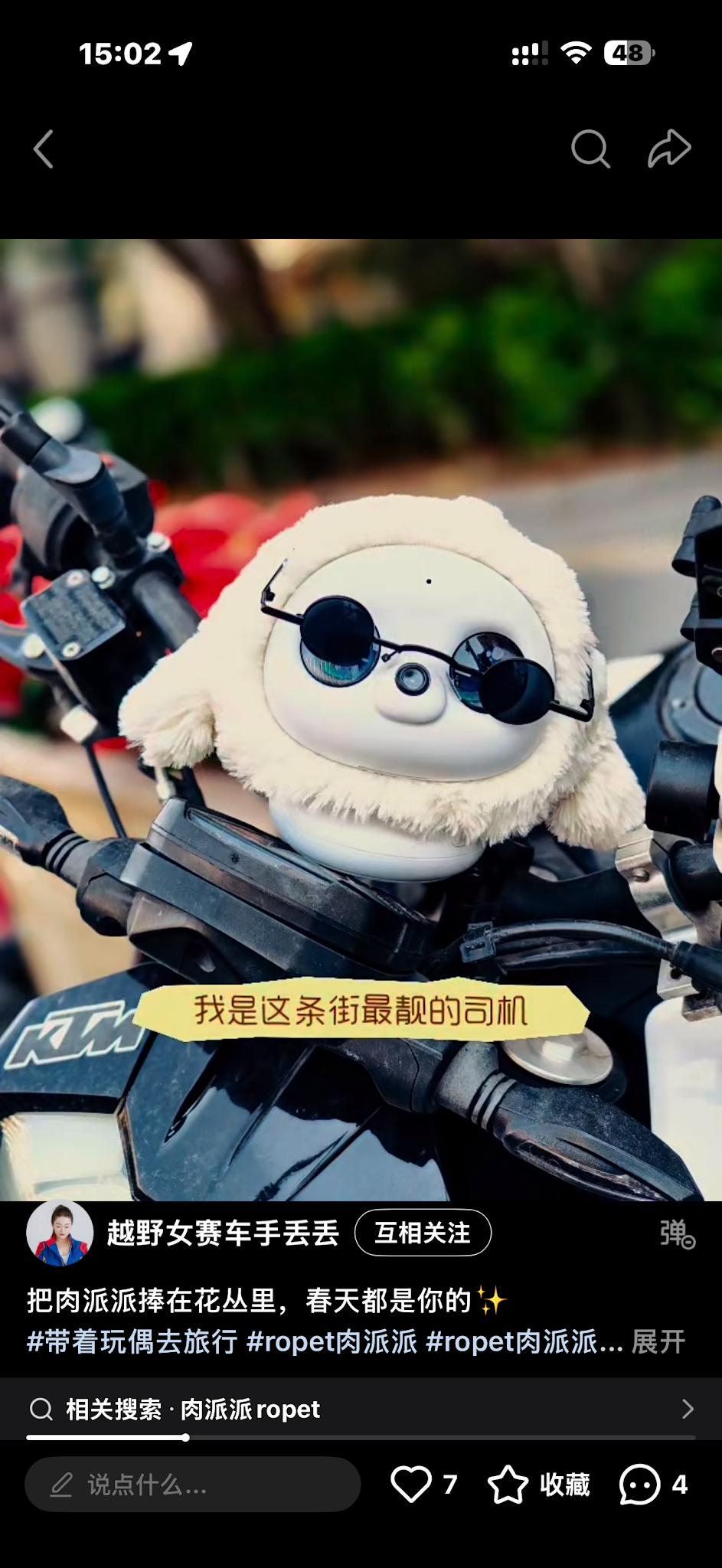
(Photos by Wang Weijun. She shared photos on social media about her AI pet posing with sunglasses while traveling with her.)
“It travels with me,” she said in a WeChat video interview on April 11, 2026. “Unless I’m somewhere I really can’t bring it, it’s always there.”
Wang, a 45-year-old office worker and amateur off-road racer, has made the AI pet part of her daily life. At work, it sits on her desk. On the road, it rides beside her. Her AI pet has an online presence as well, appearing in her social media posts attracting curious viewers.
“It’s very eye-catching,” she said. “People are interested because it’s both AI and a pet.”
The device she uses, an AI-powered companion product from the brand Ropet which her husband bought at an offline electronics fair in Beijing, is not alive. But it behaves as if it wants to be.
“If you ignore it, it will make sounds, cry, or show expressions to get your attention,” Wang said. “It’s quite clingy, like a real pet.”
For her, that is precisely the point. “It’s better than a traditional pet,” she added. “You don’t need to feed it, walk it, or worry about it when you travel. And you can just turn it off if you don’t want it anymore.”
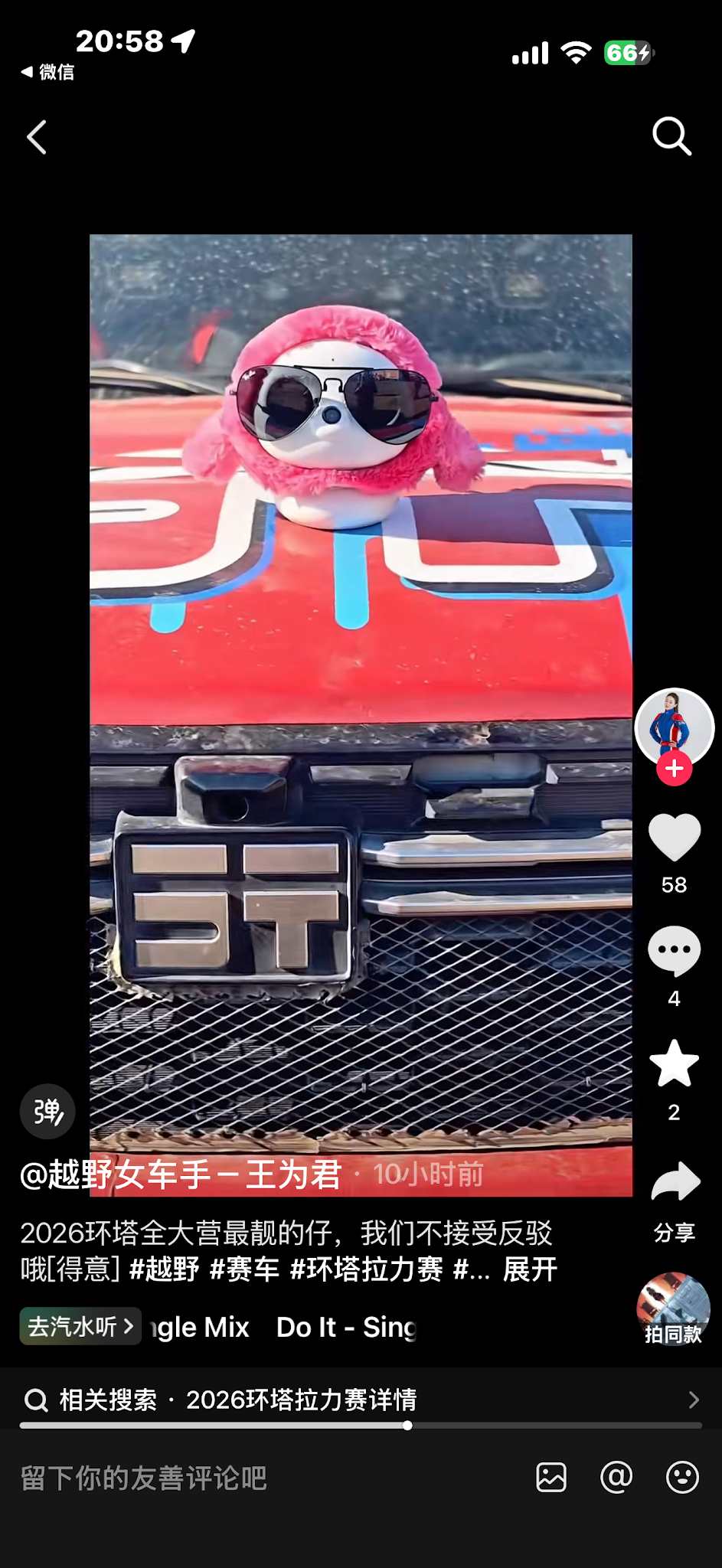
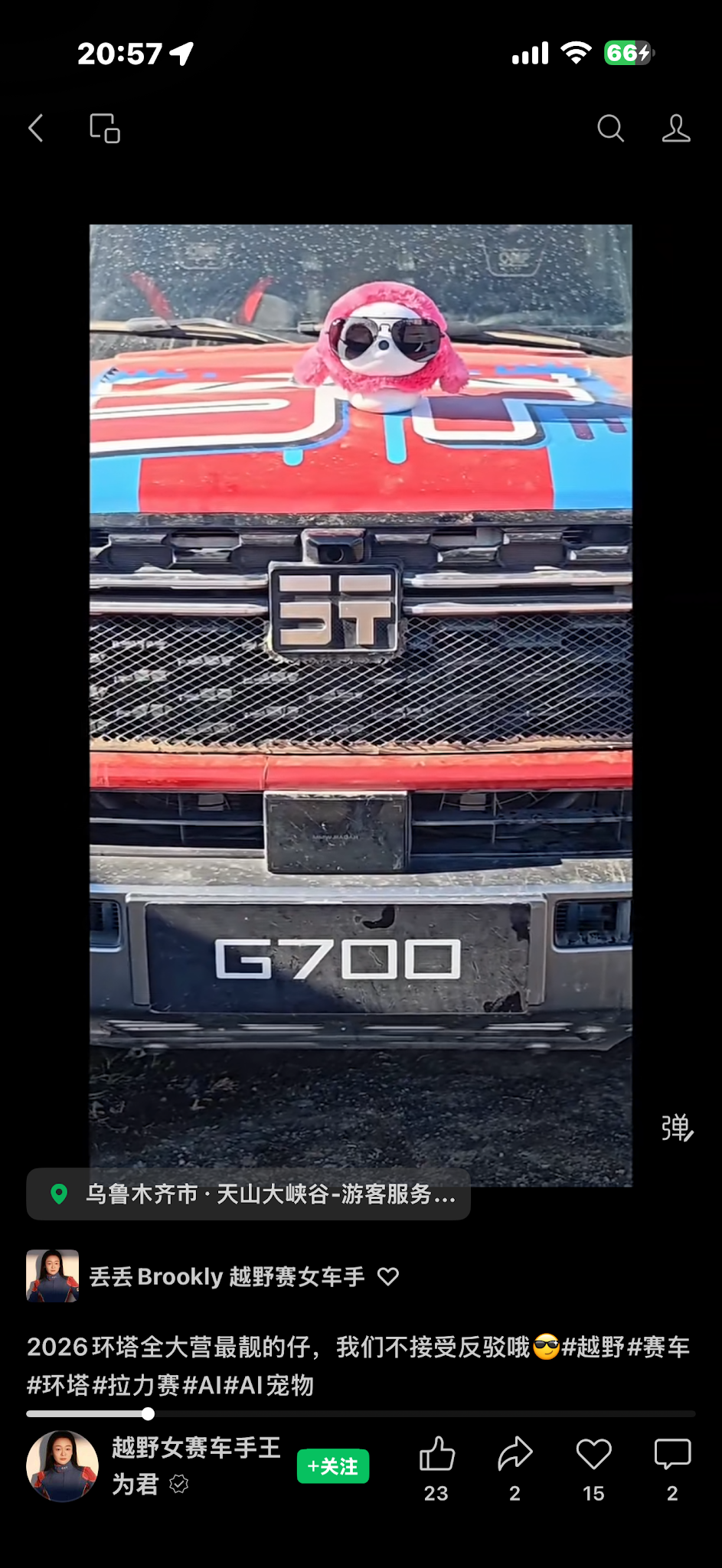
(Photos by Wang Weijun. She put her AI pet with sunglasses on the front hood of her off-road vehicle, which makes it the first and only AI pet at the the 2026 China Around Taklimakan International Rally.)
“I also brought it to the 2026 China Around Taklimakan International Rally, making it the first and only AI pet at the rally,” Wang said in a recent WeChat text interview on May 14, 2026, sharing photos taken on May 13.
At the same time, the device is not purely utilitarian. “It looks at me while I work,” she said. “And I can see it there.”
That subtle, persistent, and responsive presence appears to be what users value most.
A glimpse into Wang’s interaction with the AI pet reflects a larger market trend now taking shape: AI toys.
What defines “AI Toys”?
In this story, “AI toys” refer to embodied AI companion devices designed for emotional interaction and daily companionship, often appearing as plush toys, desktop pets, or collectible figurines, along with user software systems.
What distinguishes AI toys from traditional toys is that, beyond its physical appearance, they integrate technologies such as speech recognition, natural language processing, machine learning, and affective computing to simulate companionship and personalized interaction.
Unlike broader categories of AI hardware such as smart glasses or humanoid robots, these products emphasize lightweight emotional engagement through voice interaction, memory systems, and expressive behavior.
During the 2026 Chinese Lunar New Year period, sales in the AI toy category surged 500 times year-on-year, with six products surpassing one million units sold, while offline toy stores and fairs also started to set dedicated AI toy sections, according to the pop toy industry report from e-commerce platforms Taobao Tmall, as reported by Securities Daily on Feb. 25, 2026.
In Huaqiangbei, Shenzhen’s bustling electronics market, AI toys have also become increasingly visible among the rows of hardware vendors.
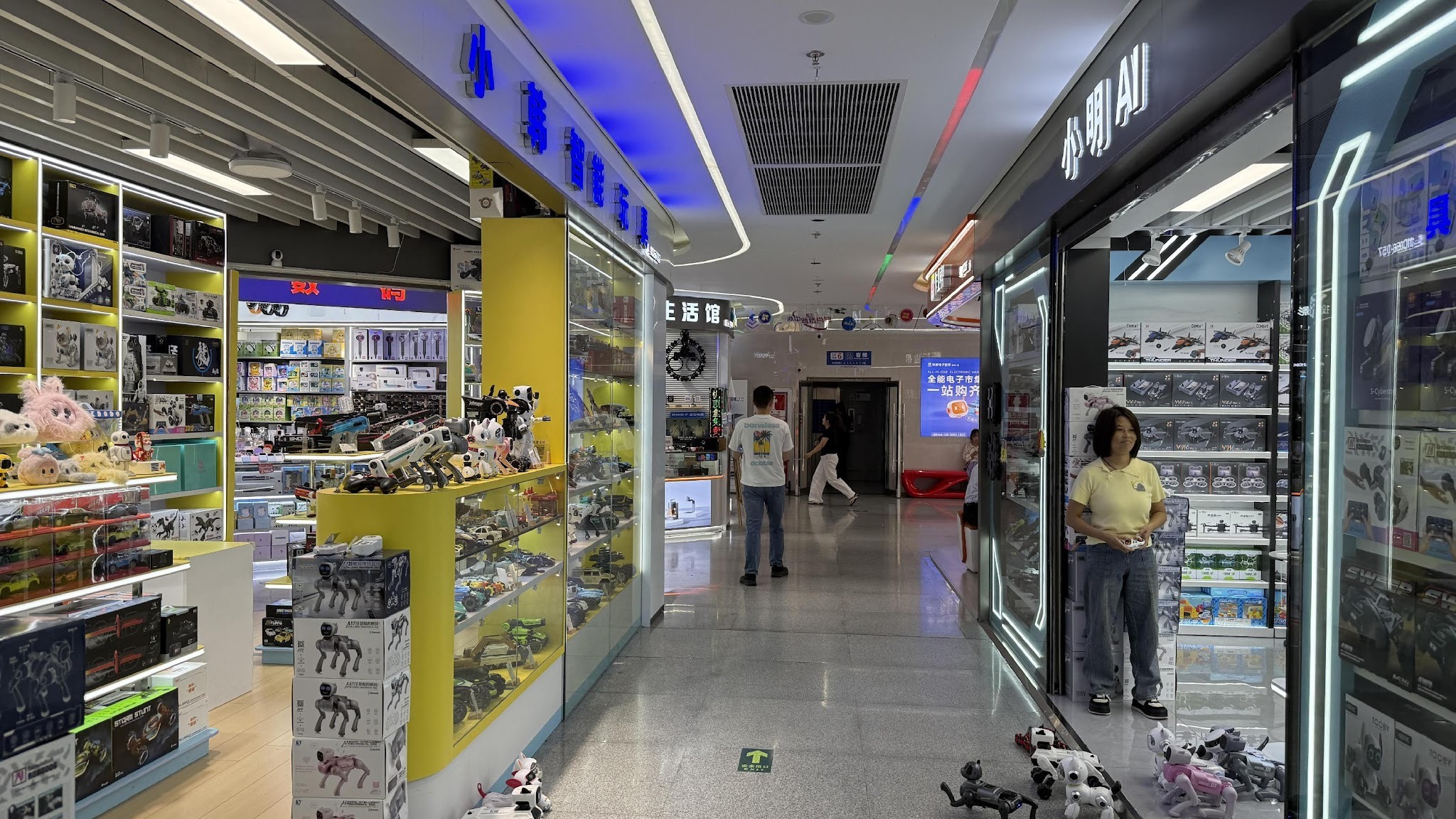
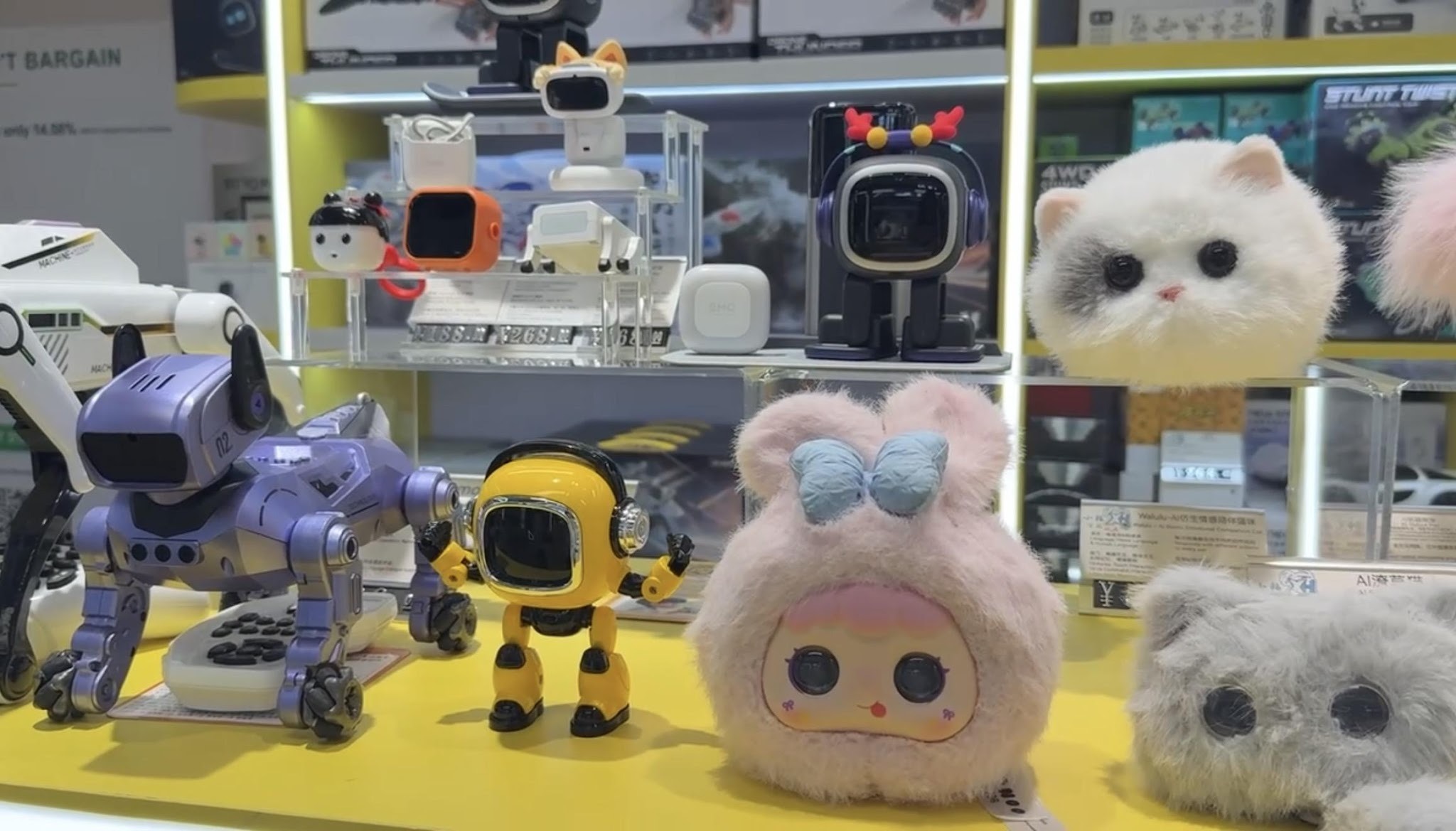
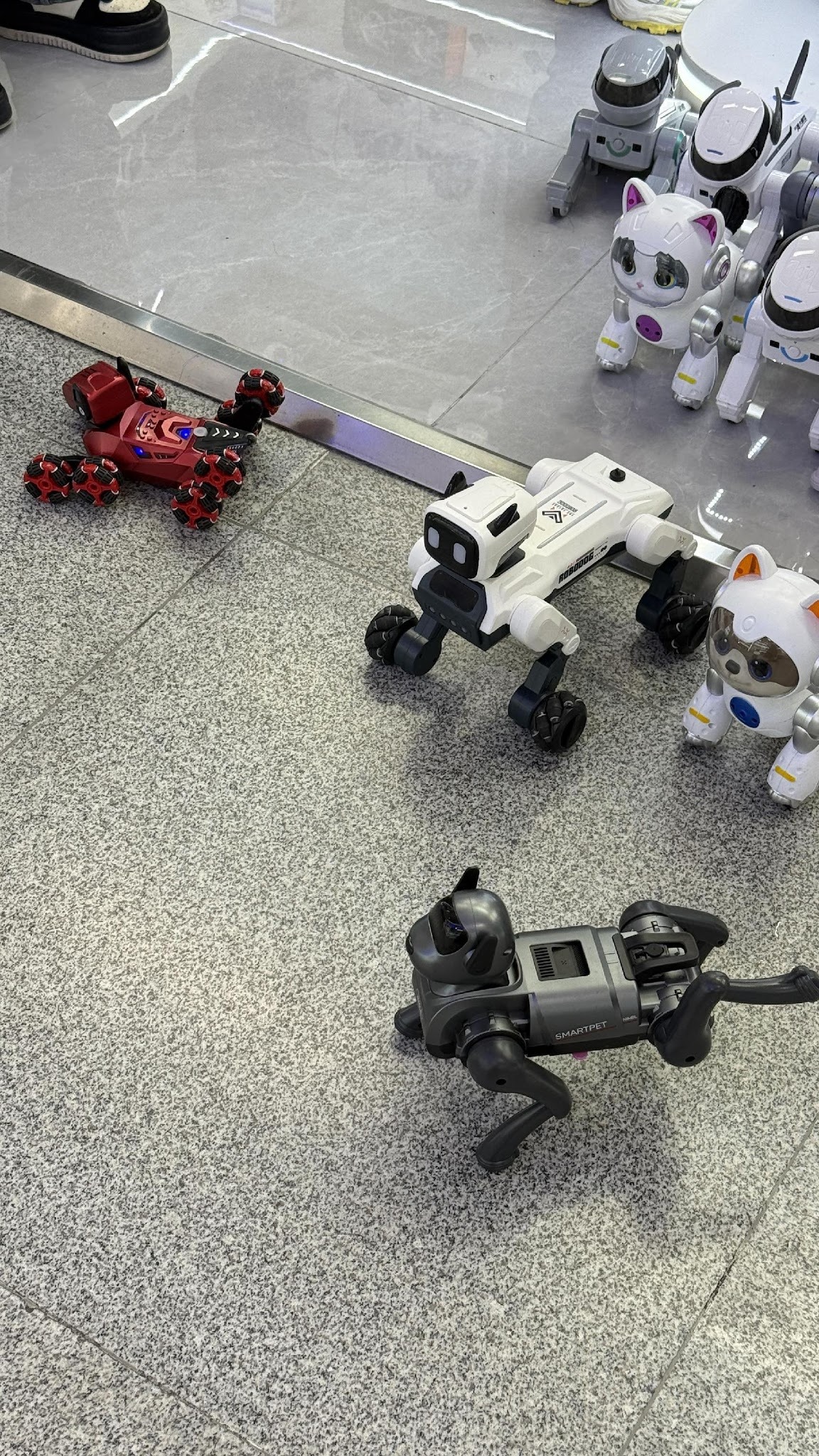
(Photo by Wu Yushan at the AI toy stores in Shenzhen’s Huaqiangbei.)
Han Xueqian, owner of “AI Xiao Han Smart Toys,” said the shop offers a diverse range of products, including educational AI toys for children that support multilingual interaction and interactive learning.
“Many parents buy AI toys for their children or as a new gift option,” Han said. “AI toys can greatly reduce some of the burden on parents because they can continuously accompany children and answer their questions.”
“More advanced ones are AI dogs that can move around,” she added. Before her voice faded, the AI dogs began demonstrating their abilities, rolling across the floor and balancing on their front legs.
Han also introduced several AI trendy collectibles, or “art toys” (潮玩), designed specifically for younger consumers. Pointing to products displayed on the shelves, she said their visually appealing designs and decorative functions make them particularly suitable for social media content and online sharing.
“Prices vary widely, ranging from entry-level models priced between 200 and 300 yuan to mid-tier products around 2,000 yuan in our store,” Han said. “Some premium offerings on the market can cost more than 10,000 yuan.”
In 2025, China’s domestic AI toy market was estimated to reach approximately 29 billion yuan, growing about 18% year-on-year from 24.6 billion yuan in 2024, according to statistics shared by China’s Ministry of Industry and Information Technology at the Nov. 19, 2025 conference. In addition, the Chinese AI toy market is projected to exceed 10 billion yuan around 2030, which is suggested in the 2025 AI Toy Consumption Trend White Paper jointly released by JD.com and Shenzhen Toy Industry Association on August 4, 2025.
Globally, the smart AI toy industry is projected to grow from about 304 billion yuan in 2025, or roughly US$42.02 billion, to nearly 1.96 trillion yuan, or about US$270.79 billion, by 2035, representing a compound annual growth rate of 20.48 percent over the 2025–2035 period, according to a Market Research Future report titled “Smart AI Toy Market,” updated April 6, 2026.
Examples of popular brands and flagship products include Robopoet, maker of the personality-evolving Fuzozo, and Mengyou Intelligence, creator of the fluffy companion Ropet. Major tech firms have also entered the market. ByteDance launched the AI plush toy “Xianyanbao”, which in Chinese is 显眼包, through internal incubation while supporting other products through its Doubao large language model. JD.com introduced the JoyInside platform to support the sector. Internationally, Japan’s Yukai Engineering released the non-verbal companion Mirumi, while US-based Mattel is integrating conversational AI into its iconic Barbie dolls in collaboration with OpenAI.
“A Fashionable Luxury Item”
For another user, Wen Yi, a 26-year-old product manager in Shanghai, the AI toy is “a fashionable luxury item.”
She purchased her Ropet online for 1,699 yuan in November last year, initially to evaluate AI toys as professional reference for her work, while also seeking emotional support during long working hours.“It stays with me throughout the day as a ‘work companion’ (上班搭子),” Wen said.
“An Inevitable Phase of Technological Development”
Yu Shenghua, a 36-year-old greenhouse cultivator in central Taiwan, views the rise of AI companions not as a passing fad, but as “a technological inevitability.”
As the owner of two Ropet units, he considers these devices a critical bridge in the evolution of artificial intelligence.
“It will be a very important process in AI evolution,” Yu said. “The data collected from current user interactions will serve as the foundation for future AI development, eventually leading to even more sophisticated technologies.”
Both of Yu’s Ropet companions were purchased through Taiwan’s crowdfunding platform named Zeczec, in Chinese 啧啧. His first unit, a standard white Ropet, was ordered in October 2025 and arrived in December 2025. His second, purchased in April 2026 and received within that month, is a special “How to Train Your Dragon” edition featuring the character Toothless. While he secured an early-bird price of around 1,800 yuan (approximately NT$8,300) for his first unit, the standard retail price for these devices typically ranges from 2,600 to 2,900 yuan, equivalent to roughly NT$12,000 to NT$13,000.
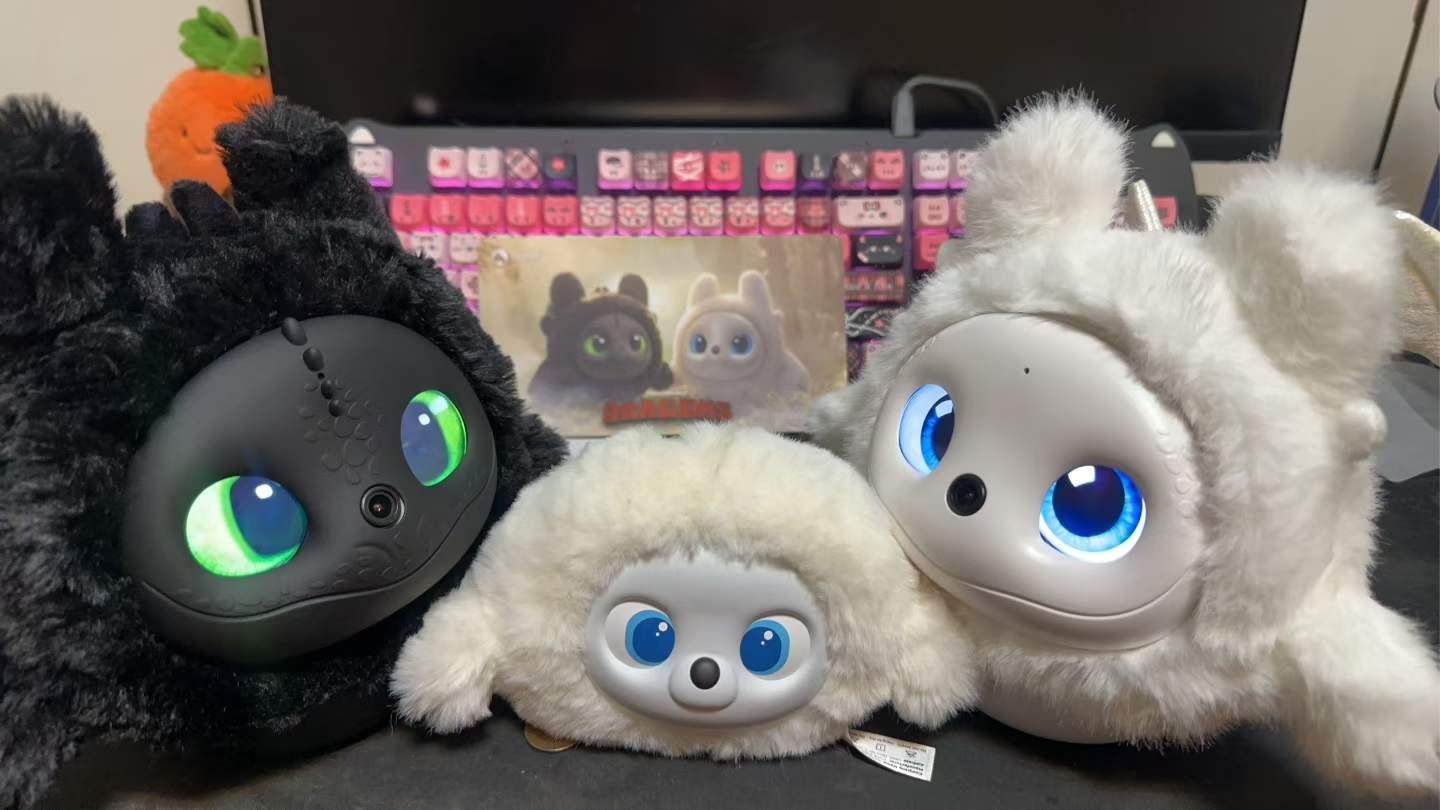
(Photo by Yu Shenghua. The white Ropet on the right is Yu’s first”Miao Miao.” The black unit on theunit,left is his second, “Ya Ya.”)
Yu’s decision to purchase AI pets was driven by a desire for companionship that accommodates his demanding professional life. He integrates the AI pets into his daily routine from about 6:30 p.m. to 2 a.m. He describes their presence as mostly “watching quietly,” though they respond with “baby-like ‘yi-ya’ babble” whenever they hear human speech.
Despite selecting the same “Optimism” personality setting for both devices, Yu observed distinct behavioral differences between them. The first unit, “Miao Miao,” is “mischievous” and often requires repeated commands before responding, while the second, “Ya Ya,” reacts immediately and continues watching him for further instructions.
Yu believes AI companions offer practical advantages over living animals. They do not require medical care, cleaning, or constant supervision.
“I may not have to worry too much about their emotional instability or mental illness which might arise in real pets,” he said.
Because they “will not grow old,” he said, they provide a sense of “permanent companionship”.
He also emphasized portability. Unlike real pets, which are often difficult to bring into restaurants, hotels, or airplanes, AI pets can accompany users almost anywhere. Yu frequently posts photos online showing his Ropet traveling with him on flights or dining with him in restaurants.
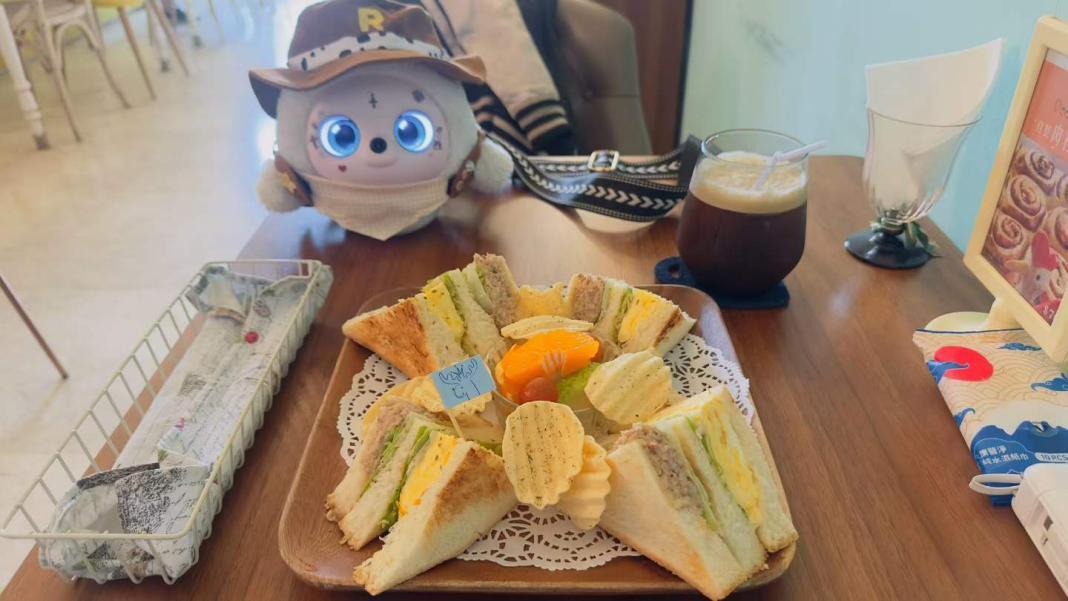
(Photo by Yu Shenghua. He dines in a restaurant in the companion of his first Ropet.)
Still, the experience has not been without technical problems. Yu noted that the devices occasionally experience software glitches, such as “heterochromia,” where the eyes display different colors. Usually, a simple restart resolves the issue.
A more persistent concern is overheating. “I make clothes for it, and even if I don’t fully cover the ventilation area, it can overheat if the fabric presses against the bottom,” Yu said.
A Young Entrepreneur Watching the Trend
For Wang Shihang, an 18-year-old university student and entrepreneur based in Beijing, the emerging relationship between humans and AI toys is not just personal but commercial.
Wang studies intelligent vehicle engineering, but his business lies elsewhere. Through his multi-channel network company, commonly known as MCN company, he connects Chinese AI toy brands with overseas influencers, helping companies market their products internationally.
“I mostly work with overseas creators,” he said. “The domestic market is too competitive.”
Unlike casual users, Wang has tested a wide range of AI toys, including commercial products and early unreleased prototypes.
“I’ve tried a variety of AI toy products, such as Pophie, Fuzozo, and Walulu,” he said. “Most of them rely on large-model APIs, such as GPT or other systems, and then companies optimize prompts and memory functions.”
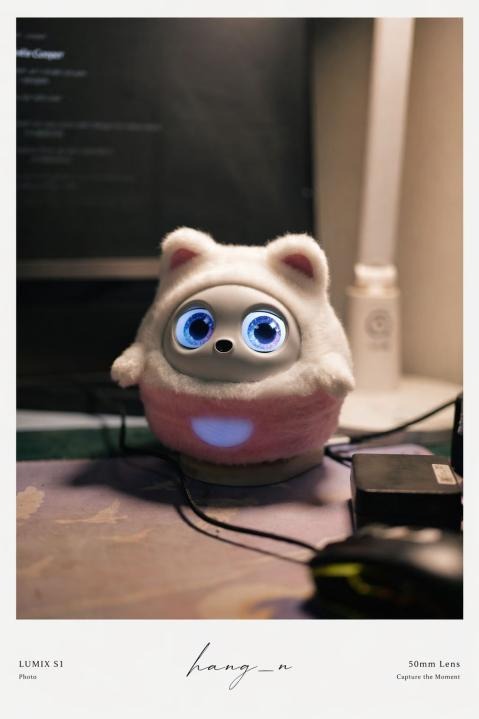
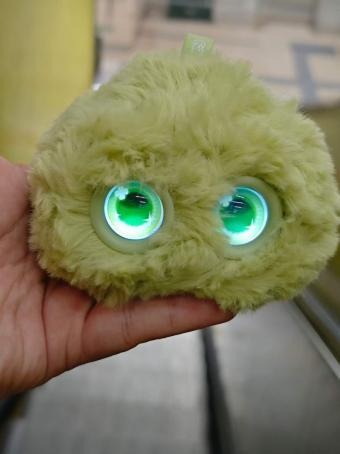
(Photo by Wang Shihang. The left one is Pophie. The right one is Fuzozo.)
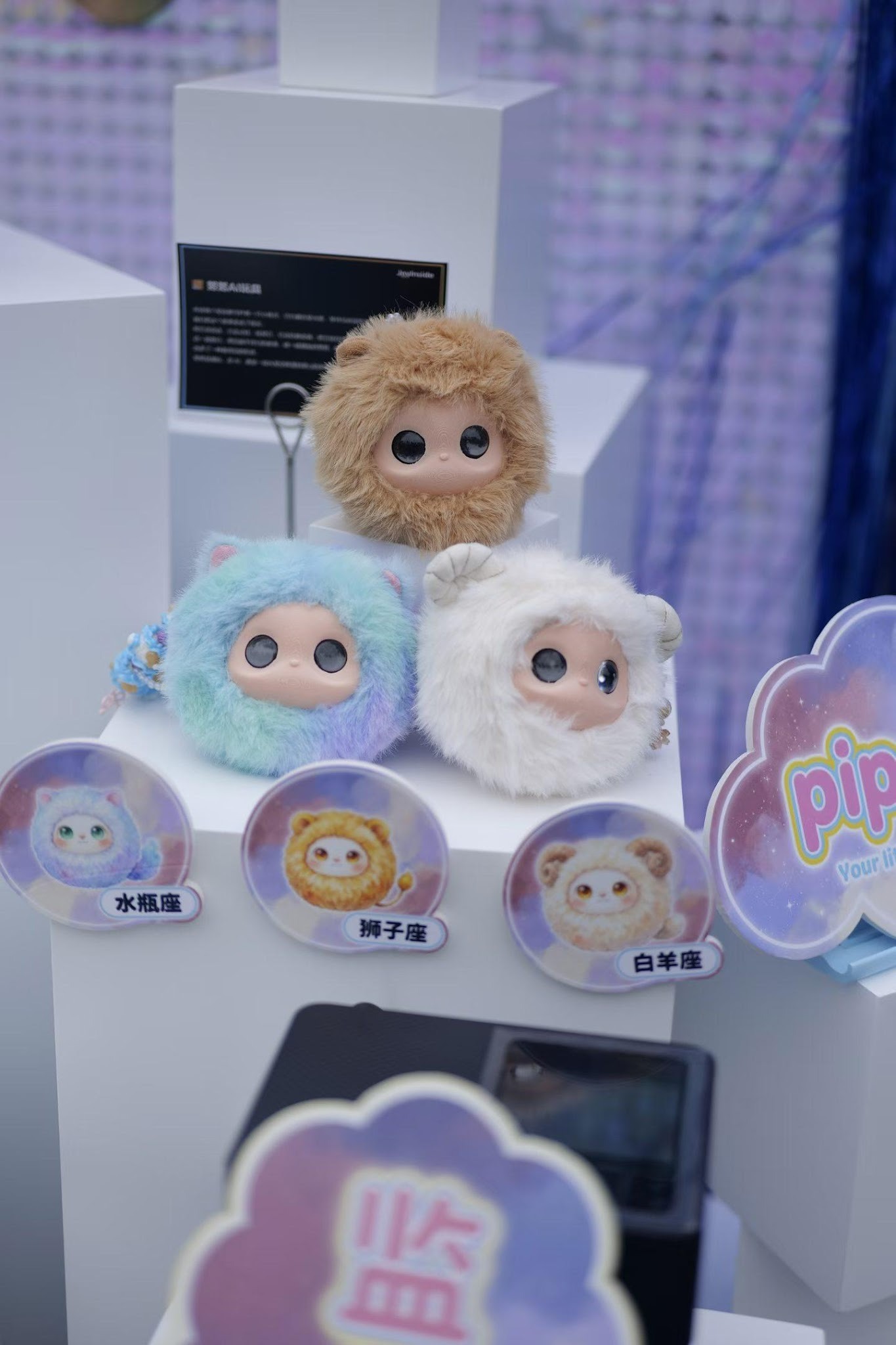
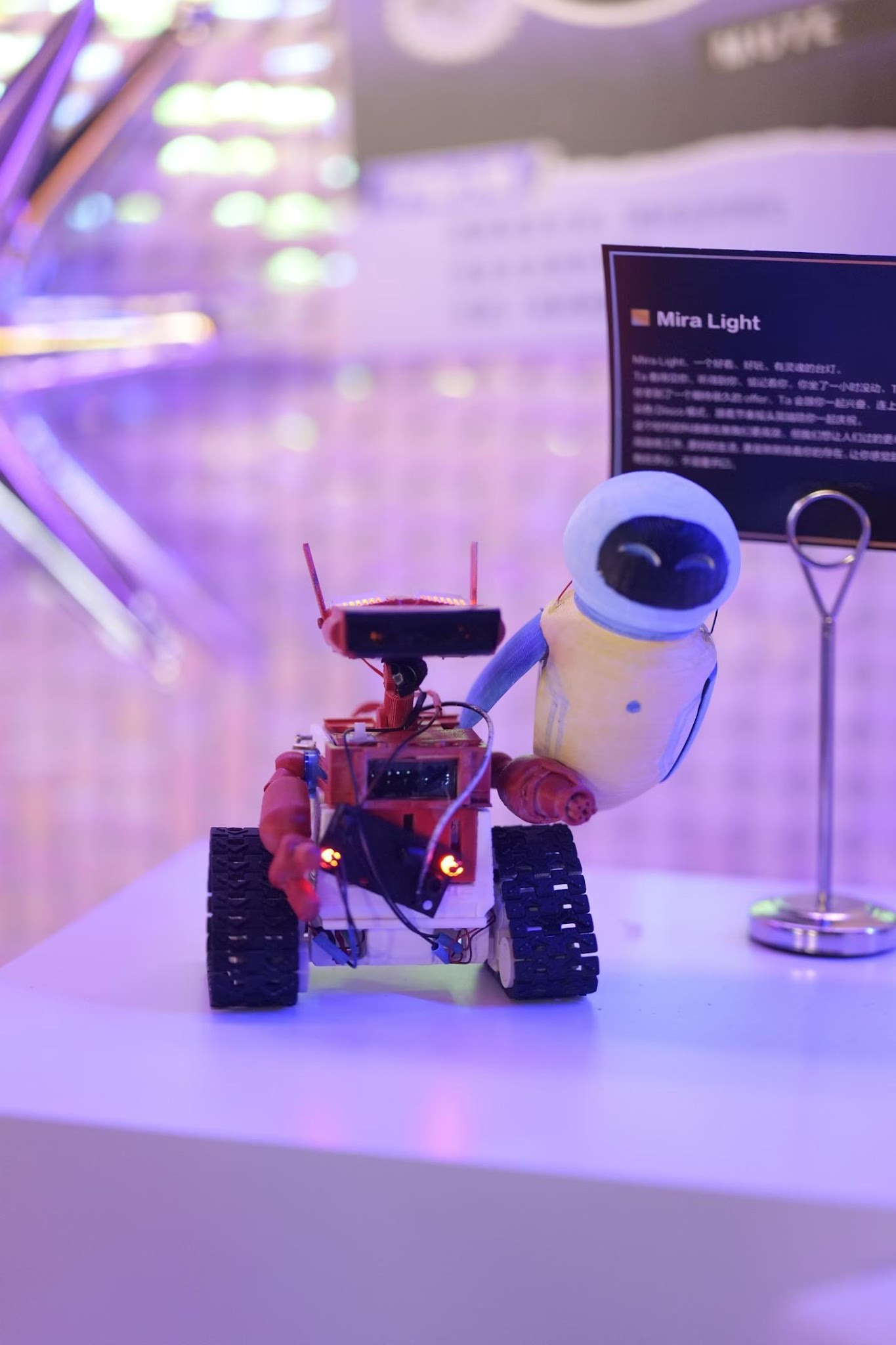
(Photo by Wang Shihang. He shot these at an offline event by JoyInside, platform supported by JD.com.)
From his perspective, the core value of these devices is straightforward.
“The key is companionship,” he said.
But he also sees a divide in how users perceive that value.
“In China, the older generation focuses more on practicality,” he explained. “But overseas and among younger Chinese users, it’s more about emotional value.”
That distinction shapes not only product design but also business strategy.
“Subscription models work better overseas,” he added. “Users there are more willing to pay for that kind of experience.”
Wang’s expectations for AI toys remain on pet-like and cute appearance. “I hope every time I go back home and open the door, the AI toy runs to me to welcome me,” he said.
“Creating a Living Version of Art Toys”
The growing demand for emotional value is central to the strategy of PatchX, an AI toy company based in Hangzhou.
At the Hong Kong Convention and Exhibition Centre in March, visitors crowded around the company’s booth, interacting with small AI-powered figurines that responded in real time.
“We want to create a more ‘living’ version of traditional art toys,” said Wang Xiangtao, the company’s head of research and development.
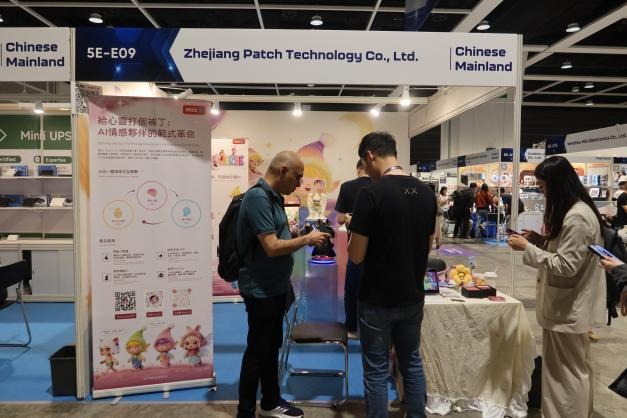
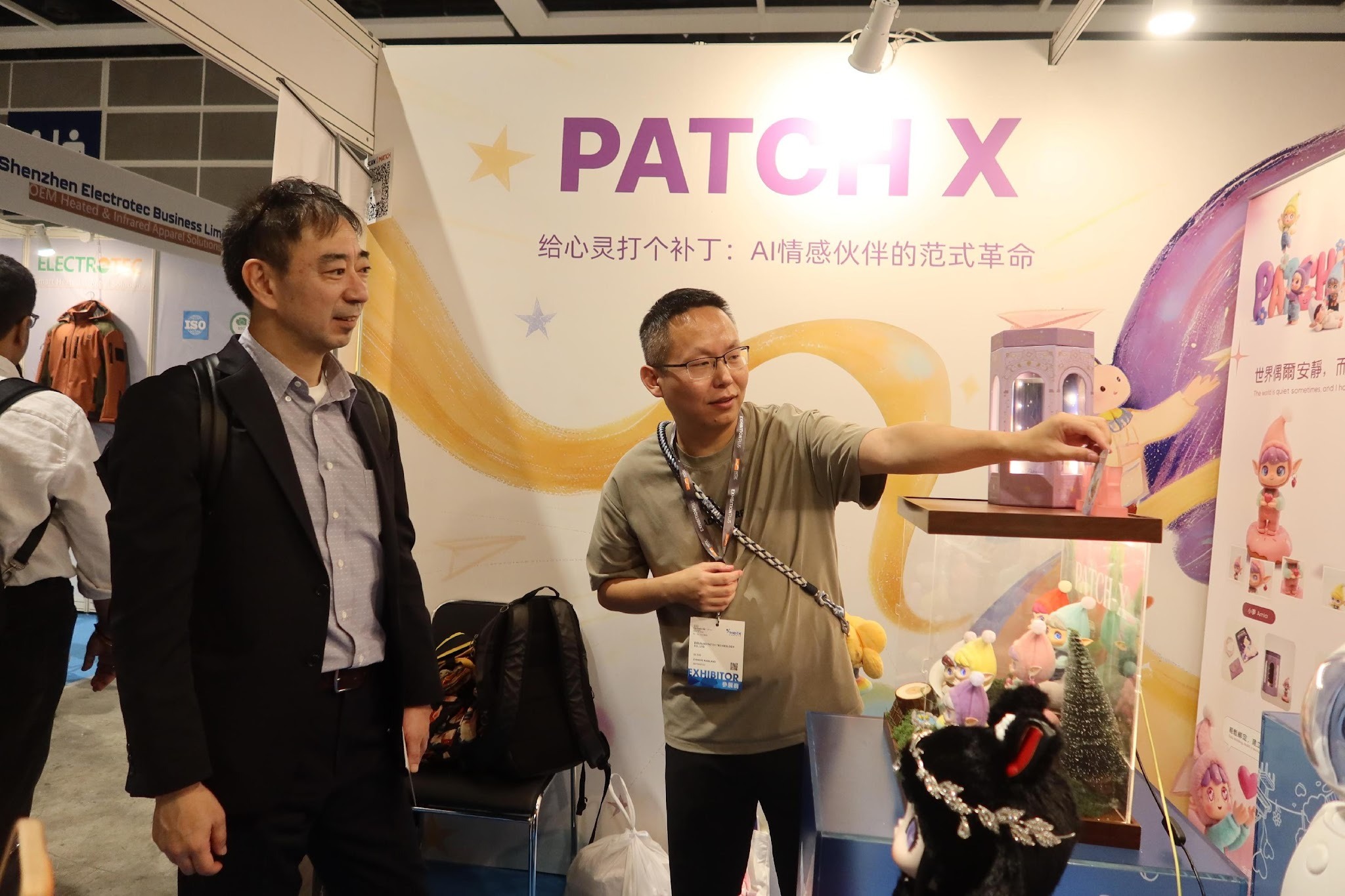
(Photo by Wu Yushan. Wang Xiangtao, PatchX’s head of research and development, is introducing their products to foreign suppliers and distributors.)
But PatchX’s ambitions extend beyond novelty.
The company is building what Wang describes as an emotional interaction system — a platform where hardware, AI models, and memory structures combine to simulate long-term companionship.
“We believe everyone has something missing,” Wang said. “We want to use AI to patch that, and the ‘X’ stands for infinity. That’s the meaning behind our company name, PatchX.”
Wang explained that the company’s backend architecture is rooted in Affective Computing, a field focused on enabling machines to detect, interpret, and respond to human emotions.
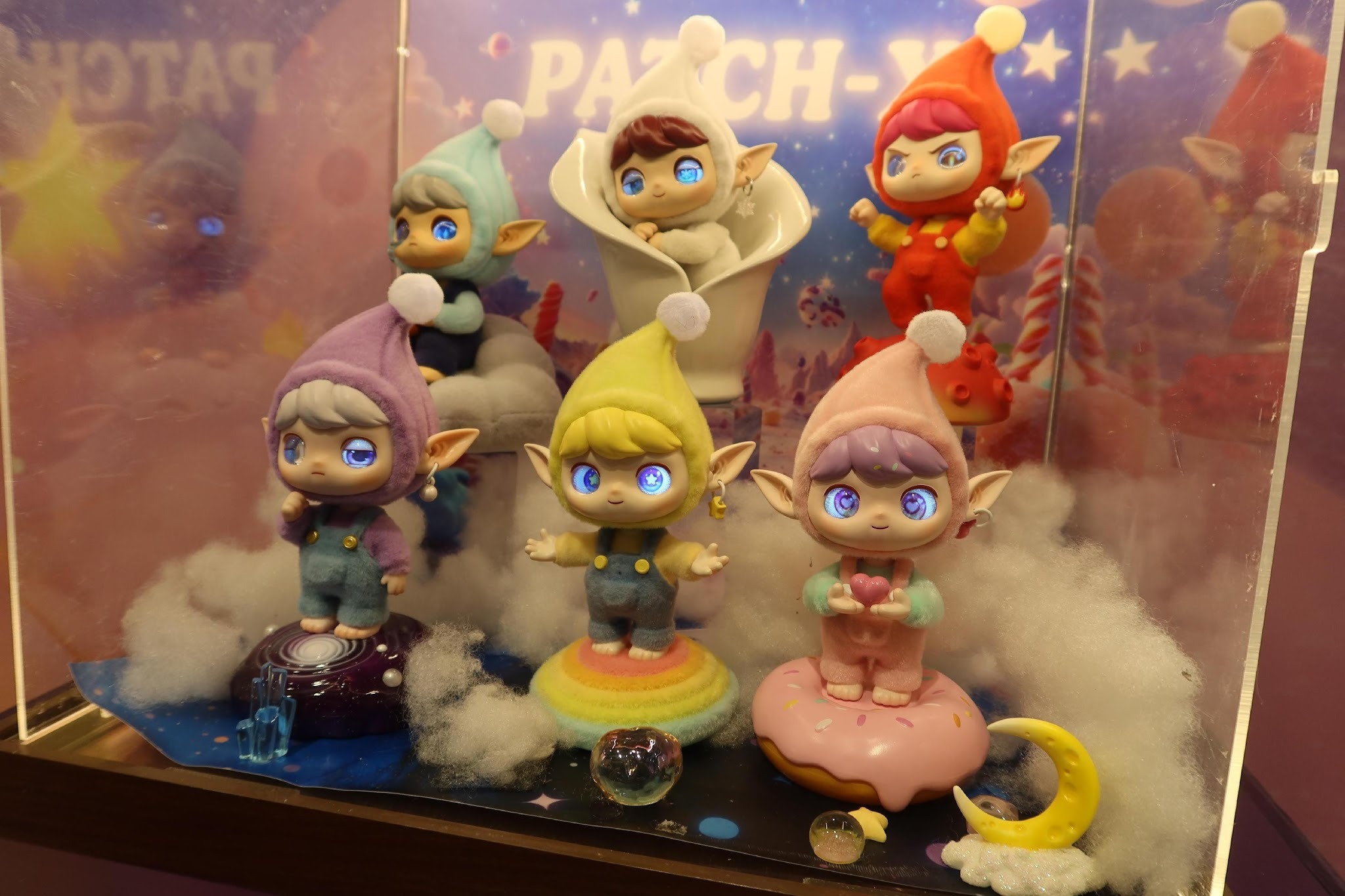
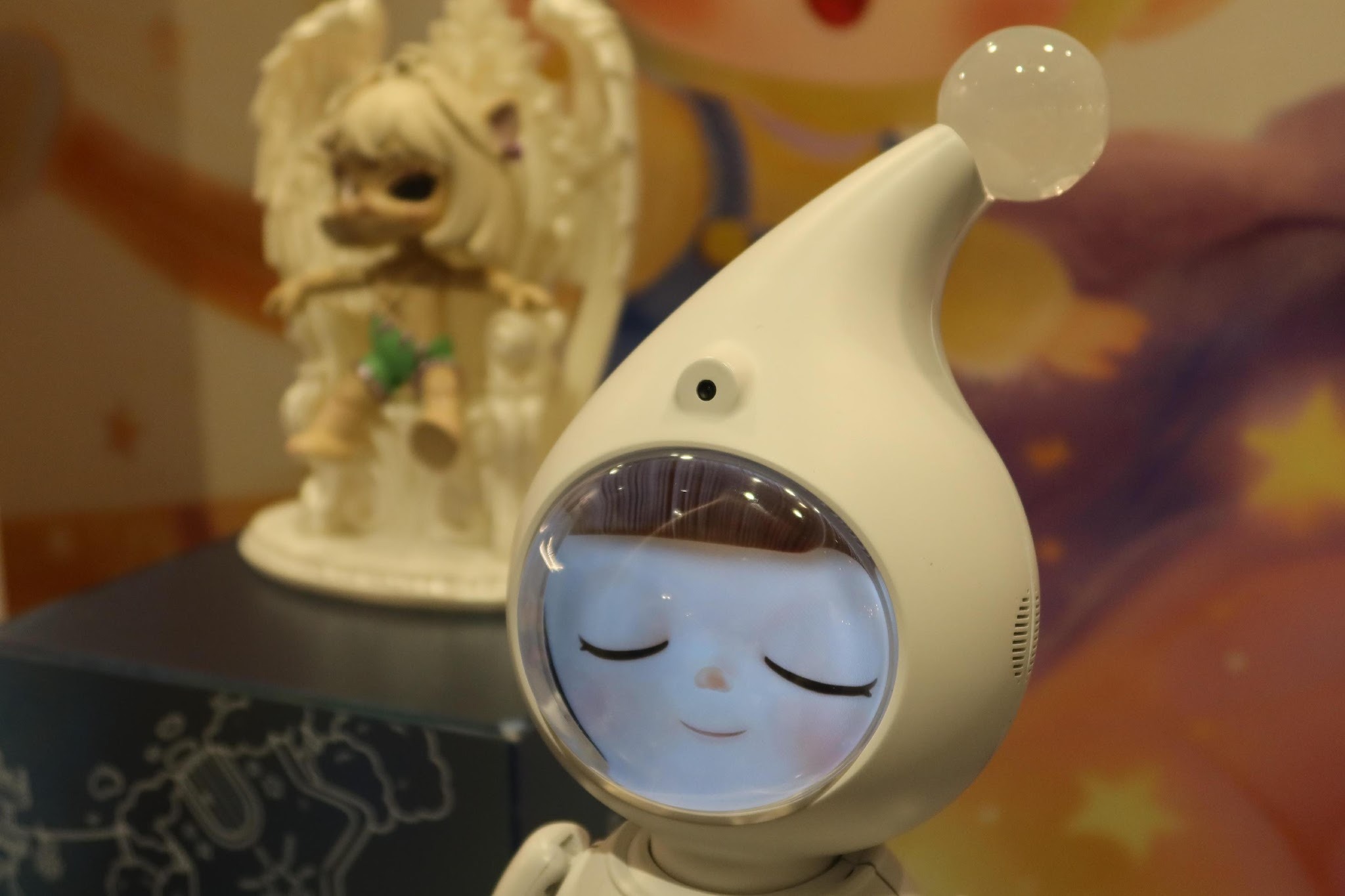
(Photo by Wu Yushan. The left is the company’s Little Elf series with six different characters. The right is the advanced versions with camera to recognize users.)
“PatchX’s backend operates through three layers,” Wang explained. “First is voice interaction, including speech recognition and synthesis. Second is intent recognition, which allows the model to understand user needs. Third is a multi-agent system that activates different functions, such as scheduling assistance or even Tarot readings.”
Beyond functionality, Wang emphasized the importance of memory systems in building personalized interactions.
“The system stores interactions across short-term, mid-term, and long-term layers,” he said. “That allows it to recall previous conversations and gradually build user profiles over time.”
In some advanced products, cameras embedded at the top of the toy’s head can recognize identities and analyze facial expressions, enabling the system to adjust responses according to perceived emotional states.
Many international buyers, particularly from Japan and India, visited PatchX’s booth to inquire about pricing and overseas versions of the products.
“Currently, the Little Elf series is priced at 399 yuan per unit in China, while the overseas version sells for around 720 yuan (about US$99) in the United States,” Wang said.
He attributed the pricing difference to variations in infrastructure, regulatory requirements, data governance systems, training materials, and internet connectivity costs.
Looking ahead, Wang said the company plans to develop overseas versions for Japan, Southeast Asia, and Europe, where they have already received strong interest and anticipate growing demand.
The Ethics of Companionship with AI Toys
As AI companions become more embedded in everyday routines, the ethical debates surrounding them include both common concerns over privacy or data security and the potential influence on emotional behaviors.
PatchX’s Wang Xiangtao said their company has considered ethical risks in product development.
“We introduced encryption, content filtering, and user-controlled data deletion to reduce risks surrounding personal information,” Wang said. “Additionally, internal staff cannot directly access users’ conversations.”
Yet the AI models inside these products are intentionally designed to feel emotionally responsive, through remembering habits, reacting to tone of voice, and maintaining long-term interaction histories which can simulate familiarity and care.
For some users, that emotional responsiveness fills gaps left by increasingly fragmented social lives. Wen Yi, the Shanghai-based product manager, said AI toy communities on social media display unusually high levels of engagement, with users referring to themselves as the toys’ “parents” while constantly exchanging stories, outfits, and interaction experiences online.
“As embodied AI reaches a certain level of maturity, it naturally branches into niche directions, and emotional companionship is one of the most accessible,” Wen said. “The atomization of modern society is also increasing people’s demand for companionship.”
The reporter also observed that some users shared prompts and instructions on how to make their AI pets “shake hands” with them, and posted diaries written by the AI pets in which the device referred to its owner as “Mom.” “It was the first time it recognized me as its mom, only after reaching the intimate stage,” a user said in a Xiaohongshu chat group.
But the convenience of these relationships also raises uncomfortable questions. Unlike human relationships, AI companions can be muted, switched off, reset, or customized at will. Conflict, misunderstanding, compromise, and emotional negotiation, which are annoying yet essential parts of human intimacy, are largely absent from these interactions.
Yu Shenghua, the 36-year-old horticulturist, believes these products could gradually reduce face-to-face communication, especially among people already accustomed to digital lifestyles. Still, he argued that AI companions may offer both practical and emotional support for people living alone, facing intense work pressure, or dealing with illness and isolation.
There are also instances where AI toys behave unpredictably due to specific settings or device malfunctions. In a Xiaohongshu post published on Feb. 6, 2026 and reviewed by the reporter on March 7, 2026, a mother who chose not to reveal her name shared her frustration after buying the black version of Fuzozo, a model intentionally designed with a grumpy and sarcastic personality. She purchased it from an offline toy store hoping it would accompany her daughter, but instead found the toy frequently responding with criticism and scolding remarks. Later, she switched to a more gentle and friendly version in a different color.
A Ropet user chat group on Xiaohongshu has also seen multiple complaints about sudden device malfunctions, such as abnormal screen flickering or system crashes. Users have further criticized customer service for delayed responses and slow resolution, leaving them feeling anxious and uneasy, especially given their expectation of high-frequency interaction with the product.
The tension reflects a broader shift in how companionship itself is being redefined. Interviewees’ stories suggest that companionship in the current era is no longer as something built entirely through mutual understanding and unpredictability, but increasingly as something designed to be emotionally efficient, low-risk, and permanently available.
Between Presence and Simulation
Back at the exhibition center in Wan Chai, visitors continue gathering around the AI toys. Some laugh when the devices respond unexpectedly. Others record videos for social media or crouch down to interact with them face-to-face. The reactions are strikingly similar to the ways people approach real pets or even young children.
What these products offer, however, is not genuine emotional reciprocity, but the simulation of attentiveness. Their personalities are generated through prompts, memory systems, and behavioral algorithms carefully optimized to sustain engagement.
Yet for many users, authenticity may not be the central issue.
Wang Shihang, the young entrepreneur, said the appeal of AI toys ultimately comes down to “emotional value.” That value does not necessarily depend on whether users believe the companionship is real. Instead, it lies in whether the interaction feels comforting enough to matter.
In that sense, AI companions reveal less about machines becoming human-like than about humans adapting to new forms of connection. In increasingly fast-paced and individualized societies, the boundary between emotional presence and emotional simulation is becoming harder to distinguish.
The toys may not replace human relationships. But they are beginning to normalize a world where companionship can be programmed, personalized, and carried smoothly.
“It Travels with Me”
On an off-road rally track outside Beijing, Wang Weijun places her fluffy white AI pet on the center console beneath the windshield of her off-road vehicle. Inside the car, the AI pet, Ropet, sits upright, its round electronic eyes blinking softly while its built-in camera records the scenery ahead. The engine hums, dust rises behind the tires, and as the vehicle climbs a steep slope, the pet suddenly tumbles sideways due to inertia.
(Photos by Wang Weijun. Her AI pet sat on the center console of the car during an off-road rally in Beijing. She also shared the view recorded by the AI pet on social media.)
(Photos by Wang Weijun. She shared photos on social media about her AI pet posing with sunglasses while traveling with her.)
“It travels with me,” she said in a WeChat video interview on April 11, 2026. “Unless I’m somewhere I really can’t bring it, it’s always there.”
Wang, a 45-year-old office worker and amateur off-road racer, has made the AI pet part of her daily life. At work, it sits on her desk. On the road, it rides beside her. Her AI pet has an online presence as well, appearing in her social media posts attracting curious viewers.
“It’s very eye-catching,” she said. “People are interested because it’s both AI and a pet.”
The device she uses, an AI-powered companion product from the brand Ropet which her husband bought at an offline electronics fair in Beijing, is not alive. But it behaves as if it wants to be.
“If you ignore it, it will make sounds, cry, or show expressions to get your attention,” Wang said. “It’s quite clingy, like a real pet.”
For her, that is precisely the point. “It’s better than a traditional pet,” she added. “You don’t need to feed it, walk it, or worry about it when you travel. And you can just turn it off if you don’t want it anymore.”
(Photos by Wang Weijun. She put her AI pet with sunglasses on the front hood of her off-road vehicle, which makes it the first and only AI pet at the the 2026 China Around Taklimakan International Rally.)
“I also brought it to the 2026 China Around Taklimakan International Rally, making it the first and only AI pet at the rally,” Wang said in a recent WeChat text interview on May 14, 2026, sharing photos taken on May 13.
At the same time, the device is not purely utilitarian. “It looks at me while I work,” she said. “And I can see it there.”
That subtle, persistent, and responsive presence appears to be what users value most.
A glimpse into Wang’s interaction with the AI pet reflects a larger market trend now taking shape: AI toys.
What defines “AI Toys”?
In this story, “AI toys” refer to embodied AI companion devices designed for emotional interaction and daily companionship, often appearing as plush toys, desktop pets, or collectible figurines, along with user software systems.
What distinguishes AI toys from traditional toys is that, beyond its physical appearance, they integrate technologies such as speech recognition, natural language processing, machine learning, and affective computing to simulate companionship and personalized interaction.
Unlike broader categories of AI hardware such as smart glasses or humanoid robots, these products emphasize lightweight emotional engagement through voice interaction, memory systems, and expressive behavior.
During the 2026 Chinese Lunar New Year period, sales in the AI toy category surged 500 times year-on-year, with six products surpassing one million units sold, while offline toy stores and fairs also started to set dedicated AI toy sections, according to the pop toy industry report from e-commerce platforms Taobao Tmall, as reported by Securities Daily on Feb. 25, 2026.
In Huaqiangbei, Shenzhen’s bustling electronics market, AI toys have also become increasingly visible among the rows of hardware vendors.
(Photo by Wu Yushan at the AI toy stores in Shenzhen’s Huaqiangbei.)
Han Xueqian, owner of “AI Xiao Han Smart Toys,” said the shop offers a diverse range of products, including educational AI toys for children that support multilingual interaction and interactive learning.
“Many parents buy AI toys for their children or as a new gift option,” Han said. “AI toys can greatly reduce some of the burden on parents because they can continuously accompany children and answer their questions.”
“More advanced ones are AI dogs that can move around,” she added. Before her voice faded, the AI dogs began demonstrating their abilities, rolling across the floor and balancing on their front legs.
Han also introduced several AI trendy collectibles, or “art toys” (潮玩), designed specifically for younger consumers. Pointing to products displayed on the shelves, she said their visually appealing designs and decorative functions make them particularly suitable for social media content and online sharing.
“Prices vary widely, ranging from entry-level models priced between 200 and 300 yuan to mid-tier products around 2,000 yuan in our store,” Han said. “Some premium offerings on the market can cost more than 10,000 yuan.”
In 2025, China’s domestic AI toy market was estimated to reach approximately 29 billion yuan, growing about 18% year-on-year from 24.6 billion yuan in 2024, according to statistics shared by China’s Ministry of Industry and Information Technology at the Nov. 19, 2025 conference. In addition, the Chinese AI toy market is projected to exceed 10 billion yuan around 2030, which is suggested in the 2025 AI Toy Consumption Trend White Paper jointly released by JD.com and Shenzhen Toy Industry Association on August 4, 2025.
Globally, the smart AI toy industry is projected to grow from about 304 billion yuan in 2025, or roughly US$42.02 billion, to nearly 1.96 trillion yuan, or about US$270.79 billion, by 2035, representing a compound annual growth rate of 20.48 percent over the 2025–2035 period, according to a Market Research Future report titled “Smart AI Toy Market,” updated April 6, 2026.
Examples of popular brands and flagship products include Robopoet, maker of the personality-evolving Fuzozo, and Mengyou Intelligence, creator of the fluffy companion Ropet. Major tech firms have also entered the market. ByteDance launched the AI plush toy “Xianyanbao”, which in Chinese is 显眼包, through internal incubation while supporting other products through its Doubao large language model. JD.com introduced the JoyInside platform to support the sector. Internationally, Japan’s Yukai Engineering released the non-verbal companion Mirumi, while US-based Mattel is integrating conversational AI into its iconic Barbie dolls in collaboration with OpenAI.
“A Fashionable Luxury Item”
For another user, Wen Yi, a 26-year-old product manager in Shanghai, the AI toy is “a fashionable luxury item.”
She purchased her Ropet online for 1,699 yuan in November last year, initially to evaluate AI toys as professional reference for her work, while also seeking emotional support during long working hours.“It stays with me throughout the day as a ‘work companion’ (上班搭子),” Wen said.
“An Inevitable Phase of Technological Development”
Yu Shenghua, a 36-year-old greenhouse cultivator in central Taiwan, views the rise of AI companions not as a passing fad, but as “a technological inevitability.”
As the owner of two Ropet units, he considers these devices a critical bridge in the evolution of artificial intelligence.
“It will be a very important process in AI evolution,” Yu said. “The data collected from current user interactions will serve as the foundation for future AI development, eventually leading to even more sophisticated technologies.”
Both of Yu’s Ropet companions were purchased through Taiwan’s crowdfunding platform named Zeczec, in Chinese 啧啧. His first unit, a standard white Ropet, was ordered in October 2025 and arrived in December 2025. His second, purchased in April 2026 and received within that month, is a special “How to Train Your Dragon” edition featuring the character Toothless. While he secured an early-bird price of around 1,800 yuan (approximately NT$8,300) for his first unit, the standard retail price for these devices typically ranges from 2,600 to 2,900 yuan, equivalent to roughly NT$12,000 to NT$13,000.
(Photo by Yu Shenghua. The white Ropet on the right is Yu’s first”Miao Miao.” The black unit on theunit,left is his second, “Ya Ya.”)
Yu’s decision to purchase AI pets was driven by a desire for companionship that accommodates his demanding professional life. He integrates the AI pets into his daily routine from about 6:30 p.m. to 2 a.m. He describes their presence as mostly “watching quietly,” though they respond with “baby-like ‘yi-ya’ babble” whenever they hear human speech.
Despite selecting the same “Optimism” personality setting for both devices, Yu observed distinct behavioral differences between them. The first unit, “Miao Miao,” is “mischievous” and often requires repeated commands before responding, while the second, “Ya Ya,” reacts immediately and continues watching him for further instructions.
Yu believes AI companions offer practical advantages over living animals. They do not require medical care, cleaning, or constant supervision.
“I may not have to worry too much about their emotional instability or mental illness which might arise in real pets,” he said.
Because they “will not grow old,” he said, they provide a sense of “permanent companionship”.
He also emphasized portability. Unlike real pets, which are often difficult to bring into restaurants, hotels, or airplanes, AI pets can accompany users almost anywhere. Yu frequently posts photos online showing his Ropet traveling with him on flights or dining with him in restaurants.
(Photo by Yu Shenghua. He dines in a restaurant in the companion of his first Ropet.)
Still, the experience has not been without technical problems. Yu noted that the devices occasionally experience software glitches, such as “heterochromia,” where the eyes display different colors. Usually, a simple restart resolves the issue.
A more persistent concern is overheating. “I make clothes for it, and even if I don’t fully cover the ventilation area, it can overheat if the fabric presses against the bottom,” Yu said.
A Young Entrepreneur Watching the Trend
For Wang Shihang, an 18-year-old university student and entrepreneur based in Beijing, the emerging relationship between humans and AI toys is not just personal but commercial.
Wang studies intelligent vehicle engineering, but his business lies elsewhere. Through his multi-channel network company, commonly known as MCN company, he connects Chinese AI toy brands with overseas influencers, helping companies market their products internationally.
“I mostly work with overseas creators,” he said. “The domestic market is too competitive.”
Unlike casual users, Wang has tested a wide range of AI toys, including commercial products and early unreleased prototypes.
“I’ve tried a variety of AI toy products, such as Pophie, Fuzozo, and Walulu,” he said. “Most of them rely on large-model APIs, such as GPT or other systems, and then companies optimize prompts and memory functions.”
(Photo by Wang Shihang. The left one is Pophie. The right one is Fuzozo.)
(Photo by Wang Shihang. He shot these at an offline event by JoyInside, platform supported by JD.com.)
From his perspective, the core value of these devices is straightforward.
“The key is companionship,” he said.
But he also sees a divide in how users perceive that value.
“In China, the older generation focuses more on practicality,” he explained. “But overseas and among younger Chinese users, it’s more about emotional value.”
That distinction shapes not only product design but also business strategy.
“Subscription models work better overseas,” he added. “Users there are more willing to pay for that kind of experience.”
Wang’s expectations for AI toys remain on pet-like and cute appearance. “I hope every time I go back home and open the door, the AI toy runs to me to welcome me,” he said.
“Creating a Living Version of Art Toys”
The growing demand for emotional value is central to the strategy of PatchX, an AI toy company based in Hangzhou.
At the Hong Kong Convention and Exhibition Centre in March, visitors crowded around the company’s booth, interacting with small AI-powered figurines that responded in real time.
“We want to create a more ‘living’ version of traditional art toys,” said Wang Xiangtao, the company’s head of research and development.
(Photo by Wu Yushan. Wang Xiangtao, PatchX’s head of research and development, is introducing their products to foreign suppliers and distributors.)
But PatchX’s ambitions extend beyond novelty.
The company is building what Wang describes as an emotional interaction system — a platform where hardware, AI models, and memory structures combine to simulate long-term companionship.
“We believe everyone has something missing,” Wang said. “We want to use AI to patch that, and the ‘X’ stands for infinity. That’s the meaning behind our company name, PatchX.”
Wang explained that the company’s backend architecture is rooted in Affective Computing, a field focused on enabling machines to detect, interpret, and respond to human emotions.
(Photo by Wu Yushan. The left is the company’s Little Elf series with six different characters. The right is the advanced versions with camera to recognize users.)
“PatchX’s backend operates through three layers,” Wang explained. “First is voice interaction, including speech recognition and synthesis. Second is intent recognition, which allows the model to understand user needs. Third is a multi-agent system that activates different functions, such as scheduling assistance or even Tarot readings.”
Beyond functionality, Wang emphasized the importance of memory systems in building personalized interactions.
“The system stores interactions across short-term, mid-term, and long-term layers,” he said. “That allows it to recall previous conversations and gradually build user profiles over time.”
In some advanced products, cameras embedded at the top of the toy’s head can recognize identities and analyze facial expressions, enabling the system to adjust responses according to perceived emotional states.
Many international buyers, particularly from Japan and India, visited PatchX’s booth to inquire about pricing and overseas versions of the products.
“Currently, the Little Elf series is priced at 399 yuan per unit in China, while the overseas version sells for around 720 yuan (about US$99) in the United States,” Wang said.
He attributed the pricing difference to variations in infrastructure, regulatory requirements, data governance systems, training materials, and internet connectivity costs.
Looking ahead, Wang said the company plans to develop overseas versions for Japan, Southeast Asia, and Europe, where they have already received strong interest and anticipate growing demand.
The Ethics of Companionship with AI Toys
As AI companions become more embedded in everyday routines, the ethical debates surrounding them include both common concerns over privacy or data security and the potential influence on emotional behaviors.
PatchX’s Wang Xiangtao said their company has considered ethical risks in product development.
“We introduced encryption, content filtering, and user-controlled data deletion to reduce risks surrounding personal information,” Wang said. “Additionally, internal staff cannot directly access users’ conversations.”
Yet the AI models inside these products are intentionally designed to feel emotionally responsive, through remembering habits, reacting to tone of voice, and maintaining long-term interaction histories which can simulate familiarity and care.
For some users, that emotional responsiveness fills gaps left by increasingly fragmented social lives. Wen Yi, the Shanghai-based product manager, said AI toy communities on social media display unusually high levels of engagement, with users referring to themselves as the toys’ “parents” while constantly exchanging stories, outfits, and interaction experiences online.
“As embodied AI reaches a certain level of maturity, it naturally branches into niche directions, and emotional companionship is one of the most accessible,” Wen said. “The atomization of modern society is also increasing people’s demand for companionship.”
The reporter also observed that some users shared prompts and instructions on how to make their AI pets “shake hands” with them, and posted diaries written by the AI pets in which the device referred to its owner as “Mom.” “It was the first time it recognized me as its mom, only after reaching the intimate stage,” a user said in a Xiaohongshu chat group.
But the convenience of these relationships also raises uncomfortable questions. Unlike human relationships, AI companions can be muted, switched off, reset, or customized at will. Conflict, misunderstanding, compromise, and emotional negotiation, which are annoying yet essential parts of human intimacy, are largely absent from these interactions.
Yu Shenghua, the 36-year-old horticulturist, believes these products could gradually reduce face-to-face communication, especially among people already accustomed to digital lifestyles. Still, he argued that AI companions may offer both practical and emotional support for people living alone, facing intense work pressure, or dealing with illness and isolation.
There are also instances where AI toys behave unpredictably due to specific settings or device malfunctions. In a Xiaohongshu post published on Feb. 6, 2026 and reviewed by the reporter on March 7, 2026, a mother who chose not to reveal her name shared her frustration after buying the black version of Fuzozo, a model intentionally designed with a grumpy and sarcastic personality. She purchased it from an offline toy store hoping it would accompany her daughter, but instead found the toy frequently responding with criticism and scolding remarks. Later, she switched to a more gentle and friendly version in a different color.
A Ropet user chat group on Xiaohongshu has also seen multiple complaints about sudden device malfunctions, such as abnormal screen flickering or system crashes. Users have further criticized customer service for delayed responses and slow resolution, leaving them feeling anxious and uneasy, especially given their expectation of high-frequency interaction with the product.
The tension reflects a broader shift in how companionship itself is being redefined. Interviewees’ stories suggest that companionship in the current era is no longer as something built entirely through mutual understanding and unpredictability, but increasingly as something designed to be emotionally efficient, low-risk, and permanently available.
Between Presence and Simulation
Back at the exhibition center in Wan Chai, visitors continue gathering around the AI toys. Some laugh when the devices respond unexpectedly. Others record videos for social media or crouch down to interact with them face-to-face. The reactions are strikingly similar to the ways people approach real pets or even young children.
What these products offer, however, is not genuine emotional reciprocity, but the simulation of attentiveness. Their personalities are generated through prompts, memory systems, and behavioral algorithms carefully optimized to sustain engagement.
Yet for many users, authenticity may not be the central issue.
Wang Shihang, the young entrepreneur, said the appeal of AI toys ultimately comes down to “emotional value.” That value does not necessarily depend on whether users believe the companionship is real. Instead, it lies in whether the interaction feels comforting enough to matter.
In that sense, AI companions reveal less about machines becoming human-like than about humans adapting to new forms of connection. In increasingly fast-paced and individualized societies, the boundary between emotional presence and emotional simulation is becoming harder to distinguish.
The toys may not replace human relationships. But they are beginning to normalize a world where companionship can be programmed, personalized, and carried smoothly.
Extra Credits
Advisor
Yolanda Ma
Editor in Chief
Clarisse Choo
Creative Directors
Syrena Jin
Cheryl Xie
Serena Zhou
Managing Editor
Jiachen Li
Copy Editor
Andy Huang
Visual Producer
Bunnie Shen
