
Triple duty
Migrant domestic workers take care of Hong Kong families, their families back home, and each other
by Charlie Zhou & Coco Yang
On Chater Road in Central, luxury brands shine from glass towers above rows of cardboard mats and colorful blankets spread across the pavement.
“Do you want to become rich? Do you want to take free courses?” shouted Rosalie Ancheta, an ambassador for Enrich. Enrich is a Hong Kong non-governmental organization (NGO) that offers financial literacy and personal development courses for migrant domestic workers
Ancheta has worked in Hong Kong for 15 years. Most days she works six days a week. In the last year she started working seven days a week. When she’s working as a domestic worker, she wakes at 5:30 a.m. to prepare meals, takes children to school, cleans apartments and does laundry before finishing work near midnight.
On Sundays, she helps migrant domestic workers understand their rights, access health services, training courses and support networks.
Lizz Natividad, who first arrived in Hong Kong in 1996, spends Sundays visiting places such as Sha Tin, Central and Victoria Park.
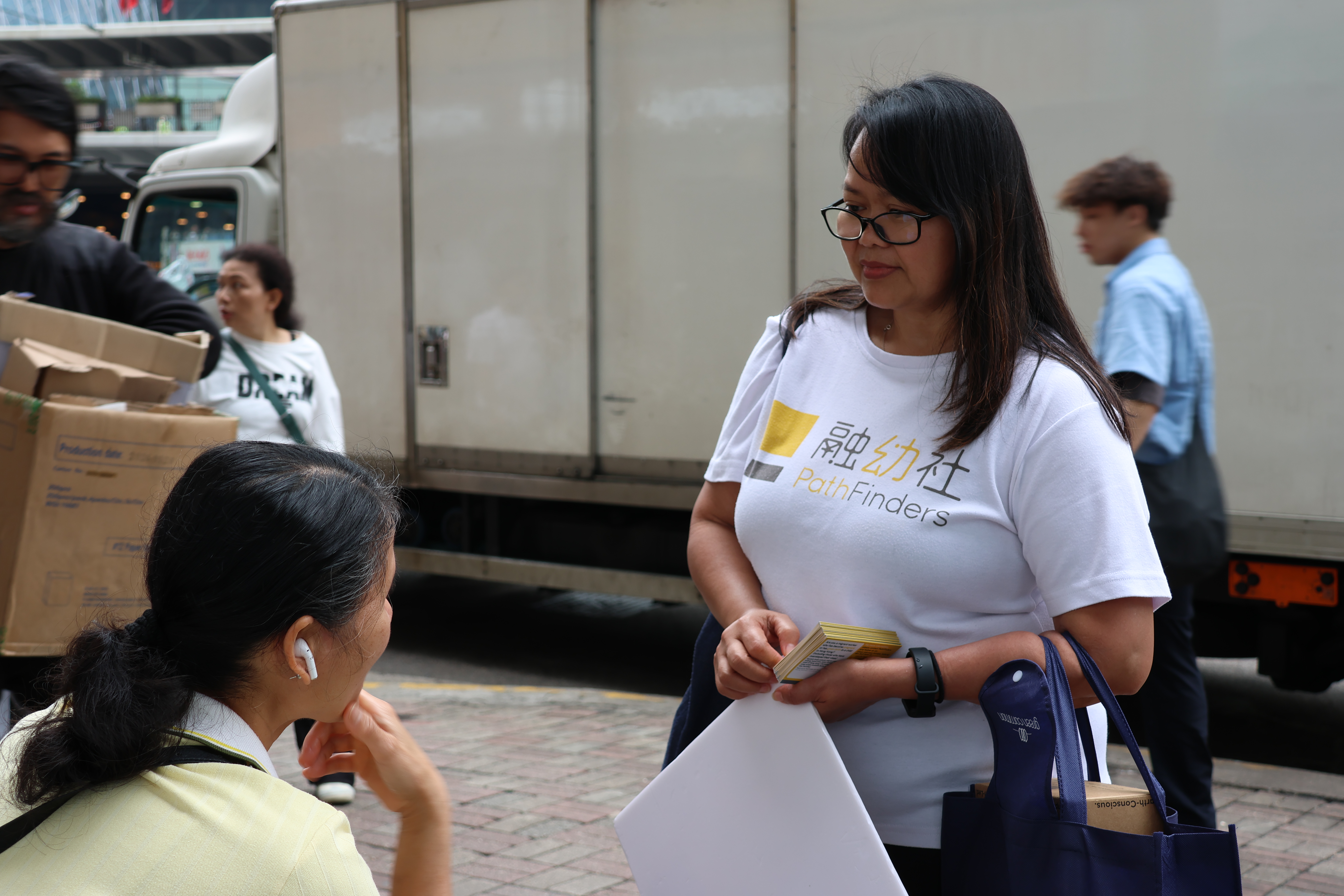
“We go where domestic workers gather,” Natividad said. “We talk to them one by one, casually, like everyday conversations. We explain that if they have problems related to pregnancy, PathFinders is somewhere they can go.” PathFinders is an NGO that supports migrant domestic workers through shelter, healthcare and legal assistance.
“As Filipinos, we know our fellow Filipinos,” Natividad said with a sigh. “We can tell from the way they look at us or answer us whether they want to talk. Many people don’t.”
Despite rejections, Ancheta and Natividad continue to share important resources with their peers.
They are part of a small network of migrant domestic worker ambassadors trained by NGOs, turning their only day off into a lifeline for fellow workers in crisis.
LONG WORKING HOURS
In Hong Kong, there are 368,000 migrant domestic workers providing full-time childcare and elderly care to Hong Kong families. This enables many local families to earn multiple salaries. But Hong Kong’s live-in policy requires domestic workers to live with their employers, blurring the lines between work and life. This policy creates long working hours and mental stress for foreign domestic workers.
A 2019 survey by the Chinese University of Hong Kong found that more than 61% of migrant domestic workers reportedly worked more than 13 hours a day while nearly 9% worked more than 16 hours a day.
“You cannot go to bed as long as your employers do not go to bed,” Ancheta said. Even after falling asleep, she said she may be woken again whenever her employer needs something. Chronic sleep deprivation has become part of her life. During lunch breaks, she often relies on 10 to 20-minute naps to regain enough energy to continue working.
BURIED UNDER DEBT
Many domestic workers come to Hong Kong because they can’t find jobs in their home country. They have no choice but to leave their families to earn a living. But to get to Hong Kong, many have to borrow money just to pay the recruitment agencies, training, and medical examination fees. They arrive already burdened by debt.
A 2019 survey by Enrich found that 83% of Hong Kong migrant domestic workers were in debt. On average, workers needed 19 months to repay what they owed.
For workers trapped in severe debt, Enrich staff also provide counseling and connect them with legal aid organizations. Ira Azwar recalled one worker who borrowed HK$30,000 through illegal lenders. Within a year, the debt ballooned to HK$150,000 including interest. With Enrich’s guidance and financial planning support, the worker was eventually able to repay the debt gradually.
It is common for unemployed family members to ask for money. “When someone asks for your help, you just give. You don’t set boundaries,” said Ancheta.
Enrich’s “Money Wise Migrant” program teaches workers how to budget, build emergency funds and rethink the habit of spending before saving.
Many send remittances back to support their families. Leah Dofredo has three children in the Philippines, ages 24, 22 and 9. Every month, she sends half of her salary home. Under Hong Kong government regulations, the minimum allowable wage for migrant domestic workers is HK$5,100 per month.
Azwar also warned that scammers increasingly target migrant workers in Hong Kong, sometimes using AI technology to impersonate relatives or investors.
“Only with Enrich, they taught us how to first build an emergency fund, then save, then invest,” Ancheta said. “That’s when I stopped living in fear.”
LONGING FOR HOME
For Dofredo, the hardest part of working in Hong Kong is being away from her children. Long working hours leave little time for video calls home. As she spoke about her children, her eyes filled with tears.
Trina Federis, a volunteer with Mission for Migrant Workers shares a story from a former client. “One night, she dreamed about her children back home,” Federis recalled. “She woke up crying and realized she was holding the toilet bowl.”
A 2021 survey by Mission for Migrant Workers found that more than 60% of migrant domestic workers do not have a separate or private room.
UNEXPECTED OBSTACLES
A vast majority of migrant domestic workers are women in their prime child-bearing years. Filipino domestic workers come from conservative Catholic communities where abortion is illegal and contraception is often criticized, leaving pregnant domestic workers with few options when pregnancies occur unexpectedly.
“We are only half a worker here,” said Beberly Lauresta, who has worked in Hong Kong for a decade. Under Hong Kong’s minimum labor requirements, domestic workers can return home once every two years. “Every time I went home, I told my husband not to get me pregnant because I was scared,” Lauresta said. “If a domestic worker became pregnant, employers would often terminate her, and she had very few rights.”
One pregnant worker she supported left for the Philippines after working for months and saving money, Lauresta said. “The experience was very stressful for her.”
A 2020 PathFinders survey of 103 employers found widespread misunderstanding about the rights of pregnant domestic workers. More than half of respondents did not know statutory maternity protections exist, while 84% mistakenly believed that employers could terminate workers immediately if they became pregnant.
Crystal Yip, who employs two domestic workers for more than ten years, said she knew little about the legal protections covering migrant domestic workers. She said most of her understanding came only from contract renewals and insurance paperwork, and she was unaware of the government’s upcoming measures targeting debt problems among domestic workers. “We never really received systematic information from the government,” Yip said. “I actually don’t know much about these policies.”
“Employers also have their own challenges,” said Stephanie Kwok, a senior case worker at PathFinders. “Many of them don’t know enough about the maternity rights that apply to migrant domestic workers. Both the employer and the workers are kind of caught in this situation.”
Like many domestic workers, Lauresta once believed employers could do whatever they wanted to her. She endured mistreatment in silence.
That changed in 2025 when a friend introduced her to PathFinders. At first, Lauresta thought the workshops would not matter to her. “I’m not pregnant anyway,” she said. But after attending training sessions about workers’ legal rights, her perspective changed completely.
“I had never spoken up before,” Lauresta said. “I never even knew I had so many rights.”
When her employer delayed her salary for the third time, she finally confronted her.
“You know, ma’am, if you delay my salary for almost two weeks, that is illegal,” Lauresta told her employer. “I can leave because everybody needs money. I need to support my children and my family.”
Lauresta said this was the reason she became an ambassador.
“I want to become a bridge between NGOs and domestic workers,” she said. “I want to pass the right information to them.”
Beyond organizations like Enrich and PathFinders, other groups focus more directly on the structural problems migrant workers face.
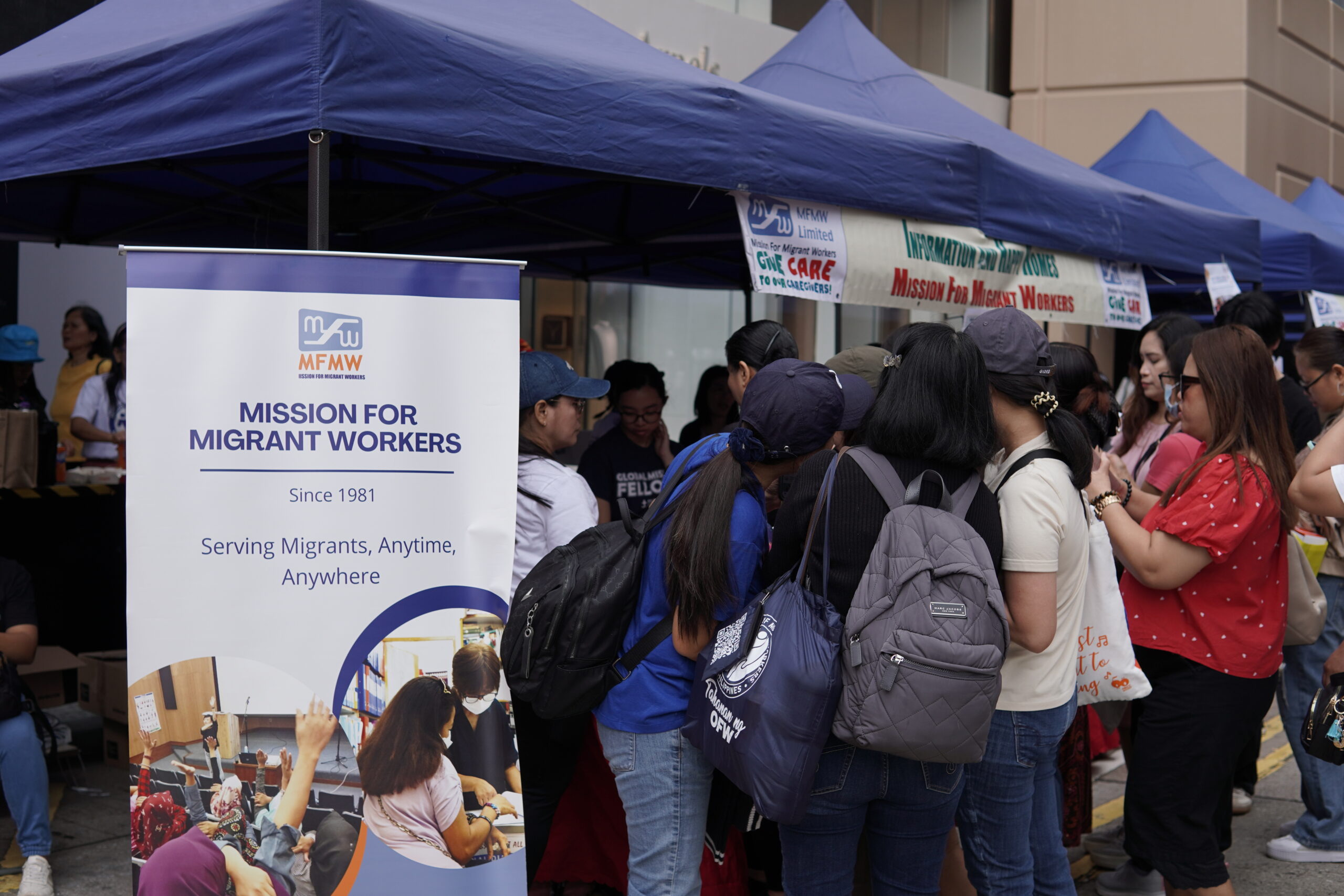
Annie Agravante, who has worked in Hong Kong as a domestic worker for 15 years, regularly spends Sundays helping organise community events and supporting fellow workers in Mission for Migrant Workers.
For workers burdened by debt, the Hong Kong government has recently moved to tighten regulation of money lending. In March 2026, the Financial Services and the Treasury Bureau announced stronger controls on loans targeting domestic workers and low-income groups.
The first phase of measures, which will take effect on August 1, 2026, includes caps on repayment-to-income ratios for lower-income borrowers, restrictions on loan referral systems, and mandatory risk warnings in advertisements.
A second phase beginning in June 2027 will require lenders to report personal loan data regularly to credit platforms and conduct debt checks for high-risk borrowers.
Azwar welcomes the changes.
Agravante’s organization also joined the International Labor Day protest on May 1, calling for improved working conditions and stronger protections.
Under the Hong Kong government’s two-week policy, workers generally must leave Hong Kong within two weeks after a contract ends unless they have found a new employer to extend their contract.
And it is precisely those structural problems that continue to drive ambassadors forward.
“I’m not happy with the situation,” Agravante said. “But I’m happy that people are more aware.”
“There is hope.”
Extra Credits
Advisor
Diana Jou
Editor in Chief
Clarisse Choo
Creative Directors
Syrena Jin
Cheryl Xie
Serena Zhou
Managing Director
Jiachen Li
Copy Editor
Andy Huang
Visual Producer
Isco Zhang
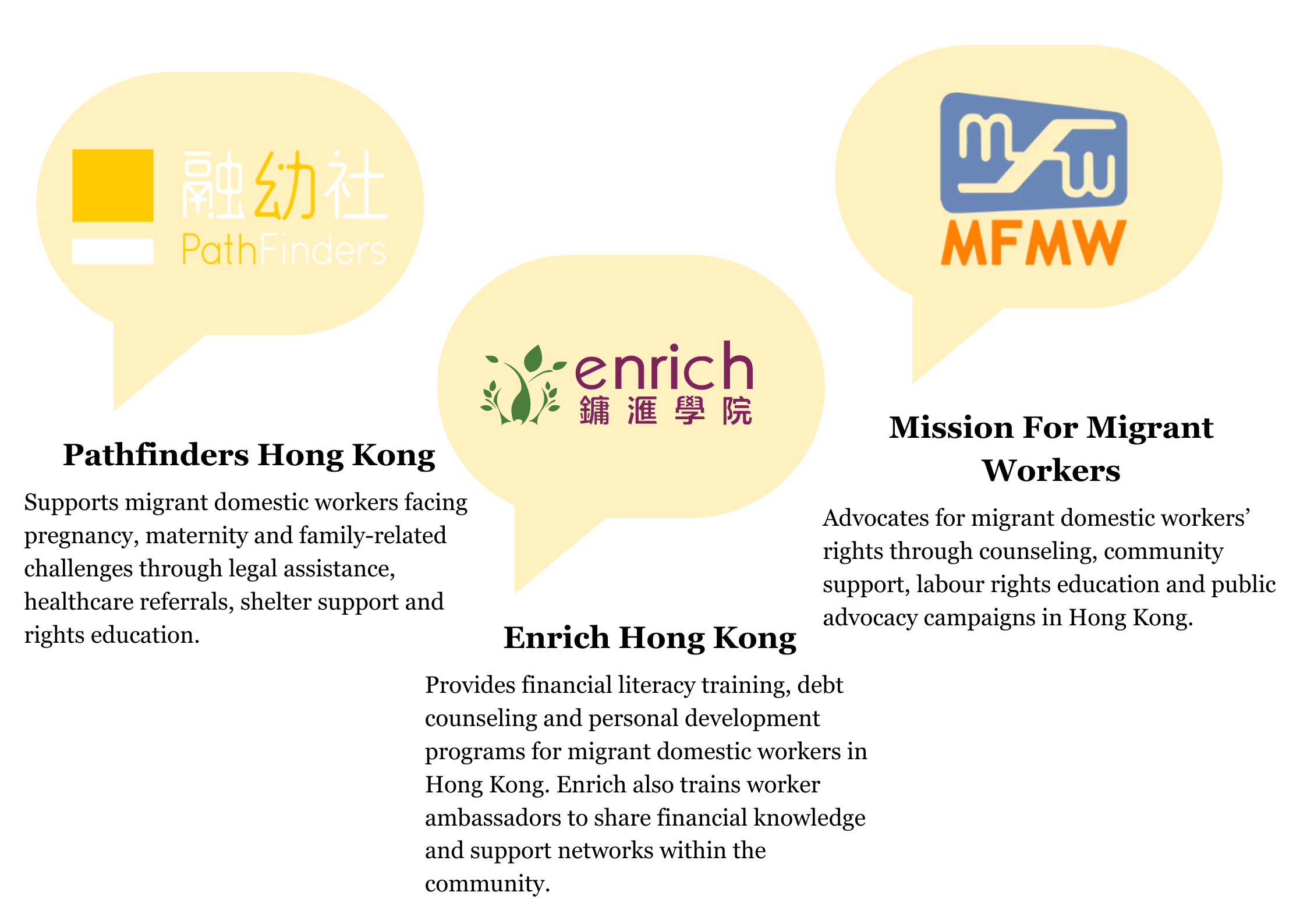
Many thanks to Pathfinders, Enrich, Mission for Migrant Workers
