
Hong Kong Insurance Becomes a Refuge for China’s Wealth — and Talent
By Caroline LIN
As mainland Chinese buyers rush into Hong Kong insurance for wealth protection, healthcare access and offshore security, a growing number of highly educated mainland professionals are also crossing the border — not to buy policies, but to sell them.
At a bustling café in Tsim Sha Tsui, Panpan Wang leans across a marble table, guiding a well-dressed mainland Chinese couple through the final paperwork for a critical illness policy. The sale marks the end of a process that began weeks earlier over WeChat, the popular Chinese messaging super-app.
Only a year ago, Wang’s hands were more accustomed to operating microscopes than flipping through insurance brochures. With a PhD in biomedical sciences, she had once planned a career in drug development. She now works as an insurance agent for Prudential Hong Kong, with nearly all her clients from the Chinese mainland.

It’s an industry on the rise, as mainlanders increasingly demand global asset allocation and more healthcare options, which local policies can’t satisfy.
Panpan Wang, from Mainland China, a PhD holder in Biomedical Science, now an insurance agent for Prudential Hong Kong
Wang is among a growing wave of professionals from mainland China flocking to Hong Kong’s insurance industry, drawn by a market boom fuelled by surging demand from their compatriots. The insurance sector and its affiliated wealth management services offer Chinese job-seekers high commissions and a pathway to maintaining Hong Kong residency through the city’s talent visa schemes.
The boom reflects more than a rising appetite from PRC residents for financial products from Hong Kong. As a real estate-induced economic slump endures, Hong Kong insurance has increasingly become a vehicle for offshore wealth allocation, healthcare security, and inheritance planning.
According to the city’s Insurance Authority, total gross premiums in Hong Kong rose 32.5% year-on-year in the first three quarters of 2025 to HK$637 billion, with new policies climbing to HK$264.5 billion, the highest level for the Jan-Sept period since the regulator was established in 2015.
Although the Authority has stopped publishing detailed mainland buyers data while reviewing its classification system for non-local policyholders, mainland Chinese visitors accounted for HK$62.8 billion worth of new policies in 2024, or 28.6% of total sales — the second-highest proportion on record.
The Anxiety behind the Numbers
Not only does China’s property market, where households have traditionally parked most of their savings, remain depressed after years of developer defaults, but domestic returns on other investments have cratered. The 10-year Chinese sovereign bond yield, for instance, hovers at around 1.8%.

The mentality has changed. Before, people chased returns. Now they care more about the safety of their money.
Jill Mao, from Mainland China, a former international communications expert at Huawei, now an insurance agent for AIA Hong Kong and Macau
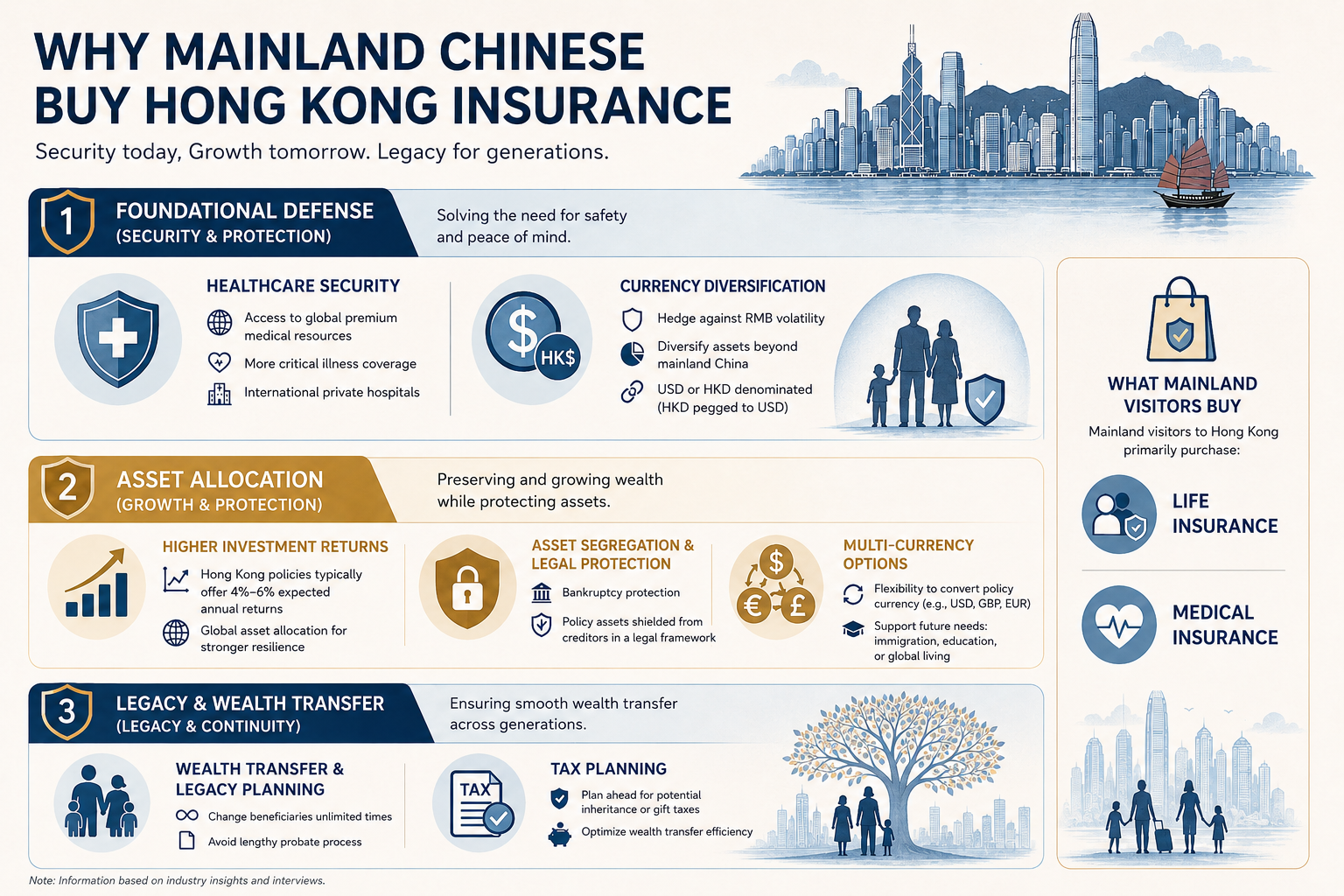
For many mainland buyers, Hong Kong insurance policies are attractive precisely because they are denominated in easily-convertible Hong Kong or U.S. dollars. Since the Hong Kong dollar is pegged to the U.S. currency, the policies offer a relatively accessible way to diversify assets offshore while gaining exposure to higher interest rates than those available on the mainland. Many policies also include savings or investment-like features that increase their appeal as long-term wealth-preservation tools.
In China, citizens face strict capital controls limiting individuals to purchasing US$50,000 worth of foreign currency annually. Insurance has therefore emerged as one of the few relatively straightforward channels for moving wealth abroad.
Customers often pay their first premium using mainland-issued Visa or Mastercard credit cards before opening Hong Kong bank accounts to continue future payments.
Buyers are not only seeking financial returns. Healthcare concerns have also become a major driver of demand.
Maria Lai, a veteran wealth-management professional at Manulife Hong Kong, said private medical insurance has become one of the most popular products among mainland customers. Compared to standard policies, Hong Kong plans allow broader disease coverage and access to private hospitals in multiple countries.
Lai said some Mainland clients have become increasingly concerned about the quality and reliability of lower-cost generic drugs used in China’s public hospitals, fuelling demand for Hong Kong medical coverage and private healthcare access.
For many clients, it’s about trust in the medical system and legal protections.
Maria Lai, Associate Wealth Management Director at Manulife Hong Kong
For wealthy mainland families, Hong Kong insurance is increasingly viewed not merely as protection, but as a tool for preserving and transferring wealth across generations.
China is entering “the golden era of wealth inheritance, Mao believes.
“For the past 30 years, Chinese families focused on creating wealth,” she said. “The next 30 years will be about passing it on.”
Many in the industry expect China to eventually introduce inheritance or gift taxes, which could further increase demand for insurance products designed for wealth transfer and estate planning, Mao adds.
The Talent That Followed the Money
The insurance boom is also reshaping who sells insurance in Hong Kong.
Hong Kong loosened its visa rules in late 2022 after a wave of emigration raised concerns over talent shortages following the Covid-19 pandemic and social turmoil a few years earlier. Since then, roughly 200,000 work visas have been issued under various schemes, with mainland Chinese making up the overwhelming majority of successful applicants.
Data from the Insurance Authority confirms the growth in the number of practitioners. As of February 28, 2026, the number of licensed insurance intermediaries reached 120,900, continuing to increase from 117,500 at the end of September 2025.
Lingtong Li, a Finance postgraduate from the London School of Economics and Political Science, entered Hong Kong under the city’s Top Talent Pass Scheme and now works as an insurance agent for AIA. Most colleagues similarly arrived through talent programmes, with many previously working in investment banking or large Chinese technology firms, she says

Hong Kong is still a financial centre, and insurance has much higher income potential than many traditional jobs.
Lingtong Li, from Mainland China, an LSE postgraduate in Finance, now an insurance agent for AIA
For many mainland professionals facing a weak job market at home, Hong Kong’s insurance industry has become an unlikely career pivot. The sector has relatively low entry barriers — newcomers only need to pass the Insurance Intermediaries Qualifying Examination — while offering flexible working arrangements, potentially lucrative commissions, and access to mainland client networks they already possess. The profession also allows agents to continue serving mainland customers without permanently relocating to Hong Kong.

Screenshot from Jill Mao’s social media account. She and others in the industry are active on social media.
Li says most members of her team are mainland Chinese and primarily serve mainland customers. Many newer agents also use social media platforms and private online networks to attract clients, reshaping the industry’s traditionally relationship-driven sales model.
Mao frequently shares financial-planning and wealth-management content on Chinese social media platforms to attract potential customers.
Wang’s own team reflects a similar profile. Among her more than 20 colleagues, most hold postgraduate degrees from top-tier universities, and several — like Wang herself — have doctorates.
“People are willing to put down the prestige associated with elite degrees and enter this industry because they see growth here,” Wang says.
The industry also offers practical immigration advantages. Under Hong Kong’s visa rules, holders of the Top Talent Pass Scheme can apply to extend their stay if they maintain employment with remuneration at “market level”. According to data from the ERI Economic Research Institute, Hong Kong insurance agents earn an average annual base salary of HK$473,564, excluding bonuses, which is above what maintaining the Pass requires.
Several agents interviewed for this story note top performers can earn more than HK$10 million annually through commissions and bonuses, though most acknowledged the industry has an extreme “winner-takes-most” structure.
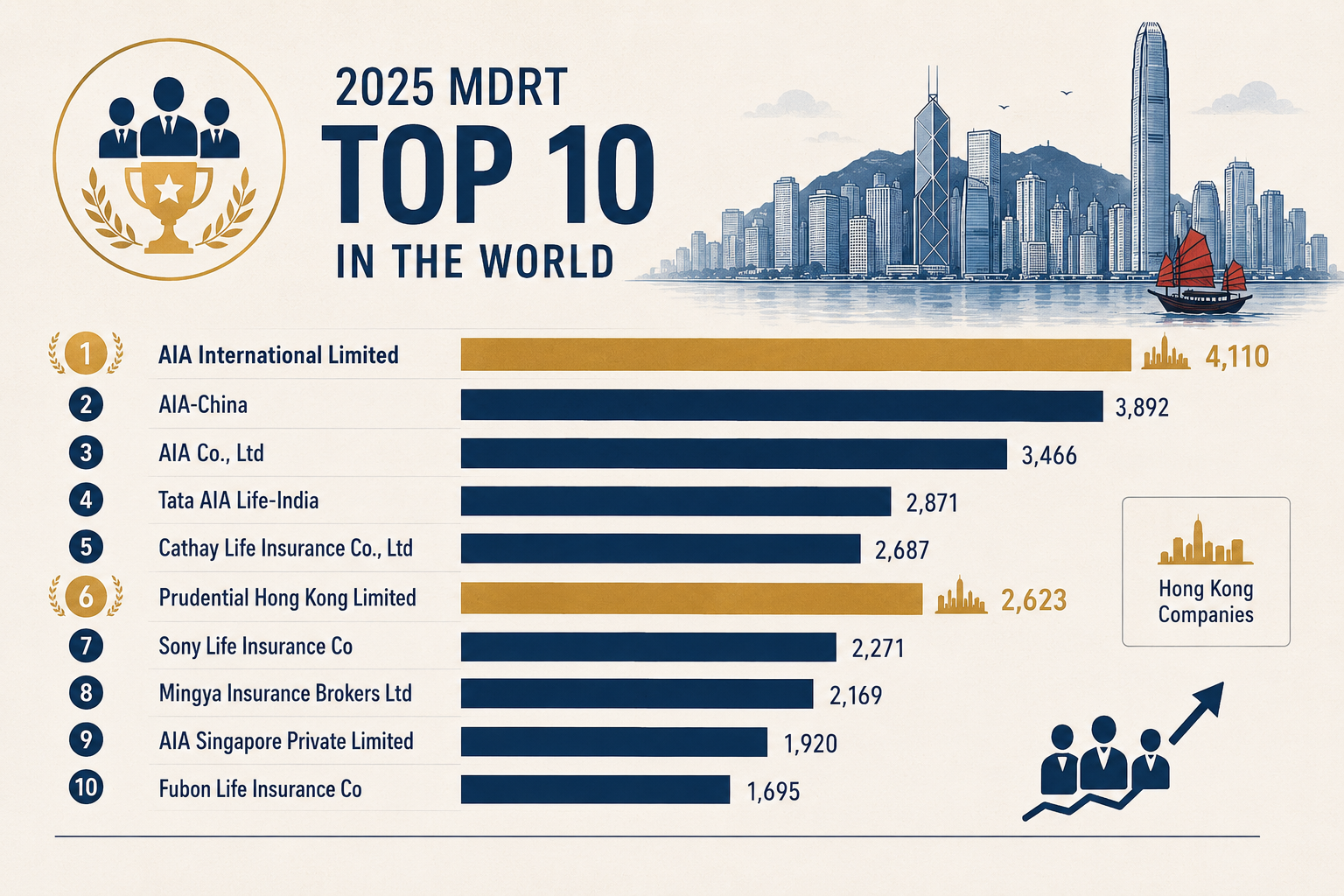
MDRT, or the Million Dollar Round Table, is a prestigious benchmark in insurance for top agents with stellar sales and hefty commissions. (AI image powered by ChatGPT with source from MDRT)
Betting on the Boom
I nsurers’ financial fortunes are improving amidst the boom in Mainland demand. AIA said in April that its value of new business — a key measure of profitability — rose 21% in the first quarter, driven by growth from both local customers and mainland Chinese visitors.
Meanwhile, insurance accounted for more than a quarter of wealth-management revenue at HSBC in the first half of last year. According to the South China Morning Post, the bank has considered shifting more resources toward its insurance operations in Hong Kong and mainland China, describing the markets as “core high-growth” areas with “underpenetrated” demand for insurance products.
Mainland clients often view Hong Kong as safer and culturally closer than other offshore financial centres such as Singapore, Mao says. “Hong Kong is backed by China while remaining internationally connected,” she notes, adding that some clients worry other overseas jurisdictions may become less accommodating toward Chinese wealth amid rising geopolitical tensions between China and the West.
The resurgence of mainland demand has helped revive an industry that suffered badly during the pandemic, when border closures cut off the steady flow of Chinese visitors into Hong Kong.
Yet the current wave feels different from the pre-pandemic boom. Buyers today appear less driven by aggressive wealth accumulation than by a search for security — financial, medical, and even geographical.
Illustration by ChatGPT & Gemini
Extra Credits
Advisor Jean-Francois Tremblay
Author

Tags: Business, Finance, Insurance