
Who Really Pays for Keeta's Discounts
Keeta’s Proposed Antitrust Commitments: What Market Voices Reveal About the Future of Hong Kong Delivery
by Jiaxi Qi & Xintong Liu

Inside a decade-old congee shop in Western District, owner Mr. Chen watched HK$45 vanish from a HK$150 delivery order before the food even left his kitchen. The 30 percent commission fee to Keeta is just the starter – he often needs to fund the Red Pocket discounts the platform offers to customers. When he called Keeta to opt out of these promotions, he was told the settings could not be changed.
Chen said he has to pay for the delivery fees as well, which eats directly into his revenue and profit. “The more orders I take, the more money I lose,” he said.
The lack of bargaining power is systematic. Keeta and Foodpanda, the duopoly in the food delivery market in Hong Kong, have similar commission rates and promotions rules, leaving little room for restaurants to negotiate but to accept the harsh terms.
The lack of choice has caught the eyes of the Hong Kong Competition Commission (HKCC), the city’s watchdog on fair-trading practice. An investigation was launched into whether the food delivery platforms are hindering competition with exclusive agreements, restrictive practices, and price-parity clauses. The watchdog is seeking public opinion through May 12 to determine if legally binding commitments from the platform can prevent them from penalizing merchants who seek alternatives.
Inside a decade-old congee shop in Western District, owner Mr. Chen watched HK$45 vanish from a HK$150 delivery order before the food even left his kitchen. The 30 percent commission fee to Keeta is just the starter – he often needs to fund the Red Pocket discounts the platform offers to customers. When he called Keeta to opt out of these promotions, he was told the settings could not be changed.
Chen said he has to pay for the delivery fees as well, which eats directly into his revenue and profit. “The more orders I take, the more money I lose,” he said.
The lack of bargaining power is systematic. Keeta and Foodpanda, the duopoly in the food delivery market in Hong Kong, have similar commission rates and promotions rules, leaving little room for restaurants to negotiate but to accept the harsh terms.
The lack of choice has caught the eyes of the Hong Kong Competition Commission (HKCC), the city’s watchdog on fair-trading practice. An investigation was launched into whether the food delivery platforms are hindering competition with exclusive agreements, restrictive practices, and price-parity clauses. The watchdog is seeking public opinion through May 12 to determine if legally binding commitments from the platform can prevent them from penalizing merchants who seek alternatives.
The Two-Year Takeover
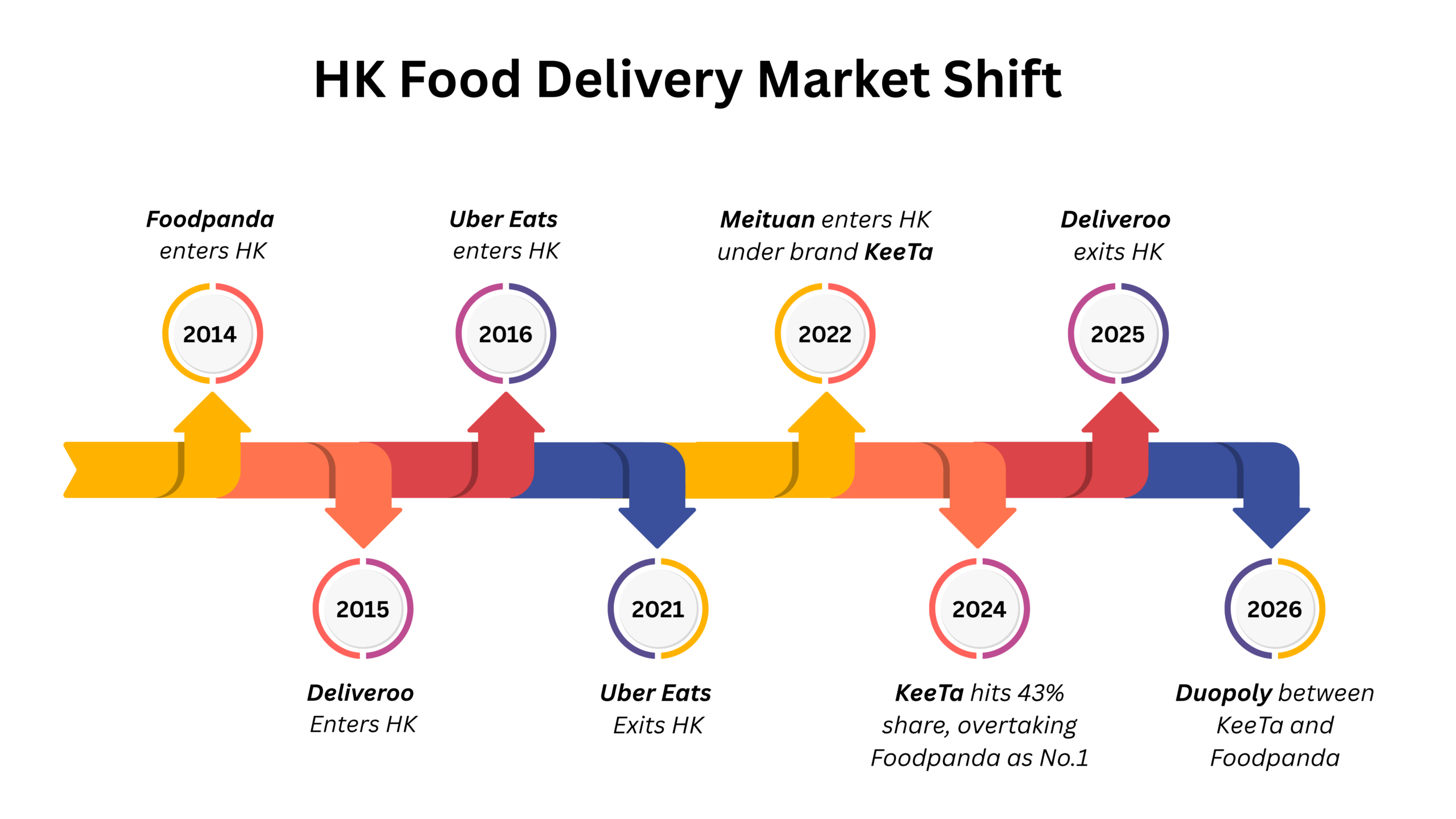
Food delivery apps have been in Hong Kong for over a decade. Foodpanda started in 2014, followed by Deliveroo in 2015 and Uber Eats in 2016. But Uber Eats exited at the end of 2021, leaving Foodpanda and Deliveroo as the duopoly for nearly two years.
Then Keeta burst into the scene in May 2023, disrupting the quiet equilibrium.
Keeta, a subsidiary of Meituan, China’s food delivery giant, came with a bang – a HK$1-billion subsidy push: cash vouchers, zero delivery fees, and HK$29 single-person meals at a time when comparable restaurant meals in the city cost HK$80 to HK$100.
It was a highly effective entry. According to data firm Measurable AI, Keeta’s share of food delivery GMV reached 21 percent by December 2023, just seven months after its launch. Three months later, Keeta overtook both Foodpanda and Deliveroo by order volume, taking 43 percent of market share, compared to Foodpanda’s 37 percent and Deliveroo’s 20 percent. More than 80 percent of orders placed on Keeta in 2023 were attached to a promotion.
Deliveroo smelled defeat and announced its exit from the Hong Kong market on March 10, 2025, after nine years in the city. It sold its remaining assets to Delivery Hero, the German group that owns Foodpanda.
The resultant duopoly between Keeta and Foodpanda drew a probe by the HKCC into Keeta’s agreements with restaurants, which tied lower commission rates to exclusivity, effectively restricting partner restaurants from working with other platforms.
While Keeta has promised to stop the exclusive agreement recently, the financial squeeze on small shops is only getting tighter. Even for exclusive restaurants like Chen’s congee shop, the commission rate has risen by 2 percent to 30 percent since the Spring Festival.
Keeta’s tighter grip on the Hong Kong market reflects the broader challenge its parent Meituan is facing in China and overseas markets, which drove share price down nearly 80 percent from its 2021 peak. According to GuruFocus and Meituan’s 2025 annual results, Meituan plunged into a net loss of 23.4 billion Chinese yuan in 2025, compared to a profit of 35.8 billion yuan in 2024. The loss came despite an 8 percent year-on-year growth in revenue, as the company grappled with a cut-throat price war in the instant commerce space in China. To diversify its revenue source, Meituan has embarked on a major overseas expansion drive, including markets like Saudi Arabia and Brazil.
Keeta is not the only platform operating in such a way. According to restaurant owners, Foodpanda and Keeta charge the same commission rates, not to mention the discount coupons and delivery fees the restaurants must swallow.
Back in 2023, the watchdog concluded an investigation into Foodpanda and Deliveroo regarding anti-competitive practices, with both platforms accepting binding commitments, to remove exclusive, price-fixing, and bundling terms, for three years.
Food delivery apps have been in Hong Kong for over a decade. Foodpanda started in 2014, followed by Deliveroo in 2015 and Uber Eats in 2016. But Uber Eats exited at the end of 2021, leaving Foodpanda and Deliveroo as the duopoly for nearly two years.
Then Keeta burst into the scene in May 2023, disrupting the quiet equilibrium.
Keeta, a subsidiary of Meituan, China’s food delivery giant, came with a bang – a HK$1-billion subsidy push: cash vouchers, zero delivery fees, and HK$29 single-person meals at a time when comparable restaurant meals in the city cost HK$80 to HK$100.
It was a highly effective entry. According to data firm Measurable AI, Keeta’s share of food delivery GMV reached 21 percent by December 2023, just seven months after its launch. Three months later, Keeta overtook both Foodpanda and Deliveroo by order volume, taking 43 percent of market share, compared to Foodpanda’s 37 percent and Deliveroo’s 20 percent. More than 80 percent of orders placed on Keeta in 2023 were attached to a promotion.
Deliveroo smelled defeat and announced its exit from the Hong Kong market on March 10, 2025, after nine years in the city. It sold its remaining assets to Delivery Hero, the German group that owns Foodpanda.
The resultant duopoly between Keeta and Foodpanda drew a probe by the HKCC into Keeta’s agreements with restaurants, which tied lower commission rates to exclusivity, effectively restricting partner restaurants from working with other platforms.
While Keeta has promised to stop the exclusive agreement recently, the financial squeeze on small shops is only getting tighter. Even for exclusive restaurants like Chen’s congee shop, the commission rate has risen by 2 percent to 30 percent since the Spring Festival.
Keeta’s tighter grip on the Hong Kong market reflects the broader challenge its parent Meituan is facing in China and overseas markets, which drove share price down nearly 80 percent from its 2021 peak. According to GuruFocus and Meituan’s 2025 annual results, Meituan plunged into a net loss of 23.4 billion Chinese yuan in 2025, compared to a profit of 35.8 billion yuan in 2024. The loss came despite an 8 percent year-on-year growth in revenue, as the company grappled with a cut-throat price war in the instant commerce space in China. To diversify its revenue source, Meituan has embarked on a major overseas expansion drive, including markets like Saudi Arabia and Brazil.
Keeta is not the only platform operating in such a way. According to restaurant owners, Foodpanda and Keeta charge the same commission rates, not to mention the discount coupons and delivery fees the restaurants must swallow.
Back in 2023, the watchdog concluded an investigation into Foodpanda and Deliveroo regarding anti-competitive practices, with both platforms accepting binding commitments, to remove exclusive, price-fixing, and bundling terms, for three years.
Restaurants: The Volume Game
For restaurants, the services and contract terms offered by the food delivery platform can vary greatly.
For well-established outlets, Keeta is a critical growth engine. Saint Noodles’ management is optimistic on the delivery channel, as their delivery orders have thrived since cooperating with Keeta, and Keeta’s order flow has outperformed other platforms. “It’s exploding,” a staff member said, but withheld the specific volumes for commercial sensitivity.
This scale provides operating leverage. The merchant reveals that its commission is not a flat fee but volume-based. “If you do HK$100,000 or HK$200,000, it’s different… the more you sell, the lower the commission,” the staff explained.
For these businesses, the platform’s efficiency in handling delivery disputes – often without charging the merchant for failed deliveries – complements the model built on high-turnover volume.
But for small owners like Chen, the story is different. His congee shop primarily serves residents in the neighborhood. On some days, he receives only two delivery orders.
He finds the platforms’ support dismissive and perfunctory. Merchants are often given standardized, scripted responses from remote staff without any real assistance. When merchants try to raise an issue, the operators only offer two scripted responses: “I’ll check with customer service” or “I’m sorry.”
Other merchants have a more transactional view of the platforms. One roasted meat shop owner Mr. Xu sees Keeta as a logistic provider and is indifferent toward its markups or commission percentages. As long as the payout meets his targeted revenue of HK$30 per meal, the platform is free to set any price for the consumer.
“You can sell it for HK$100, that’s your problem,” Xu said, adding that he only cares about his own bottom line.
As of 2026, Keeta partners with approximately 15,000 merchants (per Sing Tao Daily), while Foodpanda maintains a network of over 14,000 restaurant partners according to InvestHK. For Hong Kong’s estimated 17,600 licensed eateries – a figure from the Legislative Council Secretariat – maintaining a presence on both platforms is a strategic necessity to capture shifting consumer habits.
For restaurants, the services and contract terms offered by the food delivery platform can vary greatly.
For well-established outlets, Keeta is a critical growth engine. Saint Noodles’ management is optimistic on the delivery channel, as their delivery orders have thrived since cooperating with Keeta, and Keeta’s order flow has outperformed other platforms. “It’s exploding,” a staff member said, but withheld the specific volumes for commercial sensitivity.
This scale provides operating leverage. The merchant reveals that its commission is not a flat fee but volume-based. “If you do HK$100,000 or HK$200,000, it’s different… the more you sell, the lower the commission,” the staff explained.
For these businesses, the platform’s efficiency in handling delivery disputes – often without charging the merchant for failed deliveries – complements the model built on high-turnover volume.
But for small owners like Chen, the story is different. His congee shop primarily serves residents in the neighborhood. On some days, he receives only two delivery orders.
He finds the platforms’ support dismissive and perfunctory. Merchants are often given standardized, scripted responses from remote staff without any real assistance. When merchants try to raise an issue, the operators only offer two scripted responses: “I’ll check with customer service” or “I’m sorry.”
Other merchants have a more transactional view of the platforms. One roasted meat shop owner Mr. Xu sees Keeta as a logistic provider and is indifferent toward its markups or commission percentages. As long as the payout meets his targeted revenue of HK$30 per meal, the platform is free to set any price for the consumer.
“You can sell it for HK$100, that’s your problem,” Xu said, adding that he only cares about his own bottom line.
As of 2026, Keeta partners with approximately 15,000 merchants (per Sing Tao Daily), while Foodpanda maintains a network of over 14,000 restaurant partners according to InvestHK. For Hong Kong’s estimated 17,600 licensed eateries – a figure from the Legislative Council Secretariat – maintaining a presence on both platforms is a strategic necessity to capture shifting consumer habits.
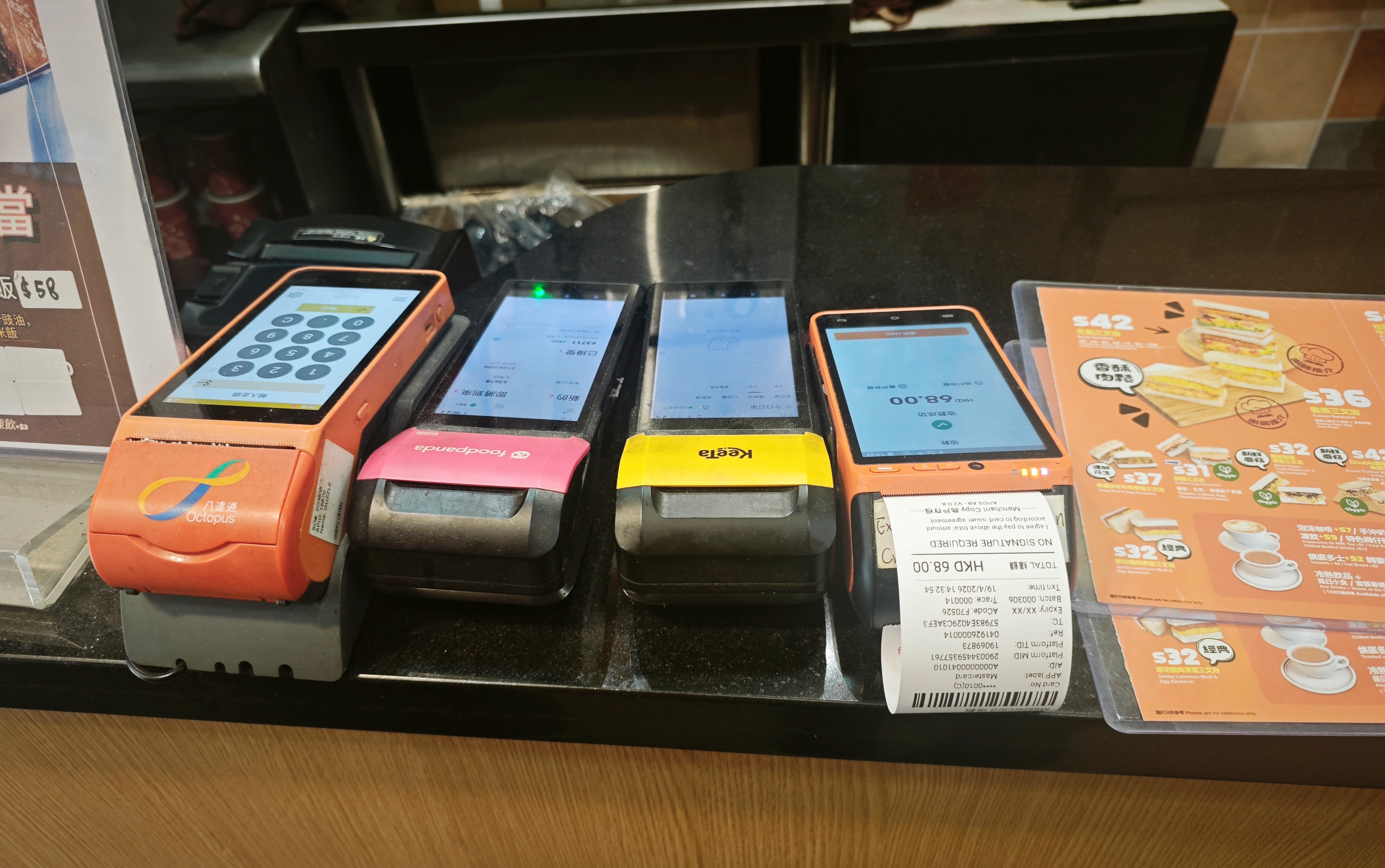
Workers at local diners observe that order volumes often fluctuate based on which app is running a more aggressive marketing campaign at any given time. “Whichever one has the discount, that’s where the customers go,” explained a staff member who worked at Guzzle Central, a sandwich shop in Central.
Workers at local diners observe that order volumes often fluctuate based on which app is running a more aggressive marketing campaign at any given time. “Whichever one has the discount, that’s where the customers go,” explained a staff member who worked at Guzzle Central, a sandwich shop in Central.
Riders: The Other End of the Chain
The pressure platforms exerted on restaurants is only one side of the equation. The same competitive logic that drives up commissions and forces merchants to subsidize consumers extends to the other end of the supply chain –the riders who deliver the orders.
When Lam Gei arrived from the mainland in 2022, food delivery gave him the first foothold in Hong Kong. But the three-year ride came with diminishing returns – he recalls earning around HK$23,000 a month in his first year riding for Keeta. By the second year, that slipped to HK$21,000. This year, he estimates around HK$20,000. “The first year was the best,” he said. “They probably needed to grab market share, so everything was at its best.”
Many Keeta riders experienced a similar decline in both order volume and per-order pay over the past two years. From part-time students to new arrivals working full-time, who came from varied backgrounds, their accounts converged on the same inflection point: as the subsidy period ends, their income falls.
Frankie, a veteran rider with eight years of experience across Uber Eats and Foodpanda, has a taste of the industry cycle from expansion to contraction. Order volume is falling, he said, and income drops accordingly. He sees the experience in mainland China as a warning sign.
“Platform competition on the mainland is fierce, and per-order pay there is extremely low,” Frankie said. “I think Hong Kong’s rates will follow, and that will cut riders’ incomes.”
For now, one structural buffer holds. “Hong Kong still hasn’t legalized e-bikes, so platforms still rely on motorcycles and on-foot riders, which keeps per-order pay higher than on the mainland.” But the buffer may be eroding soon.
Brady, a 38-year-old Keeta rider who joined after a period of unemployment, sees another drawback of the system for riders: merchants may mark an order as packed before it is ready; when customers complain, the platforms typically side with the merchants. “The platform doesn’t supervise merchants,” he said. “They take the order, they know what happened, but in the end it’s the riders who bear the consequences.”
Brady’s account captures the potential tension between merchants and riders: they sit at opposite ends of the chain and face slightly different challenges from the platforms, but they often end in the same predicament. The platforms write the rules. Someone else bears the costs.
The exclusive partnership arrangement that drew the Competition Commission’s ire in 2025 is the part of platform power that is explicit on paper. Beyond the written contract, a large grey area remains.
The pressure platforms exerted on restaurants is only one side of the equation. The same competitive logic that drives up commissions and forces merchants to subsidize consumers extends to the other end of the supply chain –the riders who deliver the orders.
When Lam Gei arrived from the mainland in 2022, food delivery gave him the first foothold in Hong Kong. But the three-year ride came with diminishing returns – he recalls earning around HK$23,000 a month in his first year riding for Keeta. By the second year, that slipped to HK$21,000. This year, he estimates around HK$20,000. “The first year was the best,” he said. “They probably needed to grab market share, so everything was at its best.”
Many Keeta riders experienced a similar decline in both order volume and per-order pay over the past two years. From part-time students to new arrivals working full-time, who came from varied backgrounds, their accounts converged on the same inflection point: as the subsidy period ends, their income falls.
Frankie, a veteran rider with eight years of experience across Uber Eats and Foodpanda, has a taste of the industry cycle from expansion to contraction. Order volume is falling, he said, and income drops accordingly. He sees the experience in mainland China as a warning sign.
“Platform competition on the mainland is fierce, and per-order pay there is extremely low,” Frankie said. “I think Hong Kong’s rates will follow, and that will cut riders’ incomes.”
For now, one structural buffer holds. “Hong Kong still hasn’t legalized e-bikes, so platforms still rely on motorcycles and on-foot riders, which keeps per-order pay higher than on the mainland.” But the buffer may be eroding soon.
Brady, a 38-year-old Keeta rider who joined after a period of unemployment, sees another drawback of the system for riders: merchants may mark an order as packed before it is ready; when customers complain, the platforms typically side with the merchants. “The platform doesn’t supervise merchants,” he said. “They take the order, they know what happened, but in the end it’s the riders who bear the consequences.”
Brady’s account captures the potential tension between merchants and riders: they sit at opposite ends of the chain and face slightly different challenges from the platforms, but they often end in the same predicament. The platforms write the rules. Someone else bears the costs.
The exclusive partnership arrangement that drew the Competition Commission’s ire in 2025 is the part of platform power that is explicit on paper. Beyond the written contract, a large grey area remains.
The Regulatory Backlash
Keeta’s strong market power over both restaurants and riders has not gone unnoticed. In November 2025, the HKCC considered Keeta’s provisions for lower commission rate for restaurants with exclusive partnership as well as penalty for adding partnering platforms as anti-competitive as they may hinder new entrants. Further, the ban on partner restaurants from offering lower menu prices on their direct channels and on competing online platforms may hurt consumer interests.
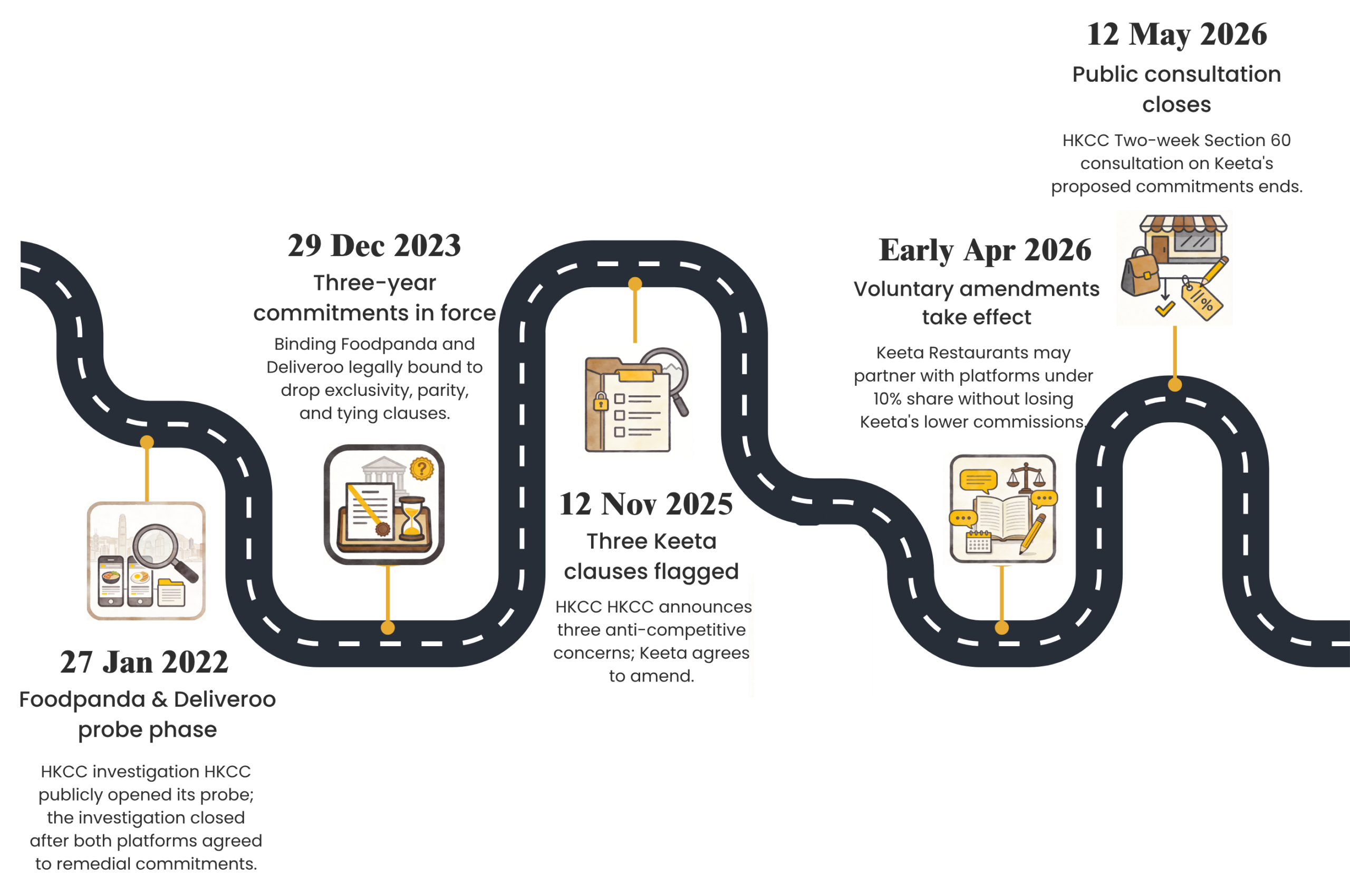
In response to the potential violations of anti-competitive conduct, Keeta has agreed to make voluntary amendments to its contracts effective early April 2026. The Commission is now moving to make these changes legally binding and enforceable through an official commitment from Keeta.
Under the proposed terms, restaurants can partner with small platforms – defined as those with less than 10 percent market share in Hong Kong – without losing the lower commission rates or other incentives offered with Keeta. The Commission stated that these commitments are “appropriate to address its competition concerns” and has proposed their formal acceptance following a consultation period ending on May 12, 2026.
It is the most concrete restraint on platform conduct since Foodpanda and Deliveroo accepted similar binding commitments in December 2023. But the restriction has its limits.
According to the First Conduct Rule under Hong Kong’s Competition Ordinance, business arrangements that do not fall within the four categories of “serious anti-competitive conduct” such as cartels, price-fixing, market sharing, and bid-rigging must first receive a warning notice before the Commission can pursue action. Only if the warning is ignored can enforcement follow.
“If all you get is a warning, why would you care? You would do it again,” said Thomas Cheng, associate dean of the Faculty of Law at the University of Hong Kong who is an expert in competition law and helped draft the city’s competition ordinance.
But many of the platforms’ day-to-day actions that impact merchants are outside the scope of the regulatory commitment to HKCC and therefore not well-known or regulated. For instance, higher commission rate during high seasons, sharing of customers’ subsidies that cannot be switched off, and payment of delivery fee by restaurants.
“The platforms are sophisticated, and a lot of these agreements are private,” Cheng said. “These are confidential commercial agreements. You don’t even know it’s happening.”
Keeta’s strong market power over both restaurants and riders has not gone unnoticed. In November 2025, the HKCC considered Keeta’s provisions for lower commission rate for restaurants with exclusive partnership as well as penalty for adding partnering platforms as anti-competitive as they may hinder new entrants. Further, the ban on partner restaurants from offering lower menu prices on their direct channels and on competing online platforms may hurt consumer interests.
In response to the potential violations of anti-competitive conduct, Keeta has agreed to make voluntary amendments to its contracts effective early April 2026. The Commission is now moving to make these changes legally binding and enforceable through an official commitment from Keeta.
Under the proposed terms, restaurants can partner with small platforms – defined as those with less than 10 percent market share in Hong Kong – without losing the lower commission rates or other incentives offered with Keeta. The Commission stated that these commitments are “appropriate to address its competition concerns” and has proposed their formal acceptance following a consultation period ending on May 12, 2026.
It is the most concrete restraint on platform conduct since Foodpanda and Deliveroo accepted similar binding commitments in December 2023. But the restriction has its limits.
According to the First Conduct Rule under Hong Kong’s Competition Ordinance, business arrangements that do not fall within the four categories of “serious anti-competitive conduct” such as cartels, price-fixing, market sharing, and bid-rigging must first receive a warning notice before the Commission can pursue action. Only if the warning is ignored can enforcement follow.
“If all you get is a warning, why would you care? You would do it again,” said Thomas Cheng, associate dean of the Faculty of Law at the University of Hong Kong who is an expert in competition law and helped draft the city’s competition ordinance.
But many of the platforms’ day-to-day actions that impact merchants are outside the scope of the regulatory commitment to HKCC and therefore not well-known or regulated. For instance, higher commission rate during high seasons, sharing of customers’ subsidies that cannot be switched off, and payment of delivery fee by restaurants.
“The platforms are sophisticated, and a lot of these agreements are private,” Cheng said. “These are confidential commercial agreements. You don’t even know it’s happening.”
The Platform as Mirror
Behind the powerlessness merchants describe sits a legal gap.
“The contract is voluntary in a legal sense,” Cheng said, “even though in everyday common sense we probably wouldn’t consider it voluntary.”
For Cheng, the underlying economics also does not change: it’s essentially a zero-sum game. “The platforms get more, the restaurants get less,” he said. “There’s only HK$100 in that transaction. It doesn’t grow.”
Delivery platforms are not the only problem for Hong Kong’s restaurants. Wong Ka-wo, chairman of the Hong Kong Catering Industry Association, has attributed the current downturn in the food and beverage industry primarily to a sluggish economy and weakening local spending.
The numbers tell that story too. The Hong Kong Restaurant Association counted nearly 300 closures in the first half of 2025, with food and beverage making up around 70 percent. And it’s not just top-line pressure: rent alone can absorb 30 to 35 percent of a typical restaurant’s budget, according to a 2025 analysis by consultancy YCP Group. Labour bills have climbed sharply too, after the government ended a four-year freeze on the statutory minimum wage in 2023 and raised it again in 2025. Platform commissions are just one line item on a longer list.
The squeeze is also uneven. “The more you turn over, the lower the take rate,” said a staff member at a top-ranked Keeta restaurant. “If you don’t hit that threshold, you stay at the higher rate.”
High-volume restaurants negotiate from a stronger position that their smaller counterparts do not have. Large food and beverage chains arrive with their legal teams. Long-established neighbourhood eateries are supported by regulars and barely need the apps. Merchants that are in between, with poor brand recognition, lower volume, and weaker leverage, have nowhere to go when the algorithm turns against them.
Jeremy Prepscius, managing director of sustainable supply chains at PwC, pushes back on Cheng’s zero-sum framing as too static. “For merchants whose food is well-suited to delivery, the platform is an enabler,” he said. “But for those whose food isn’t, the platform may simply be compressing their lifecycle.”
In his view, some of the restaurants who are losing ground, are already close to the edge. For F&B outlets built on foot traffic and menus that don’t travel well, the delivery boom may have left them behind. The opportunity has gone elsewhere.
Behind the powerlessness merchants describe sits a legal gap.
“The contract is voluntary in a legal sense,” Cheng said, “even though in everyday common sense we probably wouldn’t consider it voluntary.”
For Cheng, the underlying economics also does not change: it’s essentially a zero-sum game. “The platforms get more, the restaurants get less,” he said. “There’s only HK$100 in that transaction. It doesn’t grow.”
Delivery platforms are not the only problem for Hong Kong’s restaurants. Wong Ka-wo, chairman of the Hong Kong Catering Industry Association, has attributed the current downturn in the food and beverage industry primarily to a sluggish economy and weakening local spending.
The numbers tell that story too. The Hong Kong Restaurant Association counted nearly 300 closures in the first half of 2025, with food and beverage making up around 70 percent. And it’s not just top-line pressure: rent alone can absorb 30 to 35 percent of a typical restaurant’s budget, according to a 2025 analysis by consultancy YCP Group. Labour bills have climbed sharply too, after the government ended a four-year freeze on the statutory minimum wage in 2023 and raised it again in 2025. Platform commissions are just one line item on a longer list.
The squeeze is also uneven. “The more you turn over, the lower the take rate,” said a staff member at a top-ranked Keeta restaurant. “If you don’t hit that threshold, you stay at the higher rate.”
High-volume restaurants negotiate from a stronger position that their smaller counterparts do not have. Large food and beverage chains arrive with their legal teams. Long-established neighbourhood eateries are supported by regulars and barely need the apps. Merchants that are in between, with poor brand recognition, lower volume, and weaker leverage, have nowhere to go when the algorithm turns against them.
Jeremy Prepscius, managing director of sustainable supply chains at PwC, pushes back on Cheng’s zero-sum framing as too static. “For merchants whose food is well-suited to delivery, the platform is an enabler,” he said. “But for those whose food isn’t, the platform may simply be compressing their lifecycle.”
In his view, some of the restaurants who are losing ground, are already close to the edge. For F&B outlets built on foot traffic and menus that don’t travel well, the delivery boom may have left them behind. The opportunity has gone elsewhere.
After the Subsidies, What Comes Next
In October 2025, Keeta announced it had turned profitable in Hong Kong just 29 months after launch, six months ahead of schedule. Meituan CEO Wang Xing framed it as proof of concept for Meituan’s global ambitions. Hong Kong was never the destination — it was a stepping stone for shores afar in Meituan’s overseas expansion.
The roadmap that follows has not been formally announced. But according to a January 2026 industry report by TechBuzz China, which cited Meituan’s internal three-year plan, the company intends to increase resource investment in instant retail in 2026 and to test a series of new formats in Hong Kong, including Keemart (its grocery brand), supermarkets, power bank rentals, and hotel bookings. The same plan also identifies international payment solutions and in-store consumption services as areas for exploration.
Among the planned businesses, the one most directly tied to restaurants is Meituan’s in-store services, including reservations, coupons and reviews that help drive dine-in traffic. The segment generated 47 billion yuan in revenue in 2024, according to Meituan’s annual report, making it one of the company’s two main local commerce businesses alongside food delivery.
None of these services have launched in Hong Kong so far. But Keemart had already expanded into Saudi Arabia by late 2024, suggesting that a broader rollout in Hong Kong may be only a matter of time.
Foodpanda, meanwhile, is betting on scale and service diversification. The platform reported more than 20 percent year-on-year growth in both order volume and transaction value in early 2025. Hong Kong’s online food delivery penetration rate reached 38 percent in 2025, according to Kepios data cited by Foodpanda Hong Kong CEO Ryan Lai in an interview with the South China Morning Post.
As platforms expand beyond food delivery, restaurants and riders may find themselves tied to a broader ecosystem of local commerce — one that reaches beyond delivery orders into groceries, dine-in traffic and everyday consumer services.
Professor Cheng sees a clear trajectory. “The more competitive it gets between Keeta and Foodpanda, the more incentive they have to cut costs, and the only way to do that is to squeeze the restaurants.”
How fiercely the two platforms compete may turn out to be the key that determines the fate of everyone else in the chain.
Lam Gei logged in this morning. The app showed available orders. He took one. It paid HK$22 — less than last year, and likely less than what riders earned during the subsidy war.
A few miles away, Mr. Chen watched another HK$45 disappear from another HK$150 order. He kept the kitchen running anyway.
The Competition Commission’s consultation closes on May 12, 2026. Whether the proposed commitments can materially rebalance bargaining power in Hong Kong’s delivery market remains unclear. But after years of subsidies and expansion, the industry’s next phase is already taking shape: a market where platforms compete for profitability, and where much of that pressure continues to flow down the chain.
In October 2025, Keeta announced it had turned profitable in Hong Kong just 29 months after launch, six months ahead of schedule. Meituan CEO Wang Xing framed it as proof of concept for Meituan’s global ambitions. Hong Kong was never the destination — it was a stepping stone for shores afar in Meituan’s overseas expansion.
The roadmap that follows has not been formally announced. But according to a January 2026 industry report by TechBuzz China, which cited Meituan’s internal three-year plan, the company intends to increase resource investment in instant retail in 2026 and to test a series of new formats in Hong Kong, including Keemart (its grocery brand), supermarkets, power bank rentals, and hotel bookings. The same plan also identifies international payment solutions and in-store consumption services as areas for exploration.
Among the planned businesses, the one most directly tied to restaurants is Meituan’s in-store services, including reservations, coupons and reviews that help drive dine-in traffic. The segment generated 47 billion yuan in revenue in 2024, according to Meituan’s annual report, making it one of the company’s two main local commerce businesses alongside food delivery.
None of these services have launched in Hong Kong so far. But Keemart had already expanded into Saudi Arabia by late 2024, suggesting that a broader rollout in Hong Kong may be only a matter of time.
Foodpanda, meanwhile, is betting on scale and service diversification. The platform reported more than 20 percent year-on-year growth in both order volume and transaction value in early 2025. Hong Kong’s online food delivery penetration rate reached 38 percent in 2025, according to Kepios data cited by Foodpanda Hong Kong CEO Ryan Lai in an interview with the South China Morning Post.
As platforms expand beyond food delivery, restaurants and riders may find themselves tied to a broader ecosystem of local commerce — one that reaches beyond delivery orders into groceries, dine-in traffic and everyday consumer services.
Professor Cheng sees a clear trajectory. “The more competitive it gets between Keeta and Foodpanda, the more incentive they have to cut costs, and the only way to do that is to squeeze the restaurants.”
How fiercely the two platforms compete may turn out to be the key that determines the fate of everyone else in the chain.
Lam Gei logged in this morning. The app showed available orders. He took one. It paid HK$22 — less than last year, and likely less than what riders earned during the subsidy war.
A few miles away, Mr. Chen watched another HK$45 disappear from another HK$150 order. He kept the kitchen running anyway.
The Competition Commission’s consultation closes on May 12, 2026. Whether the proposed commitments can materially rebalance bargaining power in Hong Kong’s delivery market remains unclear. But after years of subsidies and expansion, the industry’s next phase is already taking shape: a market where platforms compete for profitability, and where much of that pressure continues to flow down the chain.
Extra Credits
Advisor
Candy Wong
Editor in Chief
Clarisse Choo
Creative Directors
Syrena Jin
Cheryl Xie
Serena Zhou
Managing Director
Jiachen Li
Copy Editor
Andy Huang
Visual Producer
Jingyi Huang
EDITOR’S NOTE: The restaurants and individuals involved were granted anonymity because of potential commercial risks to their businesses. Some interviews were conducted in Cantonese or Mandarin and translated into English by the reporters. Interviewee information is listed below in order of appearance.
[1] Mr. Chen, owner of a congee shop in the Western District; interviewed on-site, April 19, 2026.
[2] Saint Noodles’ staff in Central; interviewed on-site, April 19, 2026.
[3] Lam Gei, a Keeta rider with 3 years of experience; interviewed via video call, April 20, 2026.
[4] Frankie, a veteran rider with eight years of experience across Uber Eats and Foodpanda; interviewed via video call, April 21, 2026.
[5] Brady, a Keeta rider; interviewed via video call, April 20, 2026.
[6] Mr. Xu, owner of a roasted meat shop on Queen’s Rd. W.; interviewed on-site, April 19, 2026.
[7] Guzzle Central’s staff in Central; interviewed on-site, April 19, 2026.
[8] Cindy Fung, public affairs manager for the Hong Kong Competition Commission; interviewed via email, April 28, 2026.
[9] Thomas Cheng, associate dean of the Faculty of Law at the University of Hong Kong; interviewed via video call, April 24, 2026.
[10] Jeremy Prepscius, managing director of sustainable supply chains at PwC; interviewed on-site, April 27, 2026.
Extra Credits
Advisor
Candy Wong
Editor in Chief
Clarisse Choo
Creative Directors
Syrena Jin
Cheryl Xie
Serena Zhou
Managing Director
Jiachen Li
Copy Editor
Andy Huang
Visual Producer
Jingyi Huang
EDITOR’S NOTE: The restaurants and individuals involved were granted anonymity because of potential commercial risks to their businesses. Some interviews were conducted in Cantonese or Mandarin and translated into English by the reporters. Interviewee information is listed below in order of appearance.
[1] Mr. Chen, owner of a congee shop in the Western District; interviewed on-site, April 19, 2026.
[2] Saint Noodles’ staff in Central; interviewed on-site, April 19, 2026.
[3] Lam Gei, a Keeta rider with 3 years of experience; interviewed via video call, April 20, 2026.
[4] Frankie, a veteran rider with eight years of experience across Uber Eats and Foodpanda; interviewed via video call, April 21, 2026.
[5] Brady, a Keeta rider; interviewed via video call, April 20, 2026.
[6] Mr. Xu, owner of a roasted meat shop on Queen’s Rd. W.; interviewed on-site, April 19, 2026.
[7] Guzzle Central’s staff in Central; interviewed on-site, April 19, 2026.
[8] Cindy Fung, public affairs manager for the Hong Kong Competition Commission; interviewed via email, April 28, 2026.
[9] Thomas Cheng, associate dean of the Faculty of Law at the University of Hong Kong; interviewed via video call, April 24, 2026.
[10] Jeremy Prepscius, managing director of sustainable supply chains at PwC; interviewed on-site, April 27, 2026.
Author

Tags: Business, Finance