
The Last Brushstroke
How AI Is Challenging Hong Kong’s Final Hand-Painted Porcelain Factory
By Jingjing Li & Zixuan Shang
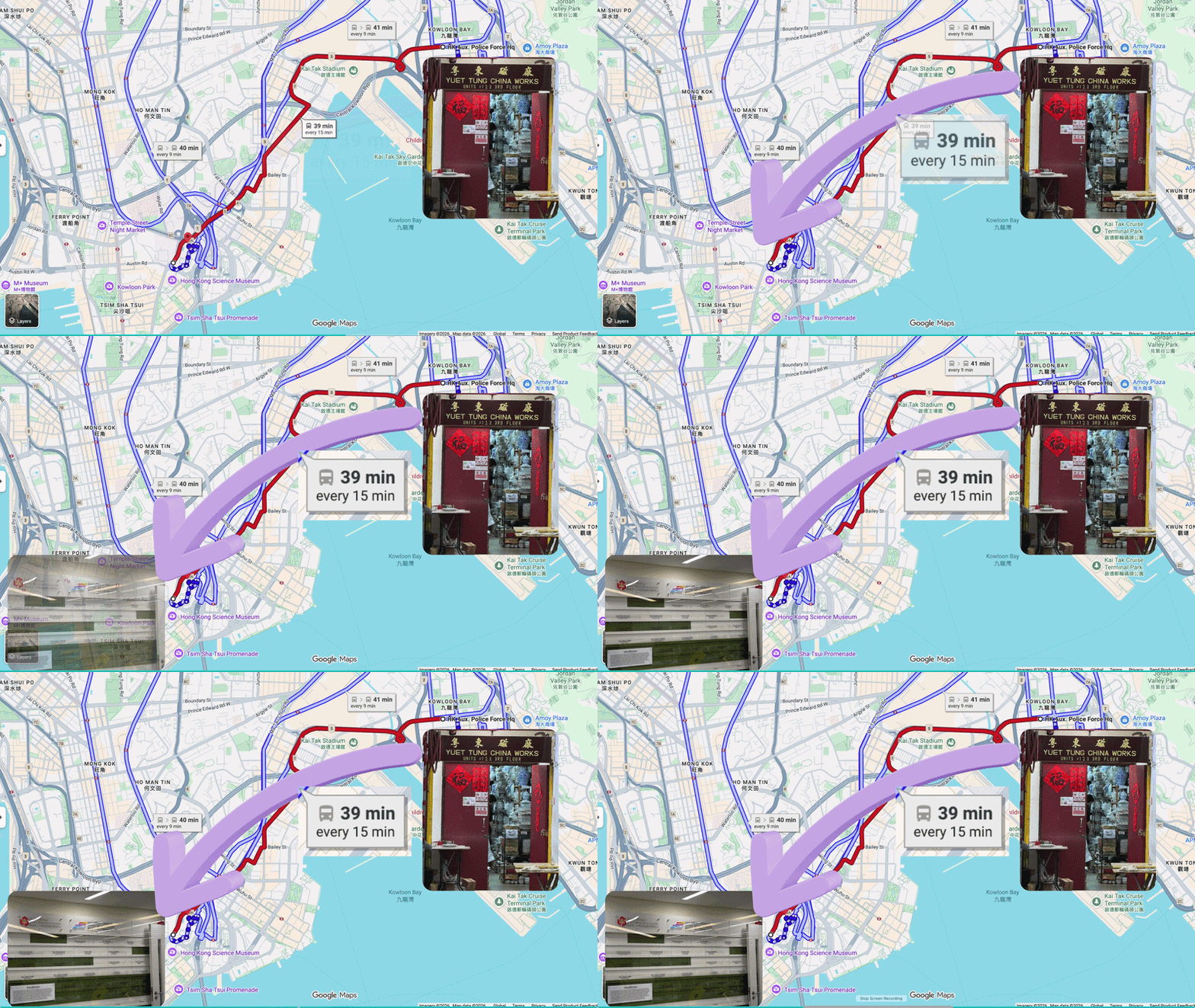
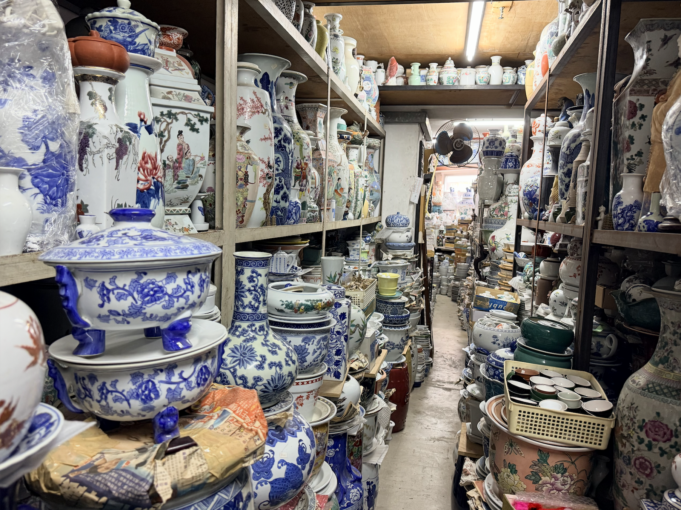
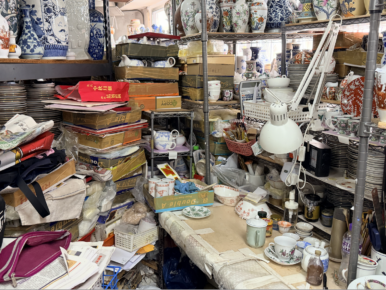
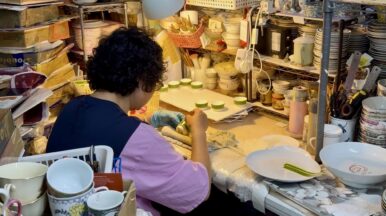
Stepping out of the elevator onto the third floor of Kowloon Bay Industrial Centre, a strong, musty and oily smell hits you first. At the end of the corridor, behind a half-open metal door, stacks of porcelain bowls, plates, and vases rise from floor to ceiling. Under dim fluorescent lights, several artisans in their sixties sit hunched over their desks. The soft scratch of brushes against glazed surfaces is the only sound in the room.
This is Yuet Tung China Works — Hong Kong’s last remaining hand-painted Cantonese porcelain factory.
Fourth-generation inheritor Martina Tso, in her forties, stands beside her father, Tso Chi Hung. They are flipping through a yellowed photo album. The images show the factory in the 1980s, when more than 300 painters worked shoulder to shoulder under a large shed, each surrounded by blank porcelain and paint brushes.
“Back then, we had branches in Peng Chau and Cheung Chau — even one in Singapore,” Tso Chi Hung says, setting down his magnifying glass and glancing at the workshop before him. “Now, only a handful of us are left.”
At 77, when asked who will take over in the future, he pauses for a few seconds.
“We’ll see,” he says quietly.
Stepping out of the elevator onto the third floor of Kowloon Bay Industrial Centre, a strong, musty and oily smell hits you first. At the end of the corridor, behind a half-open metal door, stacks of porcelain bowls, plates, and vases rise from floor to ceiling. Under dim fluorescent lights, several artisans in their sixties sit hunched over their desks. The soft scratch of brushes against glazed surfaces is the only sound in the room.
This is Yuet Tung China Works — Hong Kong’s last remaining hand-painted Cantonese porcelain factory.
Fourth-generation inheritor Martina Tso, in her forties, stands beside her father, Tso Chi Hung. They are flipping through a yellowed photo album. The images show the factory in the 1980s, when more than 300 painters worked shoulder to shoulder under a large shed, each surrounded by blank porcelain and paint brushes.
“Back then, we had branches in Peng Chau and Cheung Chau — even one in Singapore,” Tso Chi Hung says, setting down his magnifying glass and glancing at the workshop before him. “Now, only a handful of us are left.”
At 77, when asked who will take over in the future, he pauses for a few seconds.
“We’ll see,” he says quietly.
Two Worlds, Close but Far Apart
Half an hour away, in a laboratory at Hong Kong Polytechnic University, Henry Duh, a professor of the School of Design, is testing a generative AI system called “The Beauty of Canton Porcelain” (粤瓷之美) with his team.
In stark contrast to the dim and crowded factory, the lab is bright and silent. Screens flicker with algorithmic structures and vividly colored Canton porcelain patterns, while two PhD students in their twenties sketch designs on a touchscreen.
“AI can reshape how traditional crafts are taught,” Duh says. “Even young people without years of painting experience can freely create Cantonese porcelain designs here.”
This seemingly distant technological solution points directly to Yuet Tung’s most pressing problem — almost no one wants to learn anymore.
“We run workshops weekly,” Martina Tso admits. “But most people just come for fun. Almost none of them intend to become a real inheritor.”
Still, change is happening. In recent years, social media — especially Instagram — has drawn a growing number of young visitors. On this day, a young Hong Kong couple spent two hours in the workshop, learning to paint a porcelain bowl.
“We saw videos online and thought it was appealing and beautiful,” says Priya Wong. “We’re not good at it, but the process itself is healing.”
They are not successors, but Martina Tso notices something different — at least people are paying attention.
Half an hour away, in a laboratory at Hong Kong Polytechnic University, Henry Duh, a professor of the School of Design, is testing a generative AI system called “The Beauty of Canton Porcelain” (粤瓷之美) with his team.
In stark contrast to the dim and crowded factory, the lab is bright and silent. Screens flicker with algorithmic structures and vividly colored Canton porcelain patterns, while two PhD students in their twenties sketch designs on a touchscreen.
“AI can reshape how traditional crafts are taught,” Duh says. “Even young people without years of painting experience can freely create Cantonese porcelain designs here.”
This seemingly distant technological solution points directly to Yuet Tung’s most pressing problem — almost no one wants to learn anymore.
“We run workshops weekly,” Martina Tso admits. “But most people just come for fun. Almost none of them intend to become a real inheritor.”
Still, change is happening. In recent years, social media — especially Instagram — has drawn a growing number of young visitors. On this day, a young Hong Kong couple spent two hours in the workshop, learning to paint a porcelain bowl.
“We saw videos online and thought it was appealing and beautiful,” says Priya Wong. “We’re not good at it, but the process itself is healing.”
They are not successors, but Martina Tso notices something different — at least people are paying attention.
Struggles and Survival
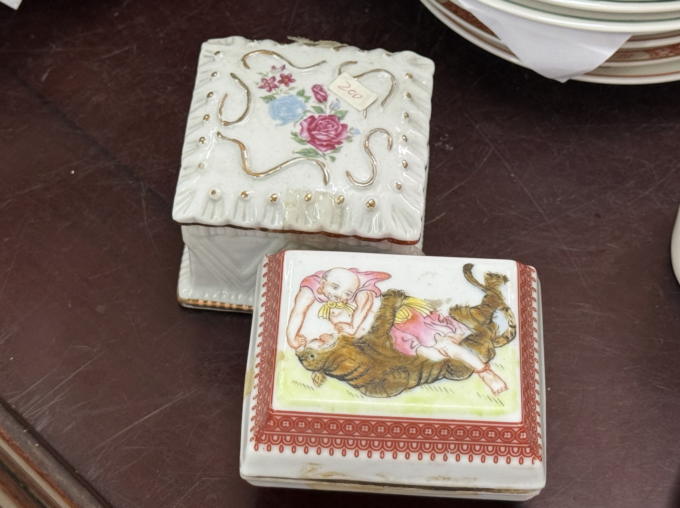
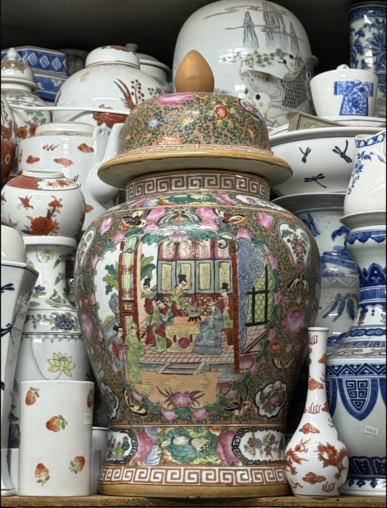
To stay afloat, the factory has transformed what it produces. With fewer artisans, mass production is no longer viable. Custom orders now dominate, mainly from Hong Kong, Europe, and Japan.
“The market has changed,” says Tso Chi Hung. “Canton porcelain has gone from daily use to collectible art.”
Yuet Tung is also part of the government’s preservation efforts.
As the Hong Kong government pushes the “Hello Hong Kong” initiative post-pandemic, the factory has been invited by the Hong Kong Tourism Board to act as a brand ambassador for the city.
In 2023, the factory co-organized the “Inheritance of Cantonese Porcelain Exhibition” at the Hong Kong Cultural Centre with support from the Intangible Cultural Heritage Funding Scheme. A year earlier, under the scheme’s Community-led Project, the factory helped run two rounds of “Inheritance of Cantonese Porcelain Training Courses.” It reached more than 100 participants who learned glazing and painting techniques.
But after the short-term promotion and initial excitement faded, few are willing to dedicate years to mastering repetitive foundational skills. The gap in transmission remains stark.
And yet, Yuet Tung continues to adapt. Since 2020, it has partnered with Eslite Bookstore to offer workshops under the brand “Hong Kong Porcelain Art.” In 2024, it co-organized exhibitions with Wong Tai Sin Temple and collaborated with a local craft beer brand on custom beer glasses. In 2025, the company launched heritage-themed phone cases with the Hong Kong Tourism Board and CASETiFY.
Online stores, social media, cross-brand collaborations — this century-old factory is trying to make itself visible to a younger generation.
A young Indian couple, drawn by Instagram videos, has travelled to the factory to commission a customized hand-painted plate for their wedding anniversary. Nearby, Chen Ming, a designer from Shenzhen, searches for suitable pieces among the shelves.
“I’m not after a specific size or pattern,” Chen says. “The hand-painted aesthetic is the thing I appreciate.”
Tso Chi Hung has noticed these changes. To retain younger audiences, the factory has begun experimenting with images. He recalls a U.S. client in 2025 who ordered a set of tableware decorated with cartoon animals for his daughter.
Now, alongside traditional motifs like chickens and dragons, cartoon versions of them— even cheerful Santas — have appeared.
“The craftsmanship hasn’t changed,” Tso Chi Hung says. “But the pattern does.”
To stay afloat, the factory has transformed what it produces. With fewer artisans, mass production is no longer viable. Custom orders now dominate, mainly from Hong Kong, Europe, and Japan.
“The market has changed,” says Tso Chi Hung. “Canton porcelain has gone from daily use to collectible art.”
Yuet Tung is also part of the government’s preservation efforts.
As the Hong Kong government pushes the “Hello Hong Kong” initiative post-pandemic, the factory has been invited by the Hong Kong Tourism Board to act as a brand ambassador for the city.
In 2023, the factory co-organized the “Inheritance of Cantonese Porcelain Exhibition” at the Hong Kong Cultural Centre with support from the Intangible Cultural Heritage Funding Scheme. A year earlier, under the scheme’s Community-led Project, the factory helped run two rounds of “Inheritance of Cantonese Porcelain Training Courses.” It reached more than 100 participants who learned glazing and painting techniques.
But after the short-term promotion and initial excitement faded, few are willing to dedicate years to mastering repetitive foundational skills. The gap in transmission remains stark.
And yet, Yuet Tung continues to adapt. Since 2020, it has partnered with Eslite Bookstore to offer workshops under the brand “Hong Kong Porcelain Art.” In 2024, it co-organized exhibitions with Wong Tai Sin Temple and collaborated with a local craft beer brand on custom beer glasses. In 2025, the company launched heritage-themed phone cases with the Hong Kong Tourism Board and CASETiFY.
Online stores, social media, cross-brand collaborations — this century-old factory is trying to make itself visible to a younger generation.
A young Indian couple, drawn by Instagram videos, has travelled to the factory to commission a customized hand-painted plate for their wedding anniversary. Nearby, Chen Ming, a designer from Shenzhen, searches for suitable pieces among the shelves.
“I’m not after a specific size or pattern,” Chen says. “The hand-painted aesthetic is the thing I appreciate.”
Tso Chi Hung has noticed these changes. To retain younger audiences, the factory has begun experimenting with images. He recalls a U.S. client in 2025 who ordered a set of tableware decorated with cartoon animals for his daughter.
Now, alongside traditional motifs like chickens and dragons, cartoon versions of them— even cheerful Santas — have appeared.
“The craftsmanship hasn’t changed,” Tso Chi Hung says. “But the pattern does.”
The Promise and Limits of AI
In Duh’s university lab, his AI system has gone through multiple iterations. Users can sketch simple outlines on a touchscreen, and the system generates complete Canton porcelain-style patterns. With mixed reality (MR) technology, these designs can even be projected onto real porcelain plates.
The Hong Kong government has encouraged such digital approaches, promoting the documentation and dissemination of traditional crafts. Duh’s project has received multiple research grants aimed at lowering barriers to entry.
Jayden Chai, the PhD student leading development, says future expansion will follow two directions—one web-based, where users design patterns that manufacturers then produce and ship; and one mobile-based, using augmented reality (AR) to visualize designs.
Some publishers have suggested placing the system in schools and libraries as an educational tool.
“Let young people encounter it first,” Chai says. “Reducing resistance is important.”
Ji Yi, a professor from the School of Art and Design at Guangdong University of Technology, believes that exploring how emerging technologies can help revive interest in traditional Chinese craftsmanship among the younger generation is essential— a challenge he has spent the past eight years exploring.
“Technology can help shorten the learning process and allow people to see innovative outcomes more quickly,” he says. “Augmented Reality (AR), Virtual Reality (VR), and AI technologies can help people understand the cultural meanings behind intangible cultural heritage within a much shorter time.”
Ji adds that creative products that incorporate cultural significance can also function as a new form of storytelling, breathing new life into historical traditions.
In Duh’s university lab, his AI system has gone through multiple iterations. Users can sketch simple outlines on a touchscreen, and the system generates complete Canton porcelain-style patterns. With mixed reality (MR) technology, these designs can even be projected onto real porcelain plates.
The Hong Kong government has encouraged such digital approaches, promoting the documentation and dissemination of traditional crafts. Duh’s project has received multiple research grants aimed at lowering barriers to entry.
Jayden Chai, the PhD student leading development, says future expansion will follow two directions—one web-based, where users design patterns that manufacturers then produce and ship; and one mobile-based, using augmented reality (AR) to visualize designs.
Some publishers have suggested placing the system in schools and libraries as an educational tool.
“Let young people encounter it first,” Chai says. “Reducing resistance is important.”
Ji Yi, a professor from the School of Art and Design at Guangdong University of Technology, believes that exploring how emerging technologies can help revive interest in traditional Chinese craftsmanship among the younger generation is essential— a challenge he has spent the past eight years exploring.
“Technology can help shorten the learning process and allow people to see innovative outcomes more quickly,” he says. “Augmented Reality (AR), Virtual Reality (VR), and AI technologies can help people understand the cultural meanings behind intangible cultural heritage within a much shorter time.”
Ji adds that creative products that incorporate cultural significance can also function as a new form of storytelling, breathing new life into historical traditions.
When AI Meets the Workshop
When Tso Chi Hung first heard that AI could design Cantonese porcelain, he considered the university’s AI system, then he paused.
“We had no idea about this project,” he says, frowning as he works on a red-glazed dragon plate. “If a machine designs it, how can it still be called Cantonese porcelain?”
Nearby, artisan Chan Mei Ling, also in her sixties, spends hours painting a peony motif.
Without looking up, she responds: “Does it know what gives a pattern its spirit? Does it understand colour harmony?”
Martina Tso understands the craft’s high threshold. She was formally trained in painting to carry on the tradition. To improve efficiency, the factory has started using pre-designed decals, allowing workers without painting skills to apply patterns.
But she points out that decal products are far less valuable than hand-painted ones.
“These designs up there,” Martina Tso says, pointing to a row of porcelain on a shelf, “will never be reproduced — because no one knows how to paint them anymore.”
This tension between efficiency and soulfulness becomes sharper with AI.
Chai acknowledges the limitation, “For high-end, personalized pieces, we still rely on human artisans.”
Martina Tso agrees. “It’s not about whether it looks similar. It’s about what gets lost in the process. AI-generated Cantonese porcelain has no soul.”
Yet younger visitors see it differently. A student from the Chinese University of Hong Kong stands by the shelves.
“AI designs are beautiful too,” he says. “People like me with no artistic talent can finally have a try.”
Rather than viewing AI as a threat to traditional craftsmanship, Ji describes it as “a collaborator” that can support innovation and cultural preservation.
“The principle of applying technology to intangible cultural heritage is to innovate based on preservation, rather than undermine its cultural foundation,” he explains, adding that “the human element will never be replaced.”
Ji acknowledged that resistance from traditional inheritors toward new technologies is understandable, given that intangible cultural heritage has been passed down through person-to-person teaching for hundreds, and sometimes thousands, of years.
Still, he sees the tension between technology and tradition as an opportunity for dialogue.
“Technology innovators need to explain that digital tools are not meant to directly transform traditional craftsmanship,” Ji said. “The goal is to explore how technology can help reinterpret and communicate traditional handicrafts in ways that meet different needs.”
When Tso Chi Hung first heard that AI could design Cantonese porcelain, he considered the university’s AI system, then he paused.
“We had no idea about this project,” he says, frowning as he works on a red-glazed dragon plate. “If a machine designs it, how can it still be called Cantonese porcelain?”
Nearby, artisan Chan Mei Ling, also in her sixties, spends hours painting a peony motif.
Without looking up, she responds: “Does it know what gives a pattern its spirit? Does it understand colour harmony?”
Martina Tso understands the craft’s high threshold. She was formally trained in painting to carry on the tradition. To improve efficiency, the factory has started using pre-designed decals, allowing workers without painting skills to apply patterns.
But she points out that decal products are far less valuable than hand-painted ones.
“These designs up there,” Martina Tso says, pointing to a row of porcelain on a shelf, “will never be reproduced — because no one knows how to paint them anymore.”
This tension between efficiency and soulfulness becomes sharper with AI.
Chai acknowledges the limitation, “For high-end, personalized pieces, we still rely on human artisans.”
Martina Tso agrees. “It’s not about whether it looks similar. It’s about what gets lost in the process. AI-generated Cantonese porcelain has no soul.”
Yet younger visitors see it differently. A student from the Chinese University of Hong Kong stands by the shelves.
“AI designs are beautiful too,” he says. “People like me with no artistic talent can finally have a try.”
Rather than viewing AI as a threat to traditional craftsmanship, Ji describes it as “a collaborator” that can support innovation and cultural preservation.
“The principle of applying technology to intangible cultural heritage is to innovate based on preservation, rather than undermine its cultural foundation,” he explains, adding that “the human element will never be replaced.”
Ji acknowledged that resistance from traditional inheritors toward new technologies is understandable, given that intangible cultural heritage has been passed down through person-to-person teaching for hundreds, and sometimes thousands, of years.
Still, he sees the tension between technology and tradition as an opportunity for dialogue.
“Technology innovators need to explain that digital tools are not meant to directly transform traditional craftsmanship,” Ji said. “The goal is to explore how technology can help reinterpret and communicate traditional handicrafts in ways that meet different needs.”
The Last Light
At 5 p.m., the lights in Yuet Tung are turned off. Tso Chi Hung locks the door and glances back at a row of unfinished plates. On one of them, Chan has just completed a dragon scale — each one carefully outlined with the finest brush.
At the same time, in the university lab, Chai drags an AI-generated dragon across a touchscreen. Within seconds, five variations appear.
One insists on precision, while the other explores possibility.
The distance between factory and lab is not a 30-minute drive, but two different answers to the same question:
Should tradition be preserved intact — or redefined?
Tso Chi Hung offers no answer.
Before he steps into the elevator, he switches off the last light at the doorway. The workshop falls into darkness. Only then does he leave.
As he steps into the elevator, he says only:
“Tomorrow, we keep painting.”
Extra Credits
Advisor
Jennifer Deayton
Editor in Chief
Clarisse Choo
Creative Directors
Syrena Jin
Cheryl Xie
Serena Zhou
Managing Editor
Jiachen Li
Copy Editor
Andy Liu
Visual Producer
Isco Zhang
At 5 p.m., the lights in Yuet Tung are turned off. Tso Chi Hung locks the door and glances back at a row of unfinished plates. On one of them, Chan has just completed a dragon scale — each one carefully outlined with the finest brush.
At the same time, in the university lab, Chai drags an AI-generated dragon across a touchscreen. Within seconds, five variations appear.
One insists on precision, while the other explores possibility.
The distance between factory and lab is not a 30-minute drive, but two different answers to the same question:
Should tradition be preserved intact — or redefined?
Tso Chi Hung offers no answer.
Before he steps into the elevator, he switches off the last light at the doorway. The workshop falls into darkness. Only then does he leave.
As he steps into the elevator, he says only:
“Tomorrow, we keep painting.”
Extra Credits
Advisor
Jennifer Deayton
Editor in Chief
Clarisse Choo
Creative Directors
Syrena Jin
Cheryl Xie
Serena Zhou
Managing Editor
Jiachen Li
Copy Editor
Andy Liu
Visual Producer
Isco Zhang
Author

Tags: Culture, Hong Kong