
At Night, They Ask the Chatbot What Comes Next
China’s Gen Z Turns to AI Fortune-Telling for Comfort
by Qi Zitong
AI fortune-telling prompts are spreading rapidly across Chinese social media, where young users turn to chatbots for guidance about work, relationships and the future.
“You are a top bazi (a traditional Chinese fortune-telling system) fortune teller. I was born on Dec. 14, 2002, at 2 p.m., female, in Chongqing. Please analyze my bazi as a professional Four Pillars of Destiny. Please interpret my recent fortune and analyze whether I should continue working in Shanghai.”
“It seems that AI really understands what I’m going through”
Chen Xinyue, a 24-year-old from Chongqing, graduated from the architecture department of Shanghai Jiao Tong University last year and stayed in this city as she had hoped. However, one year later today, she found herself asking the same question every morning as she squeezed onto the subway: What am I really doing?
The job of architectural design is completely different from what I imagined,” she said. Chen spoke about the hardships of her working life, where she finds herself changing her drawings on a daily basis to suit the client’s demands. In one particular incident, she had drawn up 17 versions, only for the client to pick the second one.


Because she began to feel that she did not understand either. She no longer knew what all the revisions were for, or why so little of her salary remained after rent. It was during this period of uncertainty that she came across AI fortune-telling prompts shared on social media.
She tried it. When she first entered her birth information, she did not even know what to ask, but the reply from DeepSeek left her stunned. The analysis said her current fortune was in the stage of “earth and metal generating each other, but with weak fire,” and she was likely to feel depressed and stagnant in her career. It suggested that she reassess whether the current environment was conducive to her development. In Chen’s words, “It seemed to really understand what I was going through.”
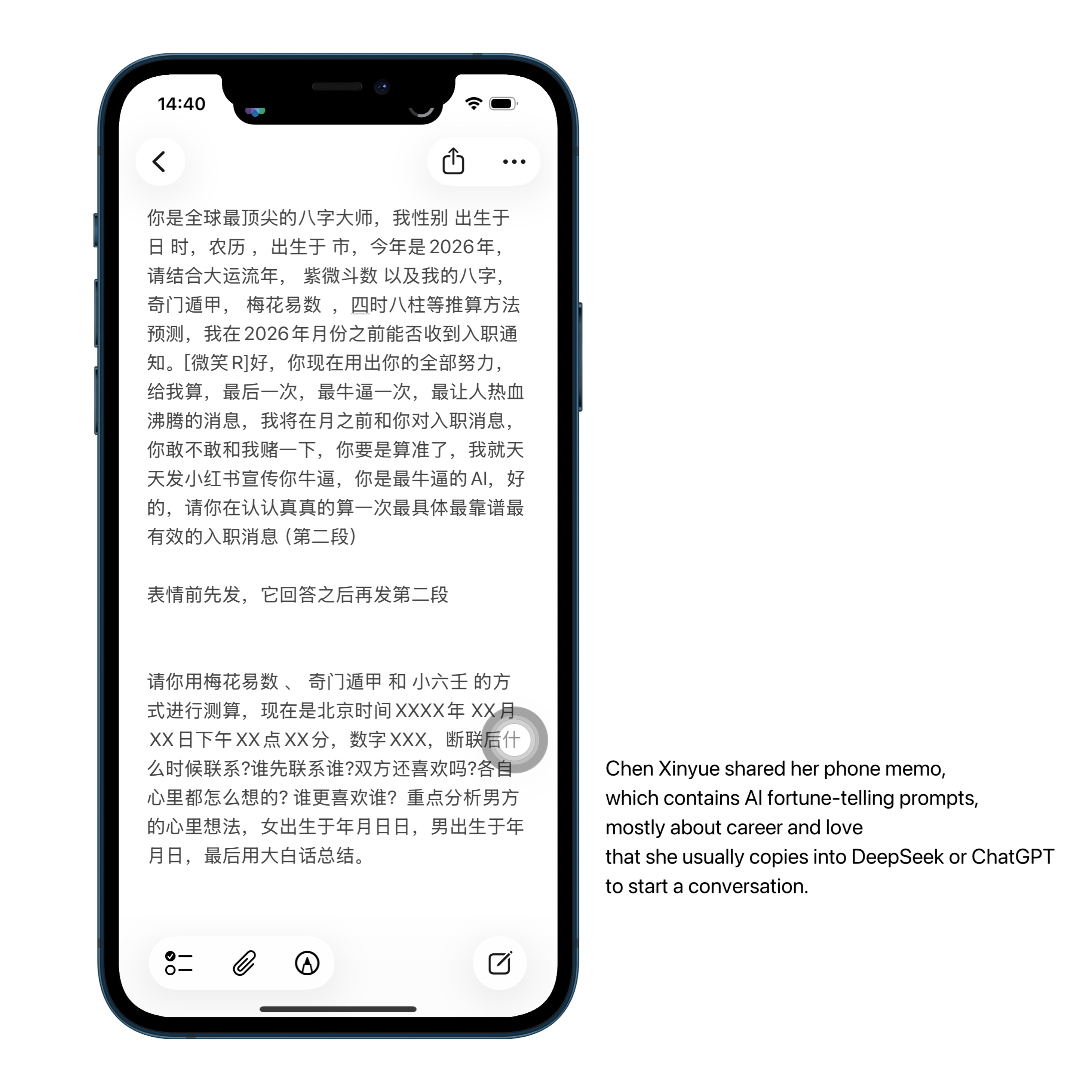
From that day on, she began to study how to use AI fortune-telling prompts to interact with DeepSeek and ChatGPT. She searched through tutorials on Xiaohongshu and learned various techniques to make her questions more specific to get more useful answers. She no longer asked, “How is my career?” Instead, she asked, “Should I continue working in Shanghai?” She even saved these prompts in her phone’s Notes app.
AI fortune-telling prompts are spreading rapidly across Chinese social media, where young users turn to chatbots for guidance about work, relationships and the future.
“You are a top bazi (a traditional Chinese fortune-telling system) fortune teller. I was born on Dec. 14, 2002, at 2 p.m., female, in Chongqing. Please analyze my bazi as a professional Four Pillars of Destiny. Please interpret my recent fortune and analyze whether I should continue working in Shanghai.”
“It seems that AI really understands what I’m going through”
Chen Xinyue, a 24-year-old from Chongqing, graduated from the architecture department of Shanghai Jiao Tong University last year and stayed in this city as she had hoped. However, one year later today, she found herself asking the same question every morning as she squeezed onto the subway: What am I really doing?
The job of architectural design is completely different from what I imagined,” she said. Chen spoke about the hardships of her working life, where she finds herself changing her drawings on a daily basis to suit the client’s demands. In one particular incident, she had drawn up 17 versions, only for the client to pick the second one.
Chen xinyue’s design
Because she began to feel that she did not understand either. She no longer knew what all the revisions were for, or why so little of her salary remained after rent. It was during this period of uncertainty that she came across AI fortune-telling prompts shared on social media.
She tried it. When she first entered her birth information, she did not even know what to ask, but the reply from DeepSeek left her stunned. The analysis said her current fortune was in the stage of “earth and metal generating each other, but with weak fire,” and she was likely to feel depressed and stagnant in her career. It suggested that she reassess whether the current environment was conducive to her development. In Chen’s words, “It seemed to really understand what I was going through.”
From that day on, she began to study how to use AI fortune-telling prompts to interact with DeepSeek and ChatGPT. She searched through tutorials on Xiaohongshu and learned various techniques to make her questions more specific to get more useful answers. She no longer asked, “How is my career?” Instead, she asked, “Should I continue working in Shanghai?” She even saved these prompts in her phone’s Notes app.
From private anxiety to a cyber social carnival
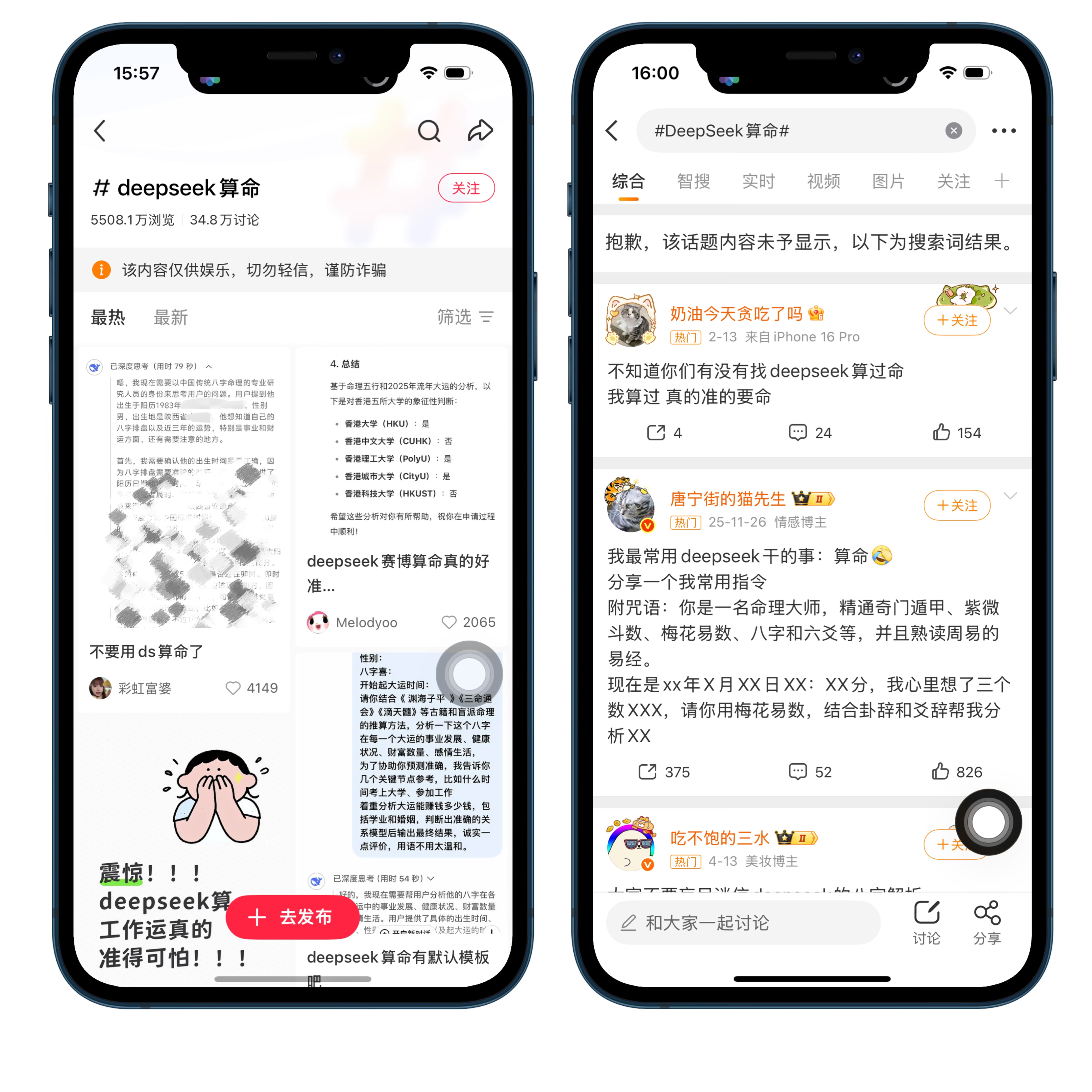
In 2025, the popularity of DeepSeek pushed this trend to its peak. On Xiaohongshu, the topic #DeepSeek fortune-telling received over 55 million views. On Weibo, under the topic #DeepSeek fortune-telling, users shared their opinions on the AI fortune-telling and various prompts. Young people are using their familiar methods to turn mysticism into a cyber social carnival.
Xiaohongshu & Weibo’s topic about AI fortune telling
In 2025, the popularity of DeepSeek pushed this trend to its peak. On Xiaohongshu, the topic #DeepSeek fortune-telling received over 55 million views. On Weibo, under the topic #DeepSeek fortune-telling, users shared their opinions on the AI fortune-telling and various prompts. Young people are using their familiar methods to turn mysticism into a cyber social carnival.
Xiaohongshu & Weibo’s topic about AI fortune telling
When predictions become rituals: Sharing luck online
“Hereby redeem a vow. Please take the prompts by yourself”
This post quickly garnered thousands of likes and saves. In the comments section, some people wrote, “Hoping for some good luck,” others asked, “Can you share the prompt?” while others shared similar stories of having their wishes fulfilled. In her subsequent posts, Hai generously shared her prompt template — the final version she had spent two nights repeatedly tweaking.
“I also saw it from other users, but the original version produced answers that were too general,” Hai said. “Later, I read many tutorials and found that in order for DeepSeek to ‘play a role,’ it also needs to be limited to which destiny system it uses, and even told it to ‘think deeply before answering’.” She smiled and said, “Actually, I don’t understand bazi either, but people online say asking this way makes it more accurate.”
Hai Yue is 29, and works as an operations manager at an internet company. Last autumn, she went through a six-month job-hunting hiatus. The resumes she sent out went unanswered, and the occasional interview invitations she received often went nowhere. “Every morning when I woke up, the first thing I did was check my email, and then I was in a state of anxiety for the entire day,” she said.
However, the DeepSeek chatbot predicted she needed to be patient and a job offer would come between 4 April and 4 May. When she successfully received the offer for the new job within the predicted time, Hai felt that she “had to fulfill her vow.” This was a sense of ritual: Just as people who make wishes at temples return to give thanks after their wishes come true, she gave her gratitude back to cyberspace. Her way of fulfilling the vow was to post a note on Xiaohongshu and share the prompt with more people in need.
This carnival of online spirituality thrives at the intersection of algorithm and human nature, belief and entertainment, solitude and connection. For Hai, that wish-fulfillment post was not simply an expression of gratitude toward AI, but also a way of bidding farewell to her anxious days.
“I have been working for half a month now,” Hai said. “Occasionally, I still ask AI some work-related questions, but I won’t use it for fortune telling like before. Perhaps once you have something certain, there is less need to seek encouragement and recognition.”
From seeking predictions to fulfilling vows, from anxiety to tranquility, Hai completed a small psychological ritual on online platforms. She typed lines of meticulously crafted prompts into DeepSeek’s dialogue box, searched the algorithm’s outputs for the answer she was willing to believe, and then passed that sense of accuracy on through social platforms.
“Hereby redeem a vow. Please take the prompts by yourself”
This post quickly garnered thousands of likes and saves. In the comments section, some people wrote, “Hoping for some good luck,” others asked, “Can you share the prompt?” while others shared similar stories of having their wishes fulfilled. In her subsequent posts, Hai generously shared her prompt template — the final version she had spent two nights repeatedly tweaking.
“I also saw it from other users, but the original version produced answers that were too general,” Hai said. “Later, I read many tutorials and found that in order for DeepSeek to ‘play a role,’ it also needs to be limited to which destiny system it uses, and even told it to ‘think deeply before answering’.” She smiled and said, “Actually, I don’t understand bazi either, but people online say asking this way makes it more accurate.”
Hai Yue is 29, and works as an operations manager at an internet company. Last autumn, she went through a six-month job-hunting hiatus. The resumes she sent out went unanswered, and the occasional interview invitations she received often went nowhere. “Every morning when I woke up, the first thing I did was check my email, and then I was in a state of anxiety for the entire day,” she said.
However, the DeepSeek chatbot predicted she needed to be patient and a job offer would come between 4 April and 4 May. When she successfully received the offer for the new job within the predicted time, Hai felt that she “had to fulfill her vow.” This was a sense of ritual: Just as people who make wishes at temples return to give thanks after their wishes come true, she gave her gratitude back to cyberspace. Her way of fulfilling the vow was to post a note on Xiaohongshu and share the prompt with more people in need.
This carnival of online spirituality thrives at the intersection of algorithm and human nature, belief and entertainment, solitude and connection. For Hai, that wish-fulfillment post was not simply an expression of gratitude toward AI, but also a way of bidding farewell to her anxious days.
“I have been working for half a month now,” Hai said. “Occasionally, I still ask AI some work-related questions, but I won’t use it for fortune telling like before. Perhaps once you have something certain, there is less need to seek encouragement and recognition.”
From seeking predictions to fulfilling vows, from anxiety to tranquility, Hai completed a small psychological ritual on online platforms. She typed lines of meticulously crafted prompts into DeepSeek’s dialogue box, searched the algorithm’s outputs for the answer she was willing to believe, and then passed that sense of accuracy on through social platforms.
Why AI fortune-telling feels accurate
“Actually, I have also encountered situations that AI could not tell accurately,” Hai said, “Before that offer letter, I had interviewed with a company that I really wanted to work for.” She used the same prompts across three AI models, all of which predicted she would get the job. But in reality, after the second interview, there was no further news.-
As more and more people, like Chen and Hai, reveal their bazi and personal problems to AI, a question worth asking arises: How does AI fortune telling attract young people? Is it providing an answer to fate, or psychological comfort?
“It understands me better than me”: Barnum Effect
The Barnum effect refers to people’s tendency to see vague, general personality descriptions as personally accurate. When AI analyzes a user’s bazi, it often produces broad statements such as “You appear carefree, but deep down you are sensitive,” or “Recently, you have felt your efforts at work have not been properly rewarded.” In other words, AI fortune telling can feel accurate not because it truly understands a person’s fate, but because users project their own experiences onto vague descriptions.
“Actually, I have also encountered situations that AI could not tell accurately,” Hai said, “Before that offer letter, I had interviewed with a company that I really wanted to work for.” She used the same prompts across three AI models, all of which predicted she would get the job. But in reality, after the second interview, there was no further news.-
As more and more people, like Chen and Hai, reveal their bazi and personal problems to AI, a question worth asking arises: How does AI fortune telling attract young people? Is it providing an answer to fate, or psychological comfort?
“It understands me better than me”: Barnum Effect
The Barnum effect refers to people’s tendency to see vague, general personality descriptions as personally accurate. When AI analyzes a user’s bazi, it often produces broad statements such as “You appear carefree, but deep down you are sensitive,” or “Recently, you have felt your efforts at work have not been properly rewarded.” In other words, AI fortune telling can feel accurate not because it truly understands a person’s fate, but because users project their own experiences onto vague descriptions.
What young users are really seeking
Wei also cautioned that this psychological comfort mechanism has its boundaries. “In the short term, external attribution can indeed alleviate anxiety,” she said, “But if a person relies on this approach to face difficulties over the long term, it may gradually weaken their ability to solve problems.”
In this wave of AI fortune telling, young people do not seem to have truly handed over their destinies to algorithms. They are simply using familiar methods to find an emotional outlet, a reference for decision-making, and a person to talk to at night. Psychological counseling is too expensive, friends are too busy, and family members are too far away or do not understand.
On a night in Shanghai, Chen closed DeepSeek’s dialogue box. She did not get a definite answer to the question of whether to leave or stay, but she said she was no longer in a hurry. “Anyway, I still need to revise the drawings tomorrow,” she said with a smile. “Let’s finish this version first and think about it later.”
Across countless late-night conversations with chatbots, the search for reassurance continues.
Wei also cautioned that this psychological comfort mechanism has its boundaries. “In the short term, external attribution can indeed alleviate anxiety,” she said, “But if a person relies on this approach to face difficulties over the long term, it may gradually weaken their ability to solve problems.”
In this wave of AI fortune telling, young people do not seem to have truly handed over their destinies to algorithms. They are simply using familiar methods to find an emotional outlet, a reference for decision-making, and a person to talk to at night. Psychological counseling is too expensive, friends are too busy, and family members are too far away or do not understand.
On a night in Shanghai, Chen closed DeepSeek’s dialogue box. She did not get a definite answer to the question of whether to leave or stay, but she said she was no longer in a hurry. “Anyway, I still need to revise the drawings tomorrow,” she said with a smile. “Let’s finish this version first and think about it later.”
Across countless late-night conversations with chatbots, the search for reassurance continues.
Advisor
Yolanda Ma
Editor in Chief
Clarisse Choo
Creative Directors
Syrena Jin
Cheryl Xie
Serena Zhou
Managing Director
Jiachen Li
Copy Editor
Andy Liu
Visual Producer
Bunnnie Shen
